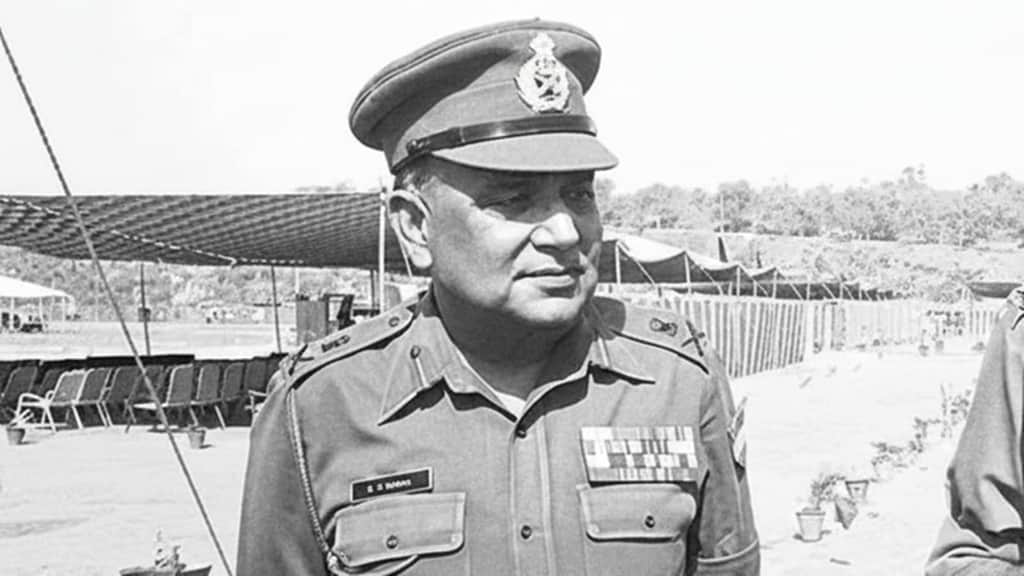
Lt Gen Srinivas Kumar Sinha. (File Photo)
Lt Gen Srinivas Kumar Sinha, known as Mannay Sinha, belonged to a rare generation of Indian soldiers whose lives paralleled the making of the Republic. Born on January 7, 1926, he entered uniform as India transitioned from colonial rule to independence. A soldier, scholar, administrator, diplomat, and governor, Sinha represented a leadership tradition that valued intellect, cultural understanding, and moral confidence.
Sinha joined the Indian Army during the final phase of World War II and witnessed the upheavals of 1947 firsthand. His posting to the Military Operations Directorate during Partition and the tribal invasion of Jammu and Kashmir placed him at the centre of India’s earliest security crisis. Kashmir remained a subject he understood deeply. His career spanned the full arc of soldiering: He commanded troops in the field, served in sensitive intelligence and staff roles, and rose to become Vice Chief of the Army Staff. He also shaped minds as an instructor at the Infantry School and later at the Defence Services Staff College, Wellington, where he served with my father. Long before the term gained currency, Sinha embodied the scholar-warrior, treating history as an operational asset rather than an academic indulgence.
What set him apart was not merely erudition but the ease with which he carried it. He could recall history, often linking present challenges to decisions taken decades earlier.
I came to know him more closely years later, when I served first as Commander Uri Brigade and subsequently as General Officer Commanding Dagger Division at Baramulla during his tenure as Governor of J&K. In that role, Sinha was far more than a constitutional figurehead. He engaged deeply with the security situation and displayed an instinctive grasp of nuance.
In March 2005, I had the privilege of driving him to the Kaman Aman Setu on the Line of Control along the Uri-Muzaffarabad Road, where I briefed him on preparations for the opening of the Karvan-e-Aman bus service the following month. For Sinha, this was not a confidence-building measure but a strategic and civilisational moment. He understood that peace processes in Kashmir could not be sustained by force alone.
That instinct had revealed itself earlier, at a time when terrorism in the Valley was at its peak. Against prevailing caution, Sinha supported the organisation of a music festival on the banks of Dal Lake — a deliberate act of cultural assertion. The intent was clear: To signal solidarity with Kashmir’s liberal traditions and deny radical elements a monopoly over public space and expression.
Sinha connected effortlessly across rank and regiment. I recall visiting a Gurkha unit with him along the LoC; what followed was not an inspection but shared soldiering — Gurkhali songs, laughter and rhythm. It was authenticity from an older tradition where command flowed from respect, not distance.
His engagement with the Kashmiri media was another lesson in leadership. The Valley’s press, intellectually alert and relentlessly probing, unsettled many officials. He neither evaded questions nor sought to dominate the room. His knowledge and composure dissolved attempts at intellectual browbeating. The media recognised they were dealing with someone who could not be cornered and respected him. Senior officers shaped by prolonged counter-insurgency service often develop a distinctive capacity to manage complexity — balancing firmness with empathy, authority with restraint. Sinha epitomised this quality. Religion was never a divider; professionalism and liberal values were the binding force.
After retiring from the Army, Sinha continued public service as Ambassador to Nepal, Governor of Assam and later Governor of Jammu and Kashmir. He also left behind books and columns reflecting lifelong engagement with India’s strategic challenges. As India marks his birth centenary, S K Sinha’s legacy endures as that of a soldier-statesman who believed that intellect in uniform was not an ornament but a duty.
The writer is a former corps commander of the Srinagar-based 15 Corps and member of NDMA. Views are personal
Editorial Context & Insight
Original analysis & verification
Methodology
This article includes original analysis and synthesis from our editorial team, cross-referenced with primary sources to ensure depth and accuracy.
Primary Source
The Indian Express