


Key takeaways
- Retrieval is critical in multi-step agentic workflows where poor retrieval can cause agents to fetch irrelevant context, re-query, waste tok
- We also tested these models across ViDoRe V3 Text, and MMTEB Retrieval and LongEmbed using average NDCG@10.
- Better retrieval can return relevant evidence earlier, helping the agent avoid repeated searches, unnecessary reasoning turns, and extra context inspection.
What happened
Retrieval is critical in multi-step agentic workflows where poor retrieval can cause agents to fetch irrelevant context, re-query, waste token budget, and carry noise into later reasoning steps. Today, we are releasing NVIDIA Nemotron 3 Embed, a collection of open and commercially available embedding models designed to improve retrieval quality while giving developers practical deployment options for production-scale RAG, agentic retrieval, code retrieval, and agent memory.
Figure 3 shows that stronger retrieval reduces downstream agentic token cost. More accurate retrievers return relevant evidence earlier, which helps agents complete tasks with fewer repeated searches and fewer reasoning turns. In these evaluations, the Nemotron 3 Embed models improve the agentic retrieval frontier, with the 8B model delivering both the highest average retrieval accuracy and the lowest estimated downstream token cost across ViDoRe V3, BRIGHT, and BrowseComp-Plus.
Why it matters
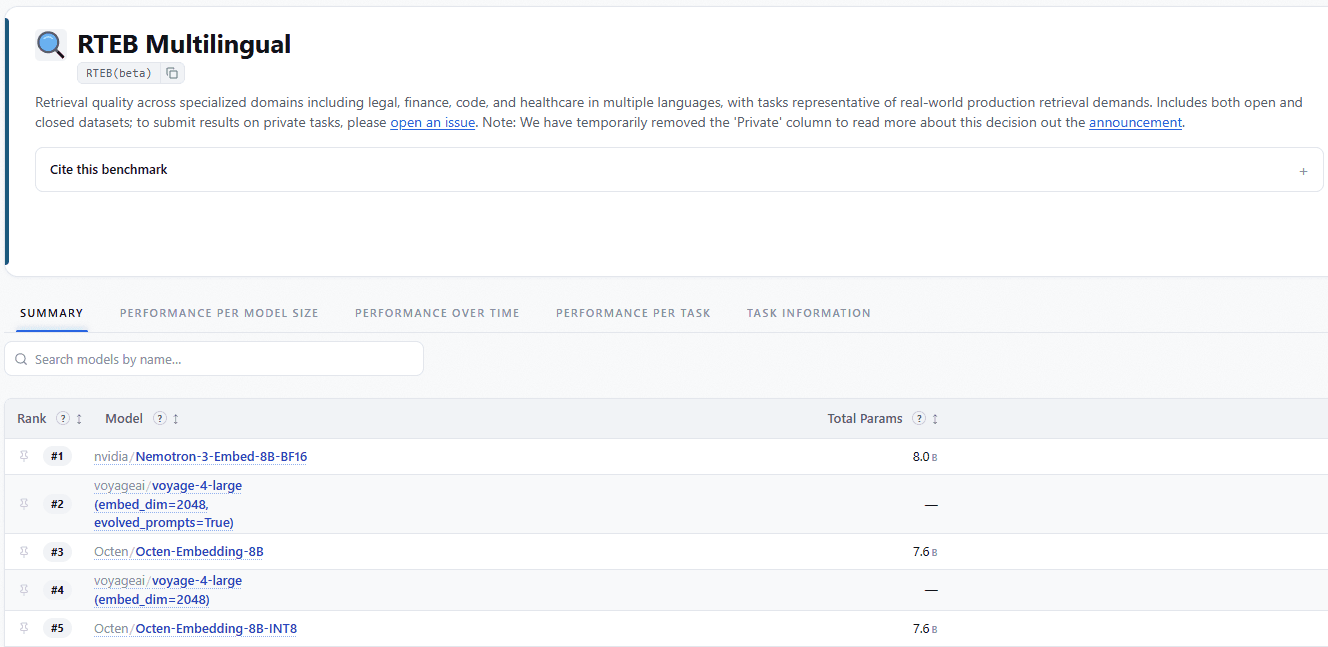
The collection includes three open models that achieve state-of-the-art retrieval across the accuracy-efficiency curve, led by an 8B model that tops the RTEB leaderboard and efficient 1B variants built for production-scale deployment: Table 1. Nemotron 3 Embed Model Usability and Deployment Matrix. Figure 1. RTEB Multilingual Leaderboard screenshot (July 15, 2026) showing Nemotron-3-Embed-8B-BF16 ranked as #1.
Beyond the RTEB result, Nemotron 3 Embed introduces a production-ready feature set for enterprise retrieval deployments: We evaluate Nemotron 3 Embed across three dimensions: retrieval quality, downstream agentic efficiency, and deployment tradeoffs. The 8B model establishes the model collection’s quality ceiling, while the 1B BF16 and NVFP4 variants bring the same retrieval-focused design to lower-cost and higher-throughput deployment settings. We first evaluated the models on RTEB, where Nemotron-3-Embed-8B-BF16 ranks #1.
We also tested these models across ViDoRe V3 Text, and MMTEB Retrieval and LongEmbed using average NDCG@10. Figure 2. Retrieval accuracy using average NDCG@10 across RTEB, ViDoRe V3 Text, MMTEB Retrieval and LongEmbed, comparing the Nemotron 3 Embed models with prior-generation Nemotron baselines. To evaluate retrieval in an agentic setting, we use a search agent powered by Nemotron 3 Ultra and vary the embedding model used by the retrieval system.
Better retrieval can return relevant evidence earlier, helping the agent avoid repeated searches, unnecessary reasoning turns, and extra context inspection. We compare average retrieval accuracy with estimated downstream agentic token cost per query across ViDoRe V3, BRIGHT, and BrowseComp-Plus. Figure 3. Average retrieval accuracy versus downstream agentic token cost per query across ViDoRe V3, BRIGHT, and BrowseComp-Plus. Evaluation note: The search agent uses Nemotron 3 Ultra. 5 pricing formula.
What to watch
For high-throughput deployments, teams often choose smaller embedding models to meet latency and cost targets. Nemotron-3-Embed-1B-NVFP4 is designed to narrow the gap between serving efficiency and retrieval quality by using native NVFP4 acceleration on NVIDIA Blackwell architectures. The model quantizes the weights and activations of linear layers to NVFP4 for efficient inference, and uses Quantization-Aware Distillation (QAD) to help recover accuracy for long input sequences. Figure 4. 6B and EmbeddingGemma-300M.
For production-scale retrieval systems, the serving stack also needs to preserve that efficiency under real request loads, across different input sequence lengths and hardware targets. To make Nemotron 3 Embed performant at enterprise scale today, we are also releasing an optimized NVIDIA NIM microservice for the 1B model. As shown in Figure 5, t