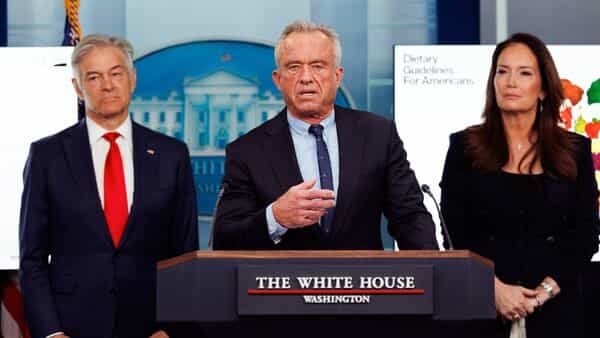
United States' Health and Human Services (HHS) Secretary Robert F. Kennedy Jr., along with the country's Agriculture Secretary Brooke Rollins, announced new dietary guidelines for Americans on Wednesday, wherein they advised citizens to ear more "real food" and less of high processed food items and added sugars.
The new food pyramid introduced by the US government replaced the MyPlate diagram, which was released during the Obama administration. The new food pyramid puts emphasis on protein, full-fat dairy, as well as vegetables.
The guidelines are the latest product of the Trump administration's "Make America Healthy Again" agenda, named for the social movement that backs RFK Jr.
"Today, our government declares war on added sugar," Kennedy said at his White House press briefing.
"The new guidelines recognize that whole nutrient-dense food is the most effective path to better health and lower healthcare costs," he added.
The dietary guidelines form the basis of federal nutrition programs for school meals consumed by nearly 30 million children, and inform medical advice and national disease prevention efforts.
Protein: The guidelines have increased recommendation of protein consumption by adults, increasing the same to 1.2 to 1.6 grams of protein per kilogram of body weight per day, up from the prior recommendation of 0.8 grams.
Dairy: The guideline has also called for the consumption of full-fat dairy, which is a shift from the decades-long guidance to consume low-fat dairy products in order to mitigate health risks.
Alcohol: In terms of alcohol consumption, whereas adults were earlier asked to limit the same to one or two drinks per day, the new advisory says that adults should "consume less alcohol for better overall health."
Added sugar: The guidelines say "no amount of added sugars or non-nutritive sweeteners is recommended or considered part of a healthy or nutritious diet" and that if consumed, added sugars should not exceed 10 grams per meal.
Prior guidelines granted that a small amount of sugars could be added to healthier foods to help meet dietary recommendations, without exceeding 10% of daily calories.
Processed food: Highly processed foods and foods and drinks with artificial flavors, low-calorie sweeteners and dyes should be avoided, the new guidelines say. Some food companies are removing artificial ingredients in alignment with the administration's priorities.
Soda makers like Coca-Cola and PepsiCo, and Mondelez, which manufactures Oreo cookies, have faced scrutiny from Kennedy. Major European-headquartered food producers Nestle and Danone are also exposed to changes pushed by Kennedy.
The guidelines do not address ultra-processed foods, the definition of which is hotly debated by the food industry. The HHS and USDA have said they are developing a federal definition for ultra-processed foods.
Editorial Context & Insight
Original analysis & verification
Methodology
This article includes original analysis and synthesis from our editorial team, cross-referenced with primary sources to ensure depth and accuracy.
Primary Source
mint - news