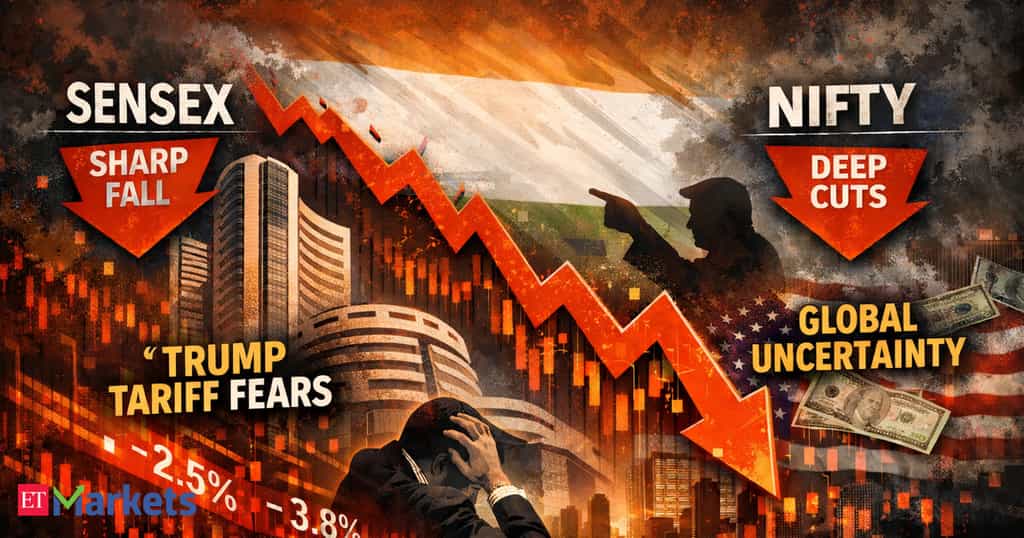
Indian equities slid deeper into the red on Friday, with the Sensex and Nifty stretching losses into a fifth straight session as global trade jitters and political uncertainty out of Washington kept investors on edge. What began as a tentative rebound at the opening bell quickly fizzled, with benchmark indices turning sharply lower within minutes as caution took hold across the board.
The BSE Sensex has now fallen 2,181.71 points over the past five sessions, sliding from a closing level of 85,762.01 on January 2 to an intraday low of 83,580.30 on Friday. The NSE Nifty 50 has declined 2.5% over the same period.
By around 12:40 PM, the Sensex was down 607 points, or 0.72%, at 83,573.67, while the Nifty fell 187 points, or 0.72%, to 25,689.90.
The selloff has wiped out Rs 6.8 lakh crore in market capitalisation over five days, taking the total value of BSE-listed companies to Rs 468.97 lakh crore.
Markets have been under pressure since U.S. President Donald Trump hinted that tariffs on Indian goods could be raised over India's purchases of Russian crude, keeping the India–US trade relationship in sharp focus.
The proposed bilateral trade agreement between India and the U.S. has yet to be finalised, despite six rounds of negotiations since March. U.S. Commerce Secretary Howard Lutnick claimed on the All-In Podcast that the deal stalled because Prime Minister Narendra Modi did not call Donald Trump. The Trump administration has already imposed 50% tariffs on India, including 25% linked to India’s purchases of Russian oil, among the highest levied on any country. India has described the U.S. action as “unfair, unjustified and unreasonable”.
The uncertainty has intensified ahead of a U.S. Supreme Court ruling on the legality of Trump’s tariffs. If deemed “illegal”, the U.S. government could be forced to refund nearly $150 billion to importers, a decision that could significantly alter the global trade landscape.
After the sharp correction yesterday triggered by the possibility of about 500% tariff on India under the provisions of the Russia Sanctioning Act approved by President Trump, the market will be focused on the verdict expected today from the US Supreme Court on the legality of Trump tariffs, said Dr. VK Vijayakumar, Chief Investment Strategist at Geojit Investments.
"There is a high probability of the verdict going against Trump. But the details are significant: that is, whether it would be a partial striking down of the tariffs or completely declaring the tariffs illegal. The market reaction would depend on the details. If the Supreme Court declares Trump tariffs illegal, there would be a rally in India since India has been the worst affected by the 50% tariffs," said Vijayakumar.
In the sharp market pullback this week even stocks which will not be impacted by any draconian action by Trump have been affected, Vijayakumar said, adding that segments like financials, consumer discretionary and industrials that have corrected due to the overall market weakness can be accumulated now for long-term investment.
The continued withdrawal of foreign capital has weighed on benchmark indices, amplifying declines amid global uncertainty and reinforcing investor caution at a time when markets are already grappling with adverse external cues.
MSCI’s broad index of Asia-Pacific shares outside Japan slipped 0.3% in early trade, hovering just below the record high touched earlier in the week. Japan’s Nikkei bucked the regional trend, rising 0.8% on strong earnings and an upbeat outlook from Fast Retailing, the operator of the Uniqlo clothing brand. European stock futures advanced 0.4%, while on Wall Street the S&P 500 ended flat, even as an aerospace and defence index climbed to a record, with European defence shares also hitting fresh highs.
Crude prices extended gains on Friday, trading near a two-week high amid worries over supply disruptions from Russia, Iraq and Iran. Brent futures rose 0.8% to $62.49 a barrel, while U.S. West Texas Intermediate crude advanced 0.8% to $58.25. Elevated oil prices tend to widen India’s import bill and heighten inflation risks, factors that typically weigh on equity valuations.
Shrikant Chouhan, Head Equity Research at Kotak Securities, noted that “technically, the market breached the 20-day SMA (Simple Moving Average) support zone, and post-breakdown, selling pressure intensified.”
“On daily charts, it has formed a long bearish candle, indicating further weakness from the current levels,” Chouhan said, adding that “We are of the view that as long as the market is trading below 26,000/84500, weak sentiment is likely to continue on the downside, and the market could slip till 25,750-25,700/84000-83700. On the flip side, if it moves above 26,000/84500, the pullback could continue till 26,075-26,100/84800-85000.”
Geojit Investments echoed the cautious view, pointing to stretched technical indicators. “Short term oscillators being oversold, and being in the vicinity of 30 December’s low, it will not be surprising if a turn high is attempted, as long as 25878 is not penetrated by much margin,” the brokerage said.
“Alternatively, slippage past 25776 would have to be taken as a sign that Nifty is coming off a sideways trading range that has been on since November 2025, prompting us to consider possibilities of sharper fall, with 200 day SMA positioned deep at 25039 now.”
Editorial Context & Insight
Original analysis & verification
Methodology
This article includes original analysis and synthesis from our editorial team, cross-referenced with primary sources to ensure depth and accuracy.
Primary Source
Economic Times