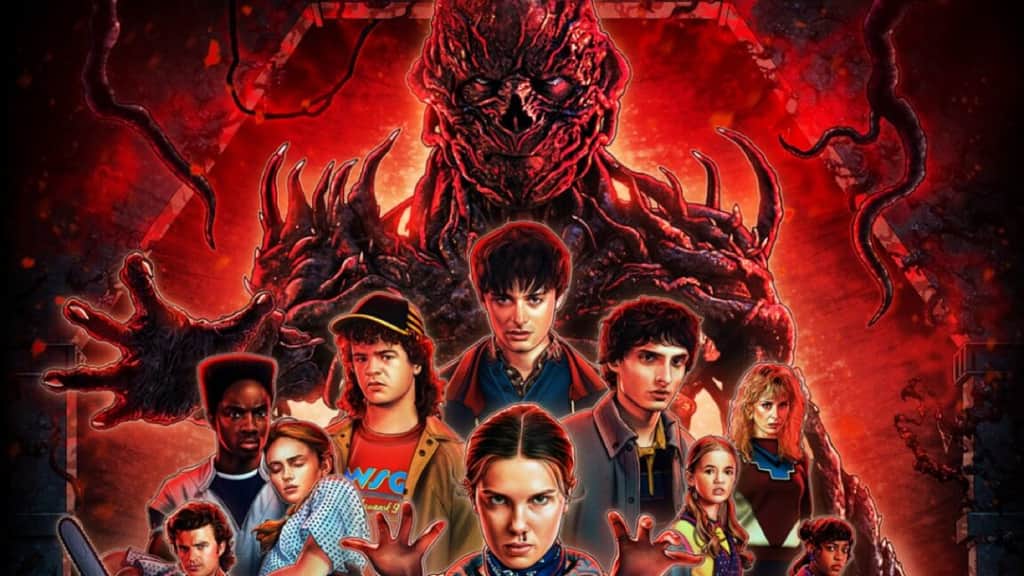
Stranger Things has finally come to an end and left us with some big complicated feels about how it all went down. Both of us (Jennifer and Beth) are bona fide fans who have seen prior seasons multiple times, and we had remarkably similar reactions to the fifth season, especially the series finale. So we decided to co-write a review, discussing everything we liked about it as well as kvetching about the things we definitely didn’t like—a shared “airing of grievances.”
(WARNING: Many, many spoilers below in the interest of a thorough analysis.)
Season 4 ended with Vecna (Jamie Campbell Bower) opening the fourth gate that allowed the Upside Down to leak into Hawkins. We got an 18-month time jump for S5, Vol. 1, but in a way, we came full circle, since those events coincided with the third anniversary of Will’s (Noah Schnapp) original disappearance in S1.
Hawkins was now under military occupation, and Vecna was targeting a new group of young children in his human form under the pseudonym “Mr. Whatsit” (a nod to A Wrinkle in Time). He kidnapped Holly Wheeler (Nell Fisher) and took her body to another dimension (the Abyss), while her consciousness was trapped in Vecna’s mind. There she found an ally in Max (Sadie Sink), still in a coma in Hawkins, but also trapped in Vecna’s mind, hiding in one of his old memories. Dustin (Gaten Matarazzo) was struggling to process his grief over losing Eddie Munson (Joseph Quinn) in S4, causing a rift with Steve (Joe Keery). The rest of the gang was devoted to stockpiling supplies and helping Eleven (Millie Bobby Brown) and Hopper (David Harbour) track down Vecna in the Upside Down. They found Kali/Eight (Linnea Berthelsen), Eleven’s psychic “sister,” instead, being held captive in a military laboratory.
Things came to a head at the military base when Vecna’s demagorgons attacked to take more children (he needed 12), wiping out most of the soldiers in record time. The big reveal was that, as a result of being kidnapped by Vecna in S1, Will has his own supernatural powers. He can tap into Vecna’s hive mind and manipulate those powers for his own purposes. He used his newfound powers to save his friends from the demagorgons. It was a bit of a deus ex machina move but one that previously has been foreshadowed, so we’ll allow it. But Vecna successfully took the children for his master plan of using their weak child minds to “reshape the world.”
Stranger Things has ballooned in size and scope over the years, so there are a lot of characters and narrative arcs to juggle along with the basic plot mechanics, making most episodes feel uncomfortably overstuffed while still peppered with plot holes. But there was a lot to like. One of Vol. 1’s best moments was wine-mom Karen Wheeler’s (Cara Buono) fierce defense of Holly from an attacking demogorgon. Alas, she was nearly killed and ended up in the hospital, along with her useless husband, Ted (Joe Chrest), to Mike (Finn Wolfhard) and Nancy’s (Natalia Dyer) horror. But she rises from her hospital bed at a crucial moment to take out a pack of demodogs that Vecna sent after a comatose Max, cementing her badass bona fides.
In S5, we find the same crazy strategies for missions that inevitably go wrong. And the Duffer brothers also didn’t forget to include their usual flashes of humor either, like Robin (Maya Hawke) finding an excuse to get Will away from his overprotective mother, Joyce (Winona Ryder), by pretending their equipment had a faulty “flux capacitor.” (Joyce clearly has not seen Back to the Future.) Joyce’s maternal instincts were useful, however: she turned the bratty kid known as “Dipshit Derek” (Jake Connelly), Vecna’s next target, into an ally by encouraging him to be “Delightful Derek” instead. Murray (Brett Gilman) is always good for a spot of comic relief. And Max and Holly’s bonding in Vecna’s mind (which Holly dubs Camazotz) was another strong point.
In S4, we learned that there are “factions” of the US government—with one, including Dr. Sam Owens (Paul Reiser), that understands what Eleven is facing and sees her as part of the solution, and another that believes Eleven is the source of Hawkins’ alleged “curse” and seeks to find and, presumably, destroy her. S4 ends with Eleven being pursued by this latter, anti-Eleven military faction in an operation led by Lieutenant Colonel Sullivan (Sherman Augustus). S5 picks up with Sullivan still seeking Eleven.
But as the season goes on, our understanding of this military faction falls apart entirely. We see Sullivan is under Major General Dr. Kay (Linda Hamilton), who doesn’t care one way or the other if Eleven is the cause or solution to Hawkins’ problems. In fact, Hawkins’ problems don’t seem to matter whatsoever. Kay has the absurdly myopic goal of simply restarting Dr. Martin Brenner’s (Matthew Modine) program, and she needs Eleven to do so. Eleven is not an evil to defeat, but a weapon to replicate.
At the start of Vol. 2, Kali reveals that Brenner gave Eight and Eleven (among other non-surviving children) their powers via prenatal transfusions with the blood of Henry Creel, aka One, aka Vecna, who we later learn got his powers directly from the Mind Flayer as a child. Kay captured Eight not to use her as bait for Eleven or to use Eight’s power against Eleven, but to try to use Eight’s blood to make more numbered super soldier children. But, the experiment fails, and the pregnant women are dying from Eight’s blood. Thus, she wants Eleven for a second try. And she explicitly doesn’t care if Eleven is good or evil.
Unlike the exposition of Brenner and Vecna in S4, we get zero insight into Kay’s motivations or goals in S5 other than the paper-thin and seemingly self-defeating aim of creating more numbered children. It’s unclear what Kay understands about the current situation in Hawkins and why she doesn’t care about it. As someone who is trying to restart Brenner’s work, she seems to be unaware of what the Upside Down is—a wormhole, it turns out, linking Hawkins to a distant world dubbed the Abyss—and the extreme existential threat it enables. She merely spends her time ruthlessly barking orders and poking at hivemind vines—a mindless plot and a waste of Hamilton’s talents. Meanwhile, Dustin easily stumbles upon the CliffsNotes version, aka Brenner’s notes, which are just sitting out in the Upside Down Hawkins National Lab, which Kay had access to for 18 months.
This all ties into a Broadway spin-off play, Stranger Things: The First Shadow, which was written amid S4 and explores One’s and Brenner’s origins more. In the play’s prologue, it’s revealed that the military accidentally transported a military ship to the Abyss in 1943 while trying to make the ship invisible. The captain and sole survivor of the ship was Brenner’s father, who returned with altered blood. A young Henry Creel, meanwhile, stumbles upon a government scientist in a cave who was carrying a Mind Flayer fragment tied to that military mishap, which is how Henry gains his powers and becomes One/Vecna.
The problem is that the percentage of Stranger Things fans who actually saw the play, or even read the Wikipedia summary, is small compared to the total viewership—so many people tuned in for the New Year’s Eve finale, in fact, that it crashed the site, and that’s not counting the more than 1 million who opted to watch in theaters. Thus far, the Duffer brothers have really nailed building up the show’s mythology, particularly the revelations of S4 with the spooky Creel House legend and its connection to Vecna, as well as the truth about what really happened the night Eleven escaped from the laboratory back in S1.
Unfortunately, this time the brothers stumbled. We are given the scantest information about Henry’s cave encounter backstory and that he knows Joyce and Hopper from high school, apparently, a coincidence that makes no sense without prior knowledge of the play. The Duffer brothers just sketched a rough outline of those pivotal events for their big, final season. Perhaps they were living and breathing their fictional world for so long that they forgot not everyone is as steeped in it as they are. Or perhaps they were just dropping crumbs and saving the good stuff for the spinoff prequel, which would be an odd creative decision. (It’s unclear whether the spinoff will have its own separate mythology, but if so, why complicate matters by including hints in the finale? The plot is already complicated enough.) The result is that we’ve lost a lot of the rich narrative texture that made the prior four seasons so compelling.
Vecna wants to use the 12 kidnapped children to channel enough energy to use the Upside Down wormhole to merge Hawkins and the Abyss into a horrifying new reality. In S4, he told Eleven that humans are pests “poisoning our world” and enforcing a “deeply unnatural structure"—hence his desire to reshape it. How much of this is due to the Mind Flayer’s influence is unclear since Vecna declines to separate himself from the Mind Flayer’s influence when Will gives him the chance in the S5 finale.
We actually see the Abyss start to crush the radio tower with several members of our intrepid Hawkins heroes still on top of it, which strains the willing suspension of disbelief to a breaking point. The Duffer brothers have said they conceived the “Upside Down is a wormhole to an even scarier dimension” twist back in S1. But given the gaping plot holes, it doesn’t seem like they mapped out a careful step-by-step execution to get there. That’s always the fundamental challenge when writing a “mystery box” kind of series: it’s very difficult to pull off a truly satisfying final reveal.
Having said all that, the final season of Stranger Things did get a lot of things exactly right. We’ve come to know and love these characters over the last decade, through suffering and heartbreak and tragic losses and bittersweet triumphs. Granted, Will’s big coming-out scene felt unnecessary—we saw him come to terms with his sexuality in the Vol. 1 finale, thereby unlocking his inner strength and power, so it felt anticlimactic and inorganic, although Schnapp’s performance was perfection. But for the most part, all those emotional heart-to-hearts at key moments really hit home.
Case in point: Nancy and Jonathan (Charlie Heaton) are trapped in a building that is literally melting around them because Nancy unwisely shot at the wormhole’s stabilizing sphere of negative matter—yes, really, and no, we don’t understand why, but the melting visual effects were very cool, so we’re going with it, okay? They confess that they both knew the relationship had run its course but had been unwilling to let each other go. They have a tearfully amicable breakup right before Dustin and Steve burst in to save them.
Speaking of Dustin and Steve, they’ve always had one of the sweetest unlikely friendships on the series, so it hurt our hearts to see Dustin constantly pushing Steve away in his grief over Eddie’s death. When he finally breaks down and admits that he just can’t bear to lose Steve too—well, viewer eyes were welling up all over the world. It’s a fitting tribute to one of the most memorable and beloved supporting characters of the series. Eddie’s death was hugely controversial among fans, and Dustin and Steve’s triggering argument revisits those issues and resolves them with a warm reconciling embrace and renewed commitment to each other: “You die, I die.”
The movie-length finale also delivered on the action front. Our heroes defeat Vecna, destroy the Mind Flayer, and blow up the wormhole tying Hawkins to the Abyss. It was everything a fan of the series might expect: a CGI-extravaganza with Rambo Nancy, a group ambush of the kaiju Mind Flayer—reminiscent of the Starcourt battle at the end of S3—while Eleven takes on Vecna, with Joyce chopping off an impaled Vecna’s head with an axe. That scene was especially effective because with each blow, we flashed back to all the characters we lost to Vecna and the Mind Flayer in prior seasons, notably Barb, Bob Newby, Billy, and Eddie. (Kali/Eight falls in battle, too, but the show has never treated her as much more than a plot device, so her death just didn’t have the same emotional impact.)
Since this was the series finale, fan speculation was rampant about whether the Duffer brothers would kill off any major characters, with many fearing Steve was due for a fatal encounter—and he did have a close call on the radio tower, saved at the last minute by Jonathan. But we lost the biggest character of all: Eleven, who chooses to remain in the wormhole when the bomb goes off to ensure that the military can’t use her to bring fresh horror onto Hawkins.
It was the right creative decision; it was even foreshadowed in the S1 finale to some extent. This was also foreshadowed in the first S5 episode when Mike invokes The Lord of the Rings: “The party doesn’t return to their local village. Too much has happened and they’ve seen too much.” Mike sees a future where he and Eleven go to a faraway land with “like three waterfalls or something"—a Tolkien-like ending. (“It must often be so, Sam, when things are in danger: someone has to give them, lose them, so that others may keep them.”)
El’s departure was always the plan. In a Netflix interview, Ross Duffer explained: “There was never a version of the story where Eleven was hanging out with the gang at the end. For us and our writers, we didn’t want to take her powers away. She represents magic in a lot of ways and the magic of childhood. For our characters to move on and for the story of Hawkins and the Upside Down to come to a close, Eleven had to go away.” So did they pull off the ending they had envisioned? In short, we would say no.
Eleven’s fate is left to the final battle with the military. And this part was just plain weak sauce. The vaguely explained military operation is the sole reason we see Eleven seize her own agency and make the ultimate sacrifice to allow the rest of the party to return to a normal life. And the military’s plot is entirely untethered from everything we know. While Eleven’s journey may have always been destined to end with the series, the sacrifice lands as ridiculous and unnecessary. After nearly a decade and five seasons, our storied, magical child hero falls to a vacuous cartoon villain.
The epilogue at least offers a cathartic glimpse into the futures for the rest of the party, one that feels satisfying in many ways. Hopper and Joyce get engaged and plan to start a new life in picturesque Montauk, New York, which was apparently a location the Duffer brothers first considered as a setting for the series. Nancy drops out of college to take a job at the Boston Herald. Max and Lucas (Caleb McLaughlin) are going strong. Dustin goes to college while continuing his bromance with Steve. After Will’s touching coming out, he finds himself—and a boyfriend—in college. Mike becomes a storyteller while holding out hope that Eleven is alive somewhere, having the happy, peaceful life she deserves.
While the finale (and the series overall) does a very nice job on the coming of age stories for the characters—handling themes of parental overprotection giving way to burgeoning autonomy; self-acceptance; ending cycles of abuse; building bridges and community; and leaving the magic of childhood behind—the epilogue feels more like Mike’s imagined fairytale ending than a reality, or Holly’s experiences in “Camazotz.” Perhaps that’s why the “Conformity gate” fan theory sprang up—i.e., Vecna somehow survived and has trapped them all in a mass illusion, with a secret bonus episode waiting in the wings as the real finale. The epilogue is a little too good to be true, however much those characters deserve peace.
Most notably, Kay and every hint of the military has vanished from Hawkins. While the series writers pressed for Eleven and the audience to think realistically about what Eleven’s future might be like if she continued on after the fighting, apparently no one else in the story had to deal with any such reckoning. For instance, Hopper, who broke into the MAC-Z and physically assaulted Kay, is not, as one might expect, locked up in the dark basement of a military prison; he’s planning a future with Joyce after getting his old job back as chief of police. None of the kids seem to be hassled by any lingering military offenses either. On the flip side, there is no reckoning for the military, which used the town’s children as bait, among other atrocities. And what happened to those pregnant women?
The town meanwhile, seems to be rebuilding and thriving once again, but we have no idea what explanation was given to Hawkins’ residents for how it was restored, what assurances they have that it is safe now, or whether there are health consequences of their exposure to the wormhole environment—something the series itself raised multiple times. Somehow Ted Wheeler survived being attacked by a demogorgon, perhaps so the writers didn’t waste screen time making the characters feign sadness for his death. But it’s hard to imagine he would handle the truth as well as his wife.
Verdict: despite its many strengths, the final season of Stranger Things didn’t quite stick the landing. But we got some much-needed closure, and it ended on a pitch-perfect note: The original gang (plus Max) holes up in the Wheeler basement for one last D&D campaign, and once it concludes, they file their individual character notebooks on a shelf—leaving childhood behind for good. But then Holly and her new young friends come barreling down the stairs to start their own campaign, passing the torch to the next generation.
The entire fifth and final season of Stranger Things is streaming on Netflix, along with the previous four seasons.
Editorial Context & Insight
Original analysis & verification
Methodology
This article includes original analysis and synthesis from our editorial team, cross-referenced with primary sources to ensure depth and accuracy.
Primary Source
Ars Technica