It was a bad start to the new year. Slipping on ice, I fell and broke my right wrist, so now I can’t hold a pen with my writing hand. But my experience of the NHS was a good reminder of a few facts.
Heading to the nearest A&E, I expected one of those 12-hour waits and corridors lined with trolleys of the near-dead, rowdy with drunken and psychotic mayhem. The Guardian recently found that violent incidents recorded by 212 NHS trusts in England rose from 91,175 in 2022-23 to 104,079 in 2024-25, the equivalent of about 285 cases reported every day. So I was ready for whatever. Notices warned that there would be zero tolerance of abuse of staff.
But the place was unexpectedly hushed, with about 25 people waiting – some very old, one a young child, some glum, most calm, with only one swaying and moaning under her breath. Names were called, consulting room doors opened and shut. Sicker patients lay on trolleys in bays with curtains. I was lucky, I reckoned, to be here on a day and at a time when the atmosphere was bustling, but without any mayhem. I settled in for many hours, my fingers swollen like fat sausages, but not in howling agony, not an emergency. How long would it take?
After half an hour I was sent for an X-ray. Less than an hour later, a tousle-haired doctor in scrubs told me that, yes, it was broken and needed a cast. He phoned specialists in thumb, hand and wrist care, took their guidance and set to work. I asked about his day: they’d had 71 patients in this fracture clinic, and my plaster cast was the 19th and last of his shift, the length of which – 12 hours – I wouldn’t have guessed from his patience. He booked a follow-up appointment and even wrote it in my diary as, of course, I couldn’t write.
How lucky I was. But then I think a bit more. All my working life I have written about the ups and downs of NHS statistics – some of the best ever in 2010, some of the worst ever since then. How bad are A&E waiting times? The Nuffield Trust and Health Foundation NHS dashboard shows the 95% target for treatment within four hours has been badly missed for years. The latest figures show a slight improvement: 26.1% of people in England waited for more than four hours. But that means 73.9% of patients didn’t wait too long. So, statistically, I was not especially fortunate, but quite ordinary.
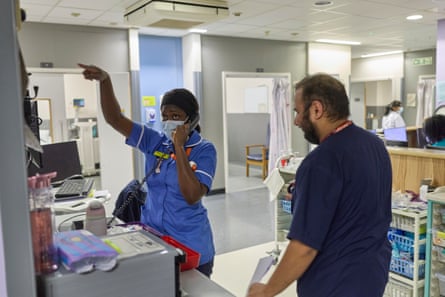
As for the disorderly reputation of emergency departments, I hadn’t been all that lucky, either, to find relative calm. A Royal College of Nursing (RCN) report last August found that “during a typical working day in England, A&E staff are now being attacked every hour”. That’s appalling. How could people behave like that? But thinking about the RCN figures, there were 4,054 incidents in the 89 trusts that replied. Multiply that by two to get close to the 200 or so trusts in the UK overall. But then put that number into the context of 6.7 million people attending A&E in the second quarter of 2024-25 in England alone. Many violent incidents against NHS staff were classed by trusts as “unintentional”, the result of delirium or mental health problems, according to a Guardian investigation.
Awful things do happen, with a new RCN investigation into the ongoing scourge of corridor care in the NHS calling it “a type of torture” that leads to patient deaths.
I fell victim to the “I’ve been lucky” syndrome monitored over decades by the pollster Ipsos, which has tracked attitudes to public services. Many more people think their local NHS provides a good service than think the NHS nationally does well. That applies to most things – crime, immigration, council services: “It’s terrible out there, but I’m lucky in my home patch.” How dispiriting for politicians that dismal news reports carry more weight than the evidence of people’s own eyes.
Painfully slowly, NHS statistics are improving. Waiting numbers fell in 2025 despite it being the NHS’s busiest year – but more of the ageing population joined the queue. Few people will have noted Labour’s focus on health inequality: waiting lists are falling three times faster in areas with the highest joblessness.
Ipsos’s annual report, The Perils of Perception, shows how wildly people overestimate social ills. Since ancient times, humans have thought the present worse than imaginary golden ages. But the current pessimism and declinism have a genuine cause, as living standards have flatlined and reckless austerity has diminished public services, in a world where there are more wars and fewer democracies than 20 years ago.
Even when things improve, politicians can expect scant credit: the best they get is public concern moving elsewhere, says Gideon Skinner, an Ipsos senior director. It’s for them, he says, to offer words of hope that things will get better. So far, this government has failed to project a belief that we are back on the path of progress. But it only takes a click of a mouse – or a trip to A&E – to find out the facts that will tell you things are usually not as bad as you fear. I should have known better – I certainly do now.
Curated by Aisha Patel