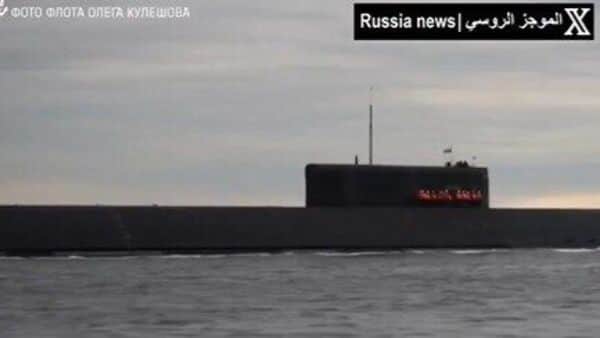
Russia has deployed a submarine and other naval assets to escort a derelict oil tanker in the North Atlantic, turning what began as a sanctions enforcement operation into a fresh geopolitical flashpoint between Moscow and Washington, according to a Wall Street Journal report cited by US officials.
The tanker, now sailing under the name Marinera, is being shadowed by the United States Coast Guard weeks after it left waters near Venezuela. Though the vessel is empty and visibly deteriorating, its journey has drawn intense scrutiny from US authorities seeking to clamp down on what they describe as a global network transporting illicit oil linked to Russia and other sanctioned states.
Despite carrying no oil, the tanker was pursued by the US Coast Guard as part of a broader effort to disrupt fleets used to ferry black-market energy supplies worldwide, including oil sold by Russia outside Western sanctions regimes.
In December, the vessel’s crew repelled an attempt by US authorities to board it before steaming into open waters. During its escape, the crew crudely painted a Russian flag on the hull, renamed the ship Marinera, and shifted its registration to Russia—moves that have significantly complicated the legal landscape surrounding any potential seizure.
According to multiple U.S. officials, Russia has formally asked Washington to halt its pursuit of the tanker. On Tuesday, Russia’s Foreign Ministry said it was monitoring the situation “with concern”, a statement carried by state news agency RIA.
The White House declined to comment. However, US Southern Command said on social media that it was prepared to “stand against sanctioned vessels and actors transiting through this region”.
Russia’s state-controlled broadcaster RT has published footage purportedly filmed from the deck of the tanker, showing a US Coast Guard cutter following closely behind. In a separate social media post, RT claimed the United States was attempting to intercept a vessel bound for Murmansk despite its “clear civilian status”.
Its subsequent registration in Russia now muddies the legal justification for boarding the ship under international maritime law.
“Once it’s legitimately registered, it gets the protection of the flag” under international law, said retired Rear Adm. Fred Kenney, former director of legal affairs and external relations at the International Maritime Organization. “It’s not retroactive, you can’t say it was stateless two weeks ago so we’re going to say it’s stateless now.”
Experts warn that any attempt by the U.S. to forcibly board the tanker could invite retaliation from Russia or its allies, including Iran.
“Will Russia step in and protect the dark fleet on a regular basis? That would undercut the argument that they have legitimate ties to the vessels,” said William Baumgartner, former judge advocate general and chief counsel for the Coast Guard. “If they repeat this, it does raise the question of whether this is a legitimate change in registry, or if it appears to be done for nefarious reasons.”
“I’m not thrilled with Putin. He’s killing too many people,” said US President Donald Trump on Saturday, referring to Russian President Vladimir Putin.
The United States has already seized two very large crude carriers—the Skipper and the Centuries—which officials say are part of the same illicit oil transport network. More seizures could follow.
Western sanctions imposed after Russia’s invasion of Ukraine have fuelled the rapid growth of what analysts describe as a “dark fleet” of more than 1,000 ageing tankers operating with opaque ownership structures and no Western insurance. These vessels often disguise their activities by switching off tracking signals or transferring cargo in poorly monitored waters, raising environmental and maritime safety concerns.
Moscow has previously rejected claims that it operates a shadow fleet and has dismissed Western sanctions as illegitimate.
Editorial Context & Insight
Original analysis & verification
Methodology
This article includes original analysis and synthesis from our editorial team, cross-referenced with primary sources to ensure depth and accuracy.
Primary Source
mint - news