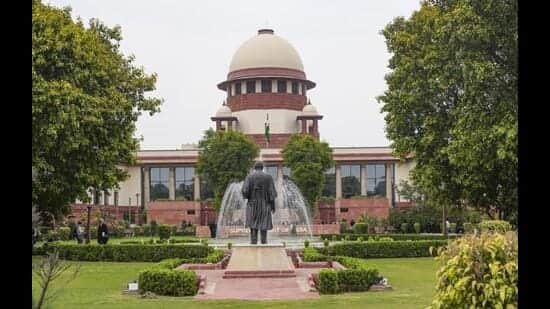
The Supreme Court on Monday dismissed a plea to restrain the Union government and the Prime Minister from offering a ceremonial chadar at the tomb of Sufi saint Khwaja Moinuddin Chishti during the annual Urs at the Ajmer Sharif dargah, holding that the plea was “not justiciable”.
“In our opinion, the issues raised in this petition are not justiciable. The petition is therefore dismissed,” a bench comprising Chief Justice of India (CJI) Surya Kant and Justice Joymalya Bagchi said, bringing the matter to a close after a brief hearing.
The plea was filed by Jitender Singh, president of the Vishwa Vedic Sanatan Sangh, through advocate Barun Kumar Sinha, in the nature of a public interest litigation. It sought directions prohibiting the Union government, including the Prime Minister, from offering ceremonial homage such as a chadar at the Ajmer Dargah, contending that such acts were contrary to the will of the people, national sovereignty, and the ethos of the Constitution.
During the hearing, Sinha submitted that the petition questioned what it described as “state-sponsored ceremonial honours, official patronage and symbolic recognition” extended to Khwaja Moinuddin Chishti. He argued that the Ajmer dargah did not qualify as a religious denomination protected under Article 26 of the Constitution, relying on a 1961 Constitution bench judgment in Dargah Committee, Ajmer and Another Vs Syed Hussain Ali and Others.
Sinha informed the court that a civil suit had been instituted in 2024 before a trial court in Ajmer, seeking appropriate reliefs in relation to the site. The suit, which is currently pending adjudication, alleges unauthorised occupation of a Hindu temple by the Dargah.
The bench was not persuaded. It said that the nature of the issues raised did not warrant judicial intervention under the court’s writ jurisdiction. At the same time, the court clarified that the dismissal of the present petition would not have any bearing on the pending civil proceedings before the Ajmer court. “Dismissal of this petition will not affect the civil suit,” the order noted.
The order came weeks after the Supreme Court declined to urgently list the plea when it was mentioned for immediate hearing on December 22, ahead of the 814th annual Urs at the Ajmer Sharif dargah. Union minority affairs minister Kiren Rijiju had on the same day offered the ceremonial chadar on behalf of Prime Minister Narendra Modi as part of the Urs observances, continuing a long-standing practice followed by successive Prime Ministers since Independence.
In its pleadings, the petitioner challenged the constitutional validity of what it termed official patronage extended to Khwaja Moinuddin Chishti, asserting that such practices were arbitrary and lacked any legal or constitutional basis. The plea cited historical accounts to claim that Chishti arrived in India during the invasions of Shahabuddin Ghori in the 12th century and was associated with foreign conquest and conversion campaigns, with his shrine being institutionalised much later.
It argued that officially honouring such a historical figure undermined India’s constitutional dignity and sovereignty, and sought a blanket prohibition on the Prime Minister and other state authorities from offering ceremonial homage, including the chadar, at the Ajmer Dargah.
Editorial Context & Insight
Original analysis & verification
Methodology
This article includes original analysis and synthesis from our editorial team, cross-referenced with primary sources to ensure depth and accuracy.