Preliminary Examination: Current events of National & International importance.
Mains Examination: General Studies-II: Effect of policies and politics of developed and developing countries on India’s interests.
What’s the ongoing story: The United States captured Venezuelan President Nicolás Maduro and flew him out of the country in an extraordinary military operation early Saturday that plucked a sitting leader from office. President Donald Trump insisted the US government would run the country at least temporarily and would tap Venezuela’s vast oil reserves to sell “large amounts” to other countries.
— What is fentanyl? How severe is the problem of fentanyl trafficking?
— Why is fentanyl a public concern in the US?
— What are the implications of the US capturing of Venezuelan President Nicolás Maduro?
— Read about the principle of non-intervention in international relations?
— What is the strategic significance of Venezuela’s oil reserves?
— What is the status of India’s ties with Venezuela?
— How have US sanctions on Venezuela impacted India–Venezuela trade relations?
— Read about the India-US relations. — Map work: Locate Venezuela on map. (Refer atlas)
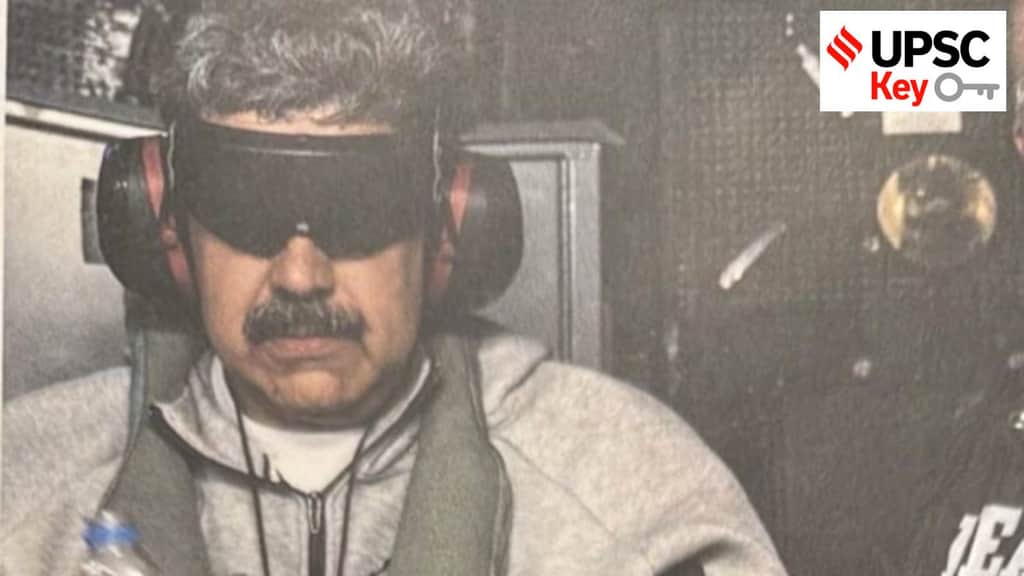
— The Trump administration’s pressure campaign on the South American country that consisted of months of strikes on boats officials said were smuggling drugs to the US. Behind the scenes, US officials tracked Maduro’s behavioural habits, including what he ate and where he slept, in preparing to execute an operation that resulted in one of the more stunning regime changes in modern history.
— Maduro and his wife, seized overnight from their home on a military base, were aboard a US warship on their way to New York, where they were to face criminal charges in connection with a Justice Department indictment accusing them of a role in a narco-terrorism conspiracy.
— Trump said the US planned to run Venezuela until a transition of power could take place. He claimed the American presence was already in place, though there were no immediate signs the US was running the country.
— Maduro and other Venezuelan officials were indicted in 2020 on “narco-terrorism” conspiracy charges, but the Justice Department released a new indictment Saturday of Maduro and his wife, Cilia Flores that described the regime as a “corrupt, illegitimate government” fueled by a drug trafficking operation that flooded the US with cocaine.
— Hours after an audacious military operation that plucked leader Nicolás Maduro from power and removed him from the country, President Donald Trump said Saturday that the United States would run Venezuela at least temporarily and tap its vast oil reserves to sell to other nations.
— The dramatic action capped an intensive Trump administration pressure campaign on the South American nation and its autocratic leader and months of secret planning resulting in the most assertive American action to achieve regime change since the 2003 invasion of Iraq.
— Legal experts immediately raised questions about whether the operation was lawful. Venezuela’s vice president Delcy Rodríguez demanded in a speech that the U.S. free Maduro and called him the country’s rightful leader, before Venezuela’s high court ordered her to assume the role of interim president.
— The announcement by President Donald Trump that the US had attacked Venezuela and captured its President Nicolas Maduro put India in a diplomatic spot Saturday: on the one side is Trump’s unilateral move and, on the other side, is Delhi’s stated position that seeks an international rules-based order.
— Delhi, which is usually conservative and wary of commenting on issues far from Indian borders, is in a bind given that many in the Global South will look to India to underline the need to respect international law, and non-intervention by foreign forces in the internal affairs of a country.
— India and the US are still negotiating a bilateral trade deal, months after Trump imposed 50 per cent tariffs, including a 25 per cent penalty over Delhi’s purchase of Russian oil. India has been tapering off that import although Delhi feels it was singled out by the US President who did not move against China and Europe over their purchase of Russian oil.
— India’s own ties with Venezuela have been of low stakes as well, although it has had a robust history of oil imports from the country.
— Bilateral trade between India and Venezuela was USD 6,397 million in 2019-20, of which Indian imports were worth USD 6,057 million. The sanctions on Venezuela imposed by the US led India to drop oil imports from Venezuela to a bare minimum. Bilateral trade was USD 1,271 million in 2020-21 (Indian imports were USD 714 million); USD 424 million in 2021-2022 (Indian imports were USD 89 million); and USD 431 million in 2022-2023 (Indian imports were USD 253 million) – clearly pointing to a declining trend following US sanctions on Venezuela oil.
— The political relationship between Delhi and Caracas was at a high in 2005 when President Hugo Chavez made a State visit to India on March 4-7 that year. He held bilateral talks with Prime Minister Manmohan Singh.
— Nicolas Maduro visited India as the Foreign Minister of Venezuela in August 2012 for the India-CELAC (Community of Latin American and Caribbean States) Troika Foreign Ministers meeting in New Delhi on August 7, 2012. He held talks with his then Indian counterpart S M Krishna.
— While the ties were largely economic and the energy basket was the only game in town, Delhi was careful in its diplomatic engagements with Caracas. There are less than 100 Indians in Venezuela – according to the Indian embassy’s records: “50 NRIs (non-resident Indians) and 30 PIOs (Persons of Indian origin)”.
— While the political stakes for India are relatively low, the principles at stake are high given the US track record of adventurism overseas.
— According to the World Health Organisation (WHO), fentanyl is a potent synthetic opioid drug which is used as a pain reliever and as an anaesthetic. It is about 50-100 times more potent than morphine.
(1) With reference to the fentanyl, consider the following statements: 1. It is a potent synthetic opioid drug used as an analgesic.
2. It is less potent than morphine. Which of the statements given above is/are correct?
Preliminary Examination: Current events of national and international importance.
Mains Examination: General Studies-I: Indian culture will cover the salient aspects of Art Forms, literature and Architecture from ancient to modern times.
What’s the ongoing story: Inaugurating an exposition of sacred ancient gems and bone fragments linked to Gautam Buddha, Prime Minister Narendra Modi Saturday said they were not mere artefacts but part of India’s revered heritage besides being a spiritual and sacred chapter of history.
— What are Piprahwa relics, and what is their cultural significance?
— Know in detail about the doctrines of Buddhism, the Four Noble Truths, the Five Precepts and the Eightfold Path.
— What are stupas? What are the famous Buddhist stupas in India?
— What is India’s Antiquities and Art Treasures Act, 1972? — What is the significance of Buddhism?
— Read about the various sects of Buddhism, the spread of Buddhism, and the decline of Buddhism.
— Map work: Mark important Buddhist sites in India. — Know about the Buddhist circuit?
— At the Grand International Exposition of Sacred Piprahwa Relics related to Lord Buddha titled “The Light & the Lotus: Relics of the Awakened One” at the Rai Pithora Cultural Complex in the capital, the PM said that the occasion marked the return of India’s heritage and legacy after 125 years.
— “This shared heritage of Lord Buddha is proof that India is not connected merely through politics, diplomacy, and economy, but through deeper bonds of emotions, faith and spirituality,” he said, adding that the sacred Piprahwa relics travelled to different countries with significant Buddhist populations.
— These included Vietnam, Thailand and Russia, where waves of faith and devotion arose, and people turned up to pay homage in huge numbers, Modi said. Terming the presence of the relics in India as “highly inspiring”, the PM expressed hope that with the blessings of Lord Buddha, 2026 will usher in a new era of peace, prosperity, and harmony for the world.
— PM Modi said the sacred relics were returning to India after more than 125 years at the intervention of the government and the Godrej Group, which together stopped them from being auctioned off in Hong Kong last May.
— Discovered in 1898, the Piprahwa relics hold a central place in the archaeological study of early Buddhism and are among the earliest and most historically significant relic deposits directly connected to Buddha. Archaeological evidence associates the Piprahwa site with ancient Kapilavastu, widely identified as the place where Buddha spent his early life prior to renunciation.
— The PM said his government was making efforts to ensure that Buddhist heritage reaches the next generations in a natural way, adding that the Global Buddhist Summit and international events like Vesak and Ashadha Purnima were driven by this very thought.
— Modi said his government had granted classical language status to Pali to make the language in which the Buddha delivered his sermons more accessible to the people.
— Buddhism is a significant world religion today, influencing many with its teachings. Originating in the 6th century BCE in the Indian subcontinent, Buddhism, along with other Śramanic sects emerged as a result of growing discontent towards ritualistic and hierarchical aspects of the Brahmanical tradition.
— Buddhism was founded by the Buddha, who was born as Siddhartha. He was the son of king Suddhodana, a leader of the Sakya clan of Kapilavastu (located in modern day Nepal). According to various narrations, Maya gave birth to Siddhartha in a grove at Lumbini while en route to her natal home.
— Buddhism prescribes the three gems (triratna) as the means of liberation. These are: — The Piprahwa relics were discovered during the excavation of an ancient Buddhist stupa in Uttar Pradesh’s Piprahwa, near the India-Nepal border. They hold immense religious and cultural importance for the Buddhist community.
(2) With reference to ancient India, consider the following statements: (UPSC CSE 2023)
1. The concept of Stupa is Buddhist in origin. 2. Stupa was generally a repository of relics.
3. The stupa was a votive and commemorative structure in Buddhist tradition.
How many of the statements given above are correct?
Preliminary Examination: Current events of national importance, General issues on Environmental Ecology, Biodiversity and Climate Change – that do not require subject specialisation.
Mains Examination: General Studies-II, III: Infrastructure, Conservation, environmental pollution and degradation, environmental impact assessment.
What’s the ongoing story: A Union Environment Ministry expert panel has recommended environmental clearance (EC) for the 1,200-MW Kalai-II hydroelectric project on Lohit River in Arunachal Pradesh’s Anjaw even as environmentalists and project-affected persons flagged glaring omissions about the presence of the critically-endangered white-bellied heron bird in the Lohit River Basin from the proposal’s environmental impact assessment report.
— Know about the Kalai-II hydroelectric project and concerns associated with it.
— What is environmental impact assessment (EIA)?
— What is the significance of EIA in safeguarding biodiversity?
— Read about the white-bellied heron.
— What is the conservation status of the white-bellied heron?
— What are the implications of hydroelectric projects on free-flowing riverine habitats?
— Development-environment debate – Think about it.
— Map work: Lohit River Basin, Kamlang Tiger Reserve, Namdapha Tiger Reserve.
— In 2020, the EAC had itself sought a detailed conservation plan for the Heron species while extending clearance for the 1,750 MW Lower Demwe project, also proposed on the Lohit River.
— As per official minutes, the Centre’s EAC on river valley and hydroelectric projects recommended environmental clearance for the Kalai-II hydel project in its December 19 meeting. The EIA report was prepared by WAPCOS Ltd, a government enterprise and an accredited EIA consultant.
— A day before the EAC’s meeting, Soblam Malo from Anjaw’s Chengung village, and Assam-based environmentalist Bimal Gogoi wrote to the panel highlighting the alleged oversight in the EIA report while seeking a prior assessment of the project’s impact on the bird species.
A white-bellied heron in Namdapha Tiger Reserve. (Expres photo by Rohit Naniwadekar)
— Gogoi said the EIA report “failed to make even a single mention of the under-threat species” despite the “project-affected area being contiguous habitat with recent records of the bird in the Lohit River basin, including Kamlang Tiger Reserve.” Gogoi added that “surprisingly” Kamlang Tiger Reserve was only recorded as a sanctuary in the EIA report.
— The report’s avian-fauna chapter that records a total of 28 species belonging to 19 families in the study area misses out on making any mention of the white-bellied heron, a schedule-I (highest protection) species under the Wildlife Protection Act. The bird is critically endangered, as per the red list of the International Union on Conservation of Nature (IUCN).
— The bird’s presence has been recorded both, upstream and downstream, of the Kalai-II project, as per independent researchers, and past records of the Arunachal Forest Department.
— Rohit Naniwadekar, scientist, Nature Conservation Foundation, who has carried out field research on the species in the Namdapha Tiger Reserve said the white-bellied heron prefers free-flowing riverine habitats with low disturbance, and predominantly depends on fish found in the river rapids.
— “While the IUCN Red list suggests there are less than 250 birds in the wild, experts speculate there might be only about 60 birds left in the wild, with 4-5 breeding pairs in Bhutan and fewer in eastern Arunachal Pradesh,” he added.
— The white-bellied heron nesting sites in Walong and Namdapha are also recorded in the June 2023 edition of Indian Birds, a journal of South Asian Ornithology. The journal article noted the bird count has rapidly declined due to habitat loss, hunting, human disturbances, while older conservation strategy documents have also noted dams and collisions with power lines as threats.
— The project, to be developed by THDC India Ltd, at an estimated cost of Rs 14,176.26 crore is planned on Lohit, a tributary of the Brahmaputra in Anjaw’s Hawai village. The project with pondage will involve construction of a 128.5-m concrete gravity dam, and an underground powerhouse.
— The development-environment debate is a contemporary matter of contestation that explores the conflict between economic advancement and ecological conservation. This issue is particularly relevant in developing nations such as India which has ambitions of raising its quality of life while simultaneously contending with challenges related to environmental degradation and climate change.
— Environmental Impact Assessment has emerged as a mechanism to aid nations in walking the tightrope between economic development and environmental protection, ensuring that growth does not come at the expense of ecological sustainability.
—EIA is a systematic process used to evaluate the potential environmental effects – both positive and negative – of a proposed project or development before it is approved. The primary objectives of EIA include the prediction and evaluation of the environmental, economic and social impacts of development projects.
— It facilitates informed decision-making by providing in-depth analysis of a proposed project and promotes sustainable development by identifying potential negative effects early in the planning stage, while also suggesting appropriate alternatives and mitigating mechanisms.
— EIA also fosters popular participation in developmental decision-making by holding public consultations where citizens can express their concerns regarding a project.
1. It is a schedule-I species under the Wildlife Protection Act.
2. The bird is critically endangered, as per the red list of the International Union on Conservation of Nature (IUCN).
Preliminary Examination: Indian Polity & Governance – Constitution, Political System, Panchayati Raj, Public Policy, Rights Issues, etc.
Mains Examination: General Studies-II: Parliament and State legislatures—structure, functioning, conduct of business, powers & privileges and issues arising out of these.
What’s the ongoing story: Chakshu Roy writes- “The past year was one of late-night functioning of Parliament. In April, the Rajya Sabha stayed up until 4 am discussing the Waqf Amendment Bill and President’s Rule in Manipur. In December 2025, the Lok Sabha wrapped up the G-RAM-G Bill discussions at 1 am. The Rajya Sabha then passed this new employment guarantee law at 2 am the next day.”
— What are parliamentary privileges?
— What is the constitutional provision with regard to parliamentary privileges?
— How does Parliament act on breach of privilege? — Are there absolutely no restrictions on this privilege?
— What are the powers and functions of a Lok Sabha Speaker?
— What are some of the important judgements related to parliamentary privileges?
— “Late-night parliamentary sittings have a long history, with the most famous being the midnight session of August 14-15, 1947, when India marked its Independence. But perhaps the first time an MP stayed overnight in Parliament had nothing to do with a momentous occasion, discussing national issues or debating critical legislation — it was to avoid arrest by the police in 1964.”
— “The MP was Mani Ram Bagri, 42, whom the voters of Hisar (now in Haryana) had elected to the Lok Sabha for the first time in 1962 on a Socialist Party ticket.”
— “Bagri began his legislative journey as an MLA in the Punjab Legislative Assembly. A quick-witted orator, he was a passionate but disruptive parliamentarian. In his first parliamentary session, his obstruction of Lok Sabha proceedings resulted in his suspension from the House for seven days.”
— “Bagri was also no stranger to the legal process. During his time as an MLA, one of his public speeches had led the Punjab government to initiate proceedings against him. After becoming an MP, he would participate in demonstrations in Delhi, including a few outside the PM’s residence. And it was his participation in one of these dharnas in 1964 that led the authorities to initiate criminal proceedings against him.”
— “Apprehending arrest, Bagri approached the Lok Sabha Speaker for protection. The Speaker consulted senior House leaders. He then allowed Bagri to remain on Parliament grounds but prohibited from entering the building after 7 pm. As long as he stayed on Parliament’s grounds, the police could not arrest him.”
— “This privilege of not being arrested on Parliament grounds was a result of legislative developments a decade earlier, which started in the Madras Legislative Assembly. A committee of this legislature, headed by PT Rajan, defined the precincts of their legislature. As a result, serving any legal processes to any MLA on the grounds of the Assembly became a breach of privilege.”
— “In December 1955, the Lok Sabha’s Rules Committee stated that the Parliament precincts were sacrosanct. Based on the panel’s recommendation, the Lok Sabha added a rule to its procedures, stating that authorities not arrest anyone within the precincts of the House without the Speaker’s permission.”
— “So in April 1964, after the Speaker’s permission, Bagri added to the architectural landscape of the Parliament House by pitching a tent on its lawns. Lok Sabha was in session and his tent, which had a table and a chair, was a crowd-puller. Since that April in Delhi was pleasant, Bagri also added a cot for a good night’s sleep. Parliament also made arrangements for him to use the washroom and other facilities.”
— “But Bagri pushed the envelope and tried to enter the building after 7 pm without the Speaker’s permission. Parliament staff prevented his entry, which sparked a House debate over MPs’ privileges and whether Parliament should offer sanctuary to members facing arrest. One of his colleagues would highlight that Bagri’s tent was an example of Parliament’s supremacy.”
— “The Speaker would then define the extent of members’ privileges in such cases and warn Bagri that the concession given to him could not continue indefinitely. Parliamentary debates suggest that Bagri took down his tent later that evening and left Parliament’s grounds without getting arrested.”
— Article 105 of the Constitution deals with “powers, privileges, etc of the Houses of Parliament and of the members and committees thereof”, and has four clauses. It reads: “(1) Subject to the provisions of this Constitution and to the rules and standing orders regulating the procedure of Parliament, there shall be freedom of speech in Parliament.
(2) No member of Parliament shall be liable to any proceedings in any court in respect of any thing said or any vote given by him in Parliament or any committee thereof, and no person shall be so liable in respect of the publication by or under the authority of either House of Parliament of any report, paper, votes or proceedings.
(3) In other respects, the powers, privileges and immunities of each House of Parliament, and of the members and the committees of each House, shall be such as may from time to time be defined by Parliament by law, and, until so defined, shall be those of that House and of its members and committees immediately before the coming into force of section 15 of the Constitution (Forty-fourth Amendment) Act, 1978.
(4) The provisions of clauses (1), (2) and (3) shall apply in relation to persons who by virtue of this Constitution have the right to speak in, and otherwise to take part in the proceedings of, a House of Parliament or any committee thereof as they apply in relation to members of Parliament.”
— This immunity extends to certain non-members as well, such as the Attorney General for India or a Minister who may not be a member but speaks in the House. In cases where a Member oversteps or exceeds the contours of admissible free speech, the Speaker or the House itself will deal with it, as opposed to the court.
1. A Member of Parliament shall be liable to any proceedings in any court in respect of a vote given by him in Parliament or any committee.
2. Members of Parliament shall be liable to proceedings in any court in respect of anything said by them in Parliament or any committee.
The ‘Powers, Privileges and Immunities of Parliament and its Members’ as envisaged in Article 105 of the Constitution leave room for a large number of un-codified and un-enumerated privileges to continue. Assess the reasons for the absence of legal codification of the ‘parliamentary privileges’. How can this problem be addressed? (UPSC CSE 2014)
Mains Examination: General Studies-II, III: Government policies and interventions for development in various sectors and issues arising out of their design and implementation, Indian Economy and issues relating to planning, mobilisation of resources, growth, development and employment.
What’s the ongoing story: The Labour Ministry has proposed a 90-day annual work threshold as the mandatory eligibility criteria for gig and platform workers to access social security under new draft rules on the Social Security Code 2020, published on December 31.
— Labour laws fall under which list of the Seventh schedule of the Indian Constitution?
— What are the key highlights of the four Labour Codes?
— How do the new labour codes impact different worker groups?
— Who are gig workers? What are the provisions related to gig workers in the New Labour Code?
— What are the challenges faced by the gig workers? — What are the various initiatives related to gig workers?
— What is the significance of gig economy?
— The four labour codes, including the Social Security Code 2020, were notified on November 21, 2025, and now draft rules have been pre-published for stakeholders’ feedback.
— “In order to be eligible for any benefit under any scheme framed under the Code for gig workers or platform workers, the Central Government may notify specific conditions for eligibility through general or special order, in addition to registration on the designated portal of the Central Government: Provided that such eligible worker has been engaged as gig worker or platform worker for not less than ninety days with an aggregator, or in the case of multiple aggregators, not less than one hundred and twenty days, in the last financial year,” according to the Code on Social Security (Central) Rules, 2025.
— If a gig worker, or a platform worker, is engaged with three aggregators on a particular calendar day, this shall count as three days, the Ministry of Labour and Employment said.
— It also clarified that an eligible gig worker or a platform worker shall include all such workers engaged by the aggregator directly or through an associate firm, holding company, subsidiary company, limited liability partnership or a third party.
— To facilitate the updation of particulars of registered gig workers or platform workers, every aggregator shall electronically share the details of the workers engaged with them quarterly or at such other periodicity and in such form as shall be specified on the designated portal of the Central government, it stated. In the absence of such updation, a gig or platform worker may not be eligible to avail the benefits of the social security schemes.
— The four labour codes – Code of Wages (2019), Industrial Relations Code (2020), Code on Social Security (2020) and Occupational Safety, Health and Working Conditions Code (2020) – replaced 29 fragmented laws with a unified, modern framework.
— Notably, India’s old labour laws were too many, too complex, and outdated. They increased the compliance burden and discouraged businesses from hiring. Many workers, especially gig, platform, MSME, and migrant workers, had no uniform social security.
— Also, as labour is a Concurrent List subject, and while most states have finalised rules aligned with the four codes, central-level implementation was pending. This delay resulted in uneven social security coverage for workers and compliance complexity for employers operating across multiple states. Thus, the new labour codes are introduced to try to fix all this.
(5) In India, which one of the following compiles information on industrial disputes, closures, retrenchments and lay-offs in factories employing workers? (UPSC CSE 2022)
Discuss the merits and demerits of the four ‘Labour Codes’ in the context of labour market reforms in India. What has been the progress so far in this regard? (UPSC CSE 2024)
Examine the role of ‘Gig Economy’ in the process of empowerment of women in India. (UPSC CSE 2021)
🚨 Click Here to read the UPSC Essentials magazine for December 2025. Share your views and suggestions in the comment box or at manas.srivastava@indianexpress.com🚨
Editorial Context & Insight
Original analysis & verification
Methodology
This article includes original analysis and synthesis from our editorial team, cross-referenced with primary sources to ensure depth and accuracy.
Primary Source
The Indian Express