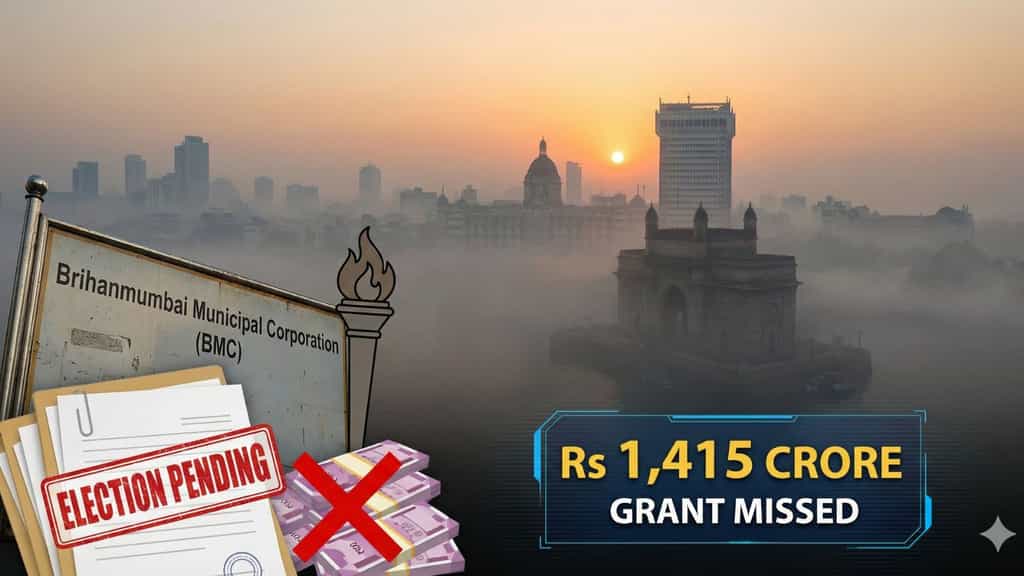
Even as major cities across the country are fighting air pollution, data received from the Ministry of Environment, Forest and Climate Change (MoEFCC) and the Brihanmumbai Municipal Corporation (BMC) show that while Rs 2,981 crore was earmarked for Maharashtra civic bodies between FY 2021 and FY 2026, as many as 20 civic bodies, including BMC and five other large municipal corporations , missed out on receiving at least Rs 1,415 crore monetary grant for air quality management after 2022, owing to delay in civic body elections in the state.
The grants were to be given by the Union Finance Ministry as part of the Fifteenth Finance Commission (FFC) based on the recommendations made by the MoEFCC.
As per the RTI data sourced from the BMC, total Rs 2,981 crore was allocated to Maharashtra by the MoEFCC and were to be released to six major urban agglomerations (UAs), including the BMC, between 2020-’21 and 2025-’26, while only Rs 1,555.34 crore got released. An overall deficit of Rs 1,415.66 crore was created for the primary municipal corporations of Mumbai, Pune, Nagpur, Nashik, Vasai-Virar and Chhatrapati Sambhaji Nagar.
The funds were supposed to be spent in implementing measures that would curb vehicular and industrial emission, as well as reduce road dust displacement — factors that contribute to air pollution.
For every UA, the FFC made individual allocations with Rs 1,832 crore for Mumbai UA or BMC, Rs 504 crore for Pune, Rs 239 crore for Nagpur, Rs 156 crore for Nashik, Rs 121 crore for Vasai Virar and Rs 119 crore for Aurangabad.
The data also shows that the civic bodies haven’t received any funds after 2022.
While only Rs 929 crore or 50 per cent of the funds were received by Mumbai UA till 2022, the balance Rs 844 crore, which was to be released between 2023 and 2026 did not get disbursed. Similarly, Pune UA received Rs 261.85 crore till 2022, and the balance fund of Rs 232 crore since 2023 is awaiting disbursal. Nagpur UA received Rs 132.6 crore till 2022, while the balance Rs 115 crore is awaited; and Nashik UA received Rs 91.35 crore till 2022, while the balance Rs 72 crore is still on hold.
Fifteenth Finance Commission FFC is a constitutional body that was established to recommend revenue sharing between the Union ministry and state governments.
The key features of the commission included improvement of public spending and issuing grants to urban local bodies for strengthening civic infrastructure. One such component of the grants included issuance of funds for strengthening infrastructures to tackle air pollution and improve air quality index (AQI) of the cities.
As per the RTI response from MoEFCC, in total, 49 different cities from 15 different states in the country were recommended by the MoEFCC for the FFC’s AQI grant for which a total fund of Rs 16,539 crore was earmarked.
The highest allocation of Rs 2,981 crore or 18 per cent of the total earmarked fund was made for Maharashtra, followed by Rs 2,684 crore for Uttar Pradesh which was 16 per cent of the total allocation, and Rs 1,574 crore for West Bengal, which was 9.5 per cent of the total allocation. These funds were to be released to the municipal corporations or ULBs in the states between 2020 and 2026.
However, the records show that the ULBs in Maharashtra stopped receiving these funds from 2022 — the year when the elected body of public representatives started getting dissolved in various municipalities.
Absence of elected bodies While a detailed questionnaire sent by The Indian Express to the MoEFCC inquiring the reasons for halt on funds since 2023 did not elicit any response, senior government officials, including IAS officers from several municipal corporations in Maharashtra, confirmed that the funds have not been received as the corporations do not have elected body.
According to a 2023 letter issued to the secretary of MoEFCC by the deputy secretary to the government of India, the funds are disbursed only to the ULBs that have a duly constituted local body.
“The FFC in its final report for the period 2020-21 to 2025-26 has recommended the grants for duly constituted local governments. A duly constituted ULB means an ULB where elections have been held and an elected body is in place as provided in Part-IXA of the constitution of India,” stated the letter undersigned by Anil Gairola, deputy secretary to the government of India.
“Therefore, million plus cities and UAs shall be deemed to be eligible for the release of FFC recommended air quality grants if duly elected body in ULB/Statutory towns are in place as per the provisions of articles 243Q and 243R of the Constitution of India,” the letter stated.
Who all missed out Nearly 20 different civic bodies missed out on funds that included municipal corporations, councils and cantonment boards in Maharashtra.
While funds are initially allocated to the six large UAs, these larger UAs would disburse a portion of the funds to smaller municipal corporations, municipal councils or cantonment boards. For example, the BMC, which is the nodal agency of Mumbai UA, would disburse funds to the municipal corporations at Navi Mumbai (NMMC), Thane (TMC), Kalyan Dombivali (KDMC), Mira Bhayander (MBMC), Ulhasnagar, and the nagar parishads at Ambernath and Badlapur.
The Pune Municipal Corporation (PMC) which is the nodal agency for Pune UA would disburse a portion of the funds that it had received to municipal corporation at Pimpri Chinchwad (PCMC), and the cantonment boards at Dehu Road, and Khadki. The Nashik Municipal Corporation (NMC) would disburse a portion of the funds it has received further to the municipal council at Bhagur and cantonment board at Deolali.
Delay in elections In Maharashtra, the civic elections, which were to be held in 2020 got deferred due to the Covid-19 pandemic. Later, the civic elections that were to be held during March 2022 also got deferred following the Supreme Court’s (SC) decision of allowing the Other Backward Class (OBC) quota in local body elections only after conducting a rigorous empirical inquiry (or triple test).
In Mumbai, there was also an additional issue of reorganisation of the municipal ward boundaries that led to the deferment of the civic polls. On August 4, 2025, the SC directed the State Election Commission (SEC) to conduct local body polls in Maharashtra by January 2026 as per new ward reservation and 27 per cent of OBC reservation. The apex court also pulled up the SEC for the delay in holding the elections.
However, the municipal corporations of Aurangabad and Vasai Virar continued to receive funds till 2022, even though their body of elected representatives got over in April and June, 2020. An official from the Central Pollution Control Board (CPCB) stated, “The elected body in the municipal corporations of Vasai Virar and Aurangabad got lapsed during the pandemic-induced lockdown in 2020. The funds for that year were released knowing that the elections couldn’t be held. In 2021 also, the same protocol was followed during the second wave of the pandemic. The release of funds was stopped after 2022 when the term of several elected bodies of corporations got over.”
‘Huge loss to state’ Senior administration officials stated that the stoppage of funds resulted in a huge loss to the state. Mumbai, along with the satellite districts of Mumbai Metropolitan Region (MMR), have been grappling under poor AQI since 2022, largely due to manmade factors such as vehicular emission, dust mitigation and open burning of solid waste.
In 2023, the BMC came up with the Mumbai Air Pollution Mitigation Action Plan (MAPMP), which was adapted as the blueprint for tackling air pollution in several other municipalities. In the MAPMP, the civic body identified vehicular emission as one of the main contributing factors behind poor AQI.
“Stopping the funds suddenly appeared to be a huge loss not just for BMC, but also for all municipal corporations. Our main target was to utilise this money for acquiring electric vehicles (EV) and add to the fleet of our BEST buses, as our primary agenda was to have electric vehicles for public transport,” said Bhushan Gagrani, Mumbai municipal commissioner and state appointed administrator.
“In the long run, we would also be able to use the funds to provide some kind of subsidies or facilities to private EV car owners. This would encourage a large number of citizens to switch to e-mobility, collectively resulting in bringing down emissions,” he added.
Senior IAS officer Avinash Dhakane, who served as the member-secretary in the Maharashtra Pollution Control Board (MPCB) and is currently the additional municipal commissioner in BMC, heading the environment department said that between 2023 and 2025, he had made multiple attempts in requesting the Union ministry to release the funds so that it could be put to use.
“In the MMR region, there is a need to augment the AQI monitoring system. Therefore, when I was heading the MPCB, my objective was to acquire more AQI monitors. This would have given us a chance to understand why certain areas were recording bad AQI and the interventions that would be needed to mitigate it,” Dhakane said.
Utilising the funds According to the government data, out of the Rs 1,555.34 crore disbursed to various municipal corporations in the state, around Rs 1,162.67 crore or 74.75 per cent have been utilised so far, with a large proportion for acquiring EV buses. Solid waste management (SWM) and dust displacement eradication measure, which were also identified as primary contributors behind plummeting AQI levels, saw comparatively lesser proportion in expenditure.
The Mumbai civic body received Rs 620.11 crore of the Rs 929 crore that was released for Mumbai UA. Civic officials said that the remaining Rs 309 crore was distributed among the other municipal corporations and Nagar Parishads in the MMR, including NMMC, TMC, KDMC and MBMC.
The RTI data shows that out of the Rs 620,11 crore, the BMC had given a lion’s share of Rs 573.88 crore to the Brihanmumbai Electric Supply and Transport (BEST) undertaking for acquiring EV buses. When contacted, BEST officials said that the amount was being used to acquire 2,100 EV buses that will be deployed in Mumbai. They said that of the total consignment, only 305 buses have been received so far.
Out of the balance Rs 47 crore with the BMC, Rs 21.47 crore was spent for setting up a hazardous waste processing unit and Rs 17.61 crore for setting up emission control devices as per MPCB norms. Around Rs 9.27 crore was used for developing green spaces, while Rs 8.7 crore was utilised for setting up piped natural gas (PNG) systems in crematoriums.
According to an official in the TMC, they had received Rs 93 crore as part of the FFC grants of which 80 per cent is being spent for acquiring electrical buses for the Thane Municipal Transport (TMT).
“Our objective is to acquire 303 electrical buses in total that will be inducted into the fleet. We have been able to acquire 160 buses and a tender for acquiring 123 more buses has been floated. The remaining 20 per cent of the funds will be spent for converting conventional wooden crematoriums to PNG units,” the official said.
Data from PMC shows that it used nearly 95 per cent of the money with officials saying that Rs 62 crore was being used for widening of roads to create of cycling tracks, Rs 50 crore for acquiring 21 electric buses and 100 CNG buses, while Rs 27.71 crore for acquiring CNG vehicles for waste collection.
Editorial Context & Insight
Original analysis and synthesis with multi-source verification
Methodology
This article includes original analysis and synthesis from our editorial team, cross-referenced with multiple primary sources to ensure depth, accuracy, and balanced perspective. All claims are fact-checked and verified before publication.
Primary Source
Verified Source
The Indian Express
Editorial Team
Senior Editor
Dr. Elena Rodriguez
Specializes in India coverage
Quality Assurance
Associate Editor
Fact-checking and editorial standards compliance