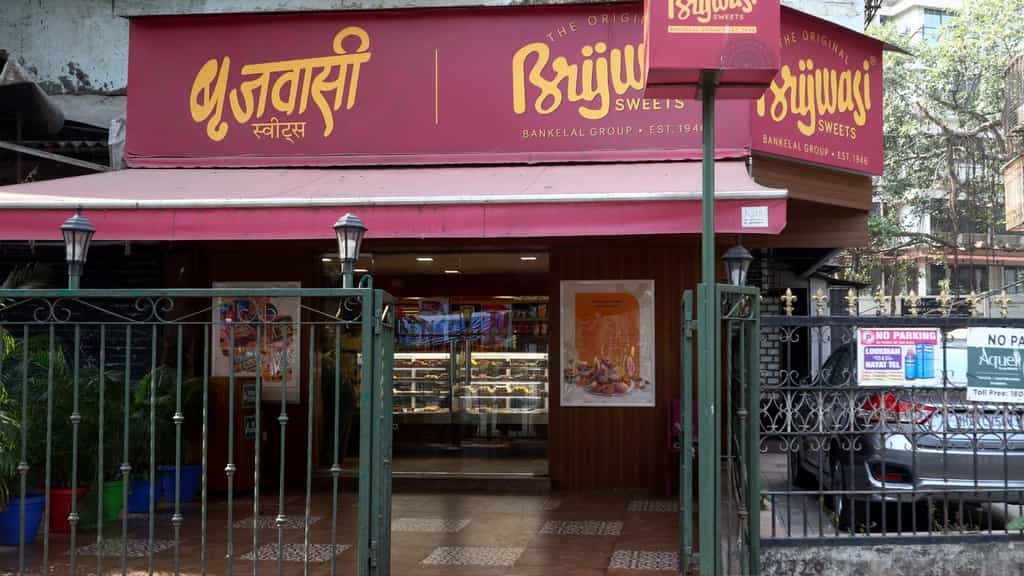
Back in the day, Brijwasi Sweets drew everyone from Raj Kapoor to Nargis, Sanjay Dutt, B.R. Chopra, and Dara Singh. “Raj Kapoor loved our motichoor ladoos and would come personally to buy them. Nargis loved rasmalai; she would sit in her car, and we’d send the order to her. Dara Singh would arrive with four men, buy a kilogram each, and eat a kilo at the counter while waiting for the rest to be packed,” recalled Mahendra Goyal, 73, the third-generation custodian of Brijwasi, who now runs the sweet empire with his sons, Pratik, 45, and Anuj, 40.
The Goyals trace their roots to Brij, Mathura, a sacred city in Uttar Pradesh. The family ran wholesale kirana stores for nearly a century, supplying eight Vallabhkul temples. Mahendra’s grandfather, Ramswaroop Goyal, came to Bombay in his early 40s seeking a golden dream. Accompanied by two of his three sons – Radharaman and Bankelal — he left the youngest, Ramniwas, at home under his wife’s care.
Kalbadevi, then a bustling hub, especially around the Cotton Exchange Building, was teeming with Gujarati and Marwari businessmen. The Goyals saw an opportunity: these businessmen were craving vegetarian, home-style food. On December 1, 1946, Brijwasi opened as a bhojanalaya offering unlimited thalis for 10 paise. “We cooked ourselves, offering pooris, aloo sabji, raita, and a traditional sweet like halwa or kheer,” recalled Anuj. Tables and chairs weren’t common; diners sat on mats with low seats called paats in front of them to keep the thalis.
Mahendra Goyal, 73, the third-generation custodian of Brijwasi, with his son Anuj, 40, outside the Brijwasi Sweets Worli store. (Express photos by Akash Patil)
A few years later, Bankelal travelled to Kolkata and discovered the magic of Bengali sweets, particularly rasgullas. He brought a karigar back to Bombay, and soon Brijwasi began selling Bengali sweets, including rasgullas and malai sandwiches. “We introduced Bengali sweets to Bombay,” Mahendra said. By the mid-1950s, they had purchased an adjacent shop, starting Brijwasi Dugdhalaya.
“We sold masala milk in bottles and about 140 bottles would go to RK Studios daily, along with sweets,” Mahendra shared. Rasgullas were packed in handis, and employees delivered 100-150 handis door-to-door by bicycle. If residents asked why, employees would simply reply, “Sahab ne bheje hai, aap dukan pe aake batana kaise hai” (The boss sent it, come and tell us what you think). This approach earned Brijwasi the nickname ‘Rasgulle wali dukan’. “That was my father’s salesmanship,” Mahendra laughed.
Pictured are some of Brijwasi’s most popular items, including rasmalai, motichoor ladoos, kaju katli, samosas, kachoris, dhokla and ghevar. (Express photos by Akash Patil)
Over the decades, Brijwasi expanded its offerings, from Bengali sweets to pedas, ladoos, barfi, and rasmalai, eventually adding dry fruit mithais and festive specials. “We became a specialty mithai store,” said Anuj. The period from the 1960s to the 1970s was one of rapid growth: Kalbadevi, Charni Road, Colaba, Breach Candy, Nepean Sea Road, Worli, Dadar, Bandra, Chembur, Andheri, and Mulund. By 1975, Brijwasi had about 30 outlets across the city. At the time, three names dominated Bombay’s mithai scene: Chandu Halwai, Ghasitaram, and Brijwasi.
The family brought in relatives from Mathura to manage the stores. “Even NRIs visiting Bombay would make it a point to go to Brijwasi,” Mahendra recalled, adding that he had read about trademarks in Class 12 and the idea stayed with him. “I tried convincing my family to register the brand, but they paid no heed. When I refused to give up, they told me to do as I pleased, and I registered it using my pocket money in 1979. Today, we’re reaping the benefits of that brand loyalty,” he added.
Anecdotes from the shop are plenty. Mahendra, who started coming to Brijwasi at the age of five, initially to eat rasgullas, but soon handling the cash counter, shared: “B.R. Chopra once offered my chacha a film role, which he declined, knowing the family wouldn’t approve. Pt. Jawaharlal Nehru’s aunt Vijay Laxmi Pandit was the Governor of Maharashtra, and our sweets were sent daily to the Governor House. Mahendra also recalls meeting former Prime Minister Atal Bihari and in the early 2000s alongside 50 other Bombay mithai shop owners over new excise duties.
Customers placing orders at Brijwasi Sweets. (Express photos by Akash Patil)
As with many family businesses, Brijwasi experienced a split in 1979. “The eldest brother, Radharaman, stepped away, leaving the reins to the younger brothers,” said Anuj. For the next four decades, Bankelal and his younger brother Ramniwas ran the business until 2017. Today, Bankelal’s son Mahendra Goyal retains the trademark and copyright, but there are many family members who continue to run sweet shops under the Brijwasi name.
“It can be confusing for customers,” admitted Anuj, who has professional experience in hospitality management and corporate sales. To distinguish the branches, they now brand their stores as ‘Brijwasi Sweets – The Original, Bankelal Group, Est. 1946’.
Modernisation has been a focus for the current generation. Staff training, digitised operations, a customer helpline, loyalty programmes, and early adoption of delivery platforms have all contributed to a consistent in-store experience. Despite these changes, the recipes remain true to the originals. “We continue to source the same ingredients, even though costs have risen. Our kesar still comes from Kashmir. Our milk comes from the same vendors for decades. You can taste the difference,” said Anuj.
Signature items remain crowd favourites: rasmalai, malai sandwiches, motichoor ladoos, kaju katli, and samosas.
Looking ahead, Brijwasi aims to double its presence from the current 11 stores to over 20 stores, combining physical outlets with delivery kitchens to reach more customers. “In five years, I hope to reach 50 stores,” Anuj said confidently.
Editorial Context & Insight
Original analysis & verification
Methodology
This article includes original analysis and synthesis from our editorial team, cross-referenced with primary sources to ensure depth and accuracy.
Primary Source
The Indian Express