



Key takeaways
- Aviation learned this the hard way.
- Every hour spent on the ground shrinks the output side of that equation while the cost side keeps running exactly as before.
- A GPU accrues cost by the calendar hour too, through financing, depreciation, power, and cooling, whether or not it's doing anything useful…
What happened
Aviation learned this the hard way. For most of the industry's history, the number that best predicted whether an airline would survive was how much of the day each aircraft spent on the ground. The reason is structural. An aircraft's costs accrue by the calendar hour: financing, depreciation, hull insurance, scheduled maintenance, crew contracts. Its revenue accrues only by the flight hour.
Six years later, that number reads more like a starting point than a ceiling. By 2026, even the best capitalized labs on the planet were treating compute access as a live strategic constraint rather than a settled one.
Anthropic alone was running simultaneous multi-gigawatt commitments across four separate hardware platforms, Amazon, Google, Microsoft, and AMD, layered within months of one another, while Meta signed a comparable multi-gigawatt deal of its own. Spreading commitments across four vendors at once is what compute scarcity looks like when a buyer has effectively unlimited capital and still can't get enough from any single source.
Six years apart, both events marked the frontier of what a lab needed just to stay competitive. What changed in between has less to do with AI getting more capable, and everything to do with capability no longer being the binding constraint. The same pattern shows up downstream of the labs, in a different form.
Enterprises consuming these models through an API run into a pricing problem more than a hardware one. Cost scales linearly with tokens used, and that single fact separates the economics of a proof of concept from the economics of production almost completely. A PoC processing a few thousand requests a month looks affordable. The same workload at production volume can turn into a cost line that never quite clears.
The alternative gaining ground is straightforward enough: enterprises acquiring their own GPUs and running models locally, trading a variable, linearly scaling cost for a fixed capital one. API cost rises with usage, while owned infrastructure stays close to fixed. Past the breakeven point, the trade reverses.
Why it matters
Every hour spent on the ground shrinks the output side of that equation while the cost side keeps running exactly as before. Utilization also sits downstream of almost everything else an airline does. Turnaround discipline, network design, maintenance planning, crew rostering, and spare parts availability all eventually show up in that one number, because a broken operation underneath it keeps planes on the ground no matter what else goes right.
A bigger fleet still helps. More aircraft means more available capacity, plainly and simply. But two airlines flying comparable fleets on comparable routes can end up with very different economics, and most of that gap traces back to one measurement rather than fleet size. Enterprise AI is running into the same structure, on a different piece of hardware.
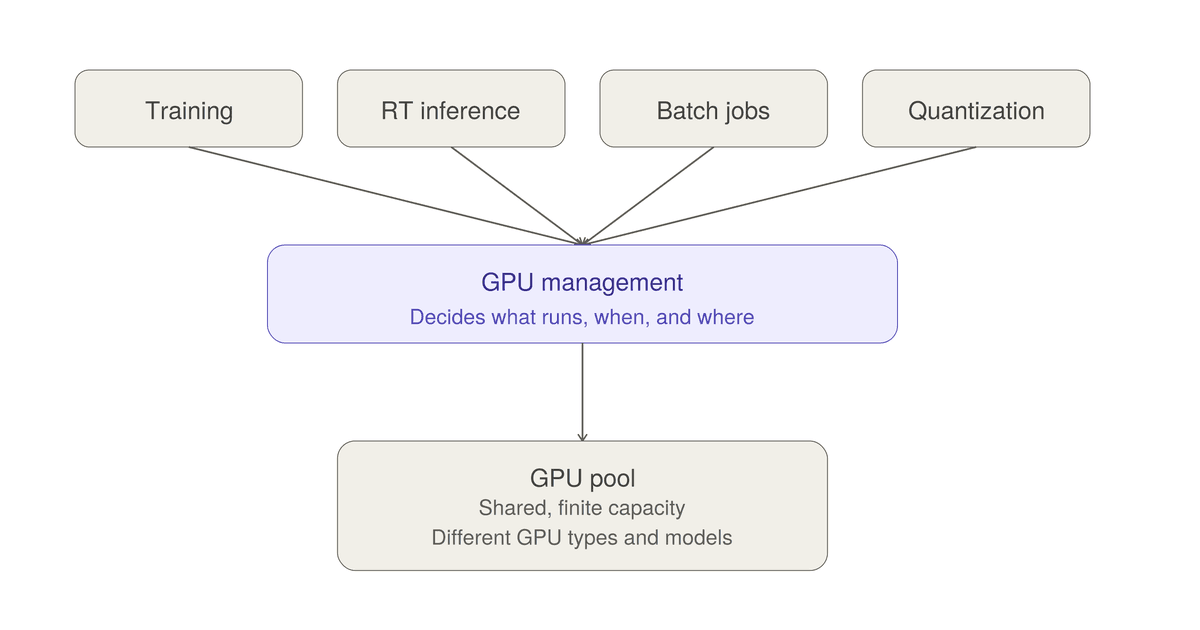
A GPU accrues cost by the calendar hour too, through financing, depreciation, power, and cooling, whether or not it's doing anything useful in a given moment. Its output only accrues by the compute hour. More GPUs helps in roughly the way a bigger fleet helps an airline: real capacity, a genuine advantage, and still no guarantee of the result that actually decides who wins.
Two companies with comparable GPU budgets increasingly diverge based on how much of that hardware is doing something useful at any given moment, not on how much of it either one owns. That same number, like an airline's utilization rate, sits downstream of nearly every other infrastructure decision a company makes. Intelligence has carried the industry this far. Utilization is where the next real constraint is forming.
The scarcity didn't disappear as AI scaled. It moved up the chain, landing on a different resource entirely. The first wave of enterprise AI was won on model quality. Bigger models, trained on more compute, evaluated against tougher benchmarks: parameter count and leaderboard position dominated the conversation, and the race produced models genuinely good enough to run real enterprise workloads. That capability arrives bundled with a dependency, though.
Production AI runs on specialized hardware, and today that hardware is almost entirely GPUs. GPUs are expensive, supply constrained, and in demand far beyond what's available, and this holds even at the very top of the market.
In 2020, Microsoft built OpenAI a dedicated supercomputer: over 10,000 GPUs and 285,000 CPU cores, reported at the time as one of the five largest systems in the world, assembled to train what became GPT-3. At the time, it looked like an almost unimaginable concentration of hardware, the kind of number that made compute look like a solved problem for whoever could get access to it.
What to watch
That shift turns the GPU into infrastructure rather than a line item, sized for growth, sized for demand peaks, and therefore sized above what any given week actually needs. Which means the purchase doesn't close the problem. It opens a new one.
The day the cluster comes online, the question stops being can we get accelerators and becomes can we keep them busy, and only the first question had a procurement team assigned to it. Signing for the hardware is the part with a deadline and an owner. Keeping it off the ground is the part that quietly decides whether the deal was worth signing. These deals describe capacity commitments, not efficiency.