On Saturday, the Congress party handed over a letter from Anandan Nambiar, an 85-year-old voter from Taliparamba in Kannur district, to the Chief Electoral Officer (Kerala) Rathan U. Kelkar. Originally addressed to the Electoral Registration Officer (Taliparamba), it reads: “Sir, as I was not at home when the enumeration form for the Special Intensive Revision (SIR), I was included in the Absent/Shifted/Dead (ASD) list as ‘Form Rejected.’ I request you to include me, who is in the existing voters’ list of Booth 154, in the draft electoral roll and not deny me my right to vote.” The former Indian Railways employee adds that his name does not figure on the 2002 SIR rolls as he was posted in Odisha at the time. ‘Family mapping’ too is impossible in his case as both his parents had died before 2002.
Nambiar’s is a not an isolated case. On December 20, Rajaji Mathew Thomas, a former CPI legislator, created a flutter when he stood up and complained at a weekly political party meeting on SIR chaired by the CEO (Kerala) that he and his wife Shantha had been left out of the electoral roll. Political parties highlighted it as one more example of the flaws in the SIR exercise in Kerala.
After the Election Commission of India (EC) published the draft roll on December 23, Thomas found that his name figures ion it, but his wife is still left out!
“The names of both my parents were on the 2002 list, but not mine. After I raised the issue at the December 20 meeting, my name has now been included on the draft rolls. But my wife’s name remains excluded. She has been a regular voter since 1991, and she has also voted in the just-concluded local body polls,” says Thomas.
The names of Thiruvalla MLA Mathew T. Thomas and Raman Srivastava, a former State Police Chief, both of whom have been continuously residing in the State and enrolled as voters for long, were also missing on the draft list, according to the Kerala government.
Srivastava says he has not yet checked the draft roll but points out that he has been casting his vote in every election. “I have an election ID card issued in 1997 and a new one subsequently issued. From 1986 onwards, I have been voting in a booth at the UP School in Kulasekharam in Thiruvananthapuram. But I was not here from October 1999 to October 2004. So, my name apparently is not on the 2002 list. But I have been voting in all the subsequent elections. My name should have been there somewhere,” argues Srivastava.
A whopping 24.08 lakh voters, which accounts for 8.65% of the electorate, stand deleted from the draft rolls published on December 23 at the conclusion of the house-to-house enumeration phase of the Kerala SIR. This has caught the political parties as well as the voters off guard. Of these, 6,49,885 were identified as dead, while 1,36,029 were ‘duplicate names.’
But the ‘untraceable/absent’ (6,45,548 names), the ‘permanently shifted’ (8,16,221 names), and the ‘others’ category have garnered much attention. As many as 1,60,830 voters have reportedly refused to accept or return the enumeration forms. These five categories together form the ‘uncollectables’ in EC parlance.
For instance, two polling stations at St. Teresa’s Higher Secondary School in the Ernakulam Assembly constituency Pattom Thanu Pillai Memorial Upper Primary School in the Thiruvananthapuram constituency, separated by a distance of over 200 km, have a high number of ‘missing’ voters.
As of December 23, the booth in Ernakulam has 382 entries on the ASD list, and the one in the State capital has a whopping 538 entries.
A few of these voters are either dead or have moved out permanently. However, a vast majority of them are listed as ‘untraceable/absent.’ The numbers may appear small. Yet, they are significant as the voter population of a polling station is now limited to 1,200 voters.
While officials engaged in the revision process maintain that the phenomenon is largely confined to Kerala’s urban areas, political parties are racking their brains, trying to assess the accuracy of the draft electoral rolls and the updated ASD list published by the EC.
Enumeration forms were distributed to 2,78,50,855 voters during the house-to-house campaign. Yet, the draft rolls have only 2,54,42,352 voters. This has made comparisons with the electoral rolls maintained by the State Election Commission (SEC), which manages the elections to the local bodies, inevitable.
For the December 2025 elections to the local bodies, the SEC list had 2,86,05,525 voters in all, 31.63 lakh voters more than the draft rolls now published by the EC.
Political parties maintain that many of the missing voters are alive and have been regular voters, and it would be unfair to ask them to enroll as new voters. They also allege that enumeration forms have remained undistributed in many places.
“We are in the process of assessing the EC’s draft rolls. We are sure that at least 40% of the people on the ASD list are still in Kerala,” says M.K. Rahman, a senior Congress leader who represents the party in the review meetings of CEO (Kerala). Rahman has been keenly contesting the EC’s claims regarding the numbers in the ‘untraceable,’ ‘permanently shifted,’ and ‘others’ categories.
M.V. Jayarajan, a senior leader of the Communist Party of India (Marxist), echoes these concerns. “It is now evident that what the political parties have been saying is true. Only 2.54 crore of the 2.78 crore voters in the electoral rolls as on October 27, 2025, have found a place on the draft rolls. Around 19.32 lakh voters on the draft rolls are on the ‘unmapped’ list. Their names could not be linked (mapped) to the 2002 SIR rolls. These voters would be issued notices to produce documents and establish their identity,” says Jayarajan.
The EC’s decision to go ahead with the SIR had sparked concern in Kerala. Apart from their ideological and political objections to the SIR, political parties drew attention to practical issues involved in the process. Moreover, ensuring that Kerala’s large expatriate population, exceeding 30 lakh, is not left out posed a stiff challenge. Political parties’ demand that the SIR be postponed in view of the local body elections in Kerala was not accepted by the EC.
On September 29, the Kerala Assembly passed a unanimous resolution urging the EC to desist from actions that could “potentially harm the people’s rights.” The resolution also raised concerns about the timing of the process, as it coincided with the local body polls. The decision to use the 2002 SIR roll as the base document and the eligibility conditions prescribed for voters also invited opposition from political parties.
The alleged work pressure and ‘deadline anxiety’ faced by the booth-level officers (BLOs), who distributed and collected the enumeration forms to voters and uploaded the data online, came into sharp focus following the suicide of Aneesh George, a BLO in Payyannur, Kannur district. The BLOs struck work and took out protest marches on November 17.
By then, the demand for extending the SIR deadlines had become louder. With the SEC going ahead with its plans for holding the local body elections in December, political parties informed the EC that the government machinery and their booth-level agents would be tied up with the electoral process. Moreover, the SEC was in the process of updating its own electoral rolls through enrolment campaigns. All in all, the operational overlap with the local body polls would confuse the public, eventually affecting the quality of SIR, the parties alleged.
Subsequently, the Kerala government, the CPI(M), and the Indian Union Muslim League (IUML) moved the Supreme Court seeking an extension of the deadline.
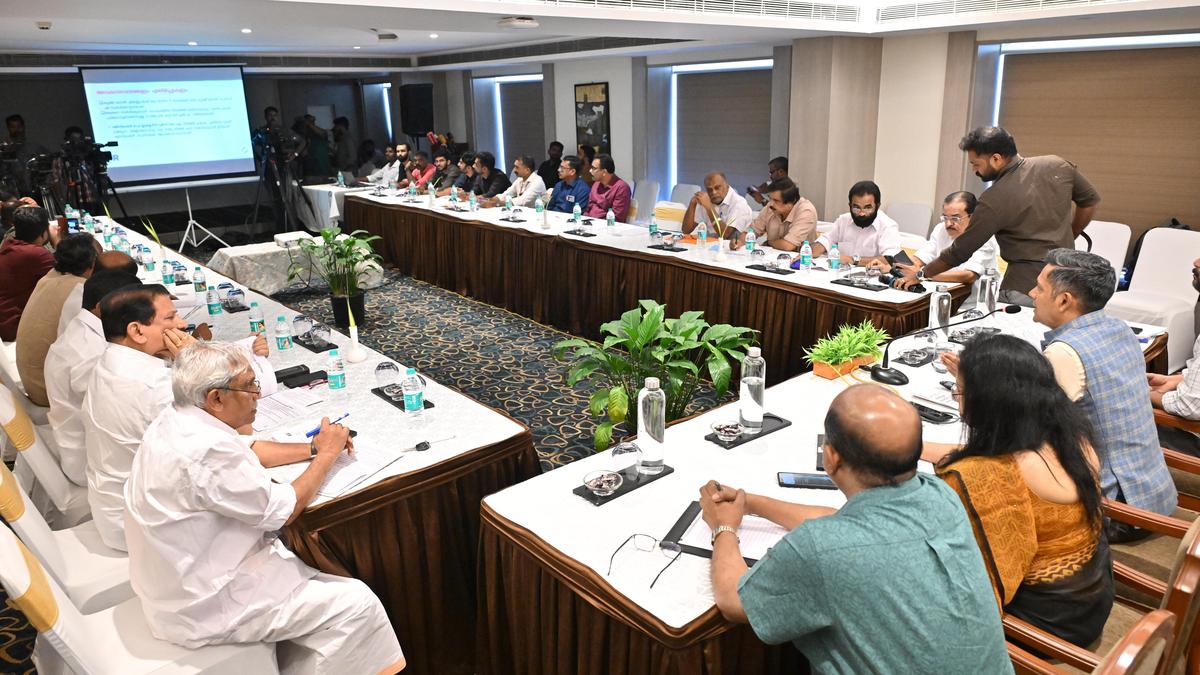
Kelkar has been holding weekly meetings with political parties for updating them about the process and its progress. The media is allowed access to these meetings, and press releases on the process are being issued regularly. Special camps were also organised across the State for collecting the filled-up forms and digitising the data. The ASD list is also published in advance to allow party workers to help trace the missing voters. “Our mandate is to include all eligible voters on the rolls and exclude ineligible voters. But we have tried to take the process forward by making it more participatory,” says Kelkar. Voters can be enrolled until the last day of the filing of nominations for the 2026 Assembly elections, he assures.
The claims and objections to the draft list can be filed till January 22, and the hearing/verification phase ends on February 14. The final electoral roll is scheduled to be published on February 21, say officials.
On December 19, Chief Minister Pinarayi Vijayan urged the EC to re-examine the SIR process and avoid undue haste, while suggesting that voters should not be omitted on technicalities. In a formal letter from the Chief Secretary of Kerala, A. Jayathilak, to Chief Election Commissioner Gyanesh Kumar, the Kerala government listed the flaws in the exercise and sought an extension of at least two weeks for the submission of enumeration forms.
Though the State government highlighted the cases of Mathew T. Thomas, Rajaji Thomas, and Srivastava as specific instances of even high-profile citizens being left out from the list, and sought extension of time for the completion of the process, the plea was turned down.
Now, lakhs of voters, who have found themselves removed from the list, face the arduous task of queuing up before the designated officials to get themselves enrolled as new voters.