



Key takeaways
- Offline top-100 logit caching allows student models to train without holding the teacher model in VRAM.
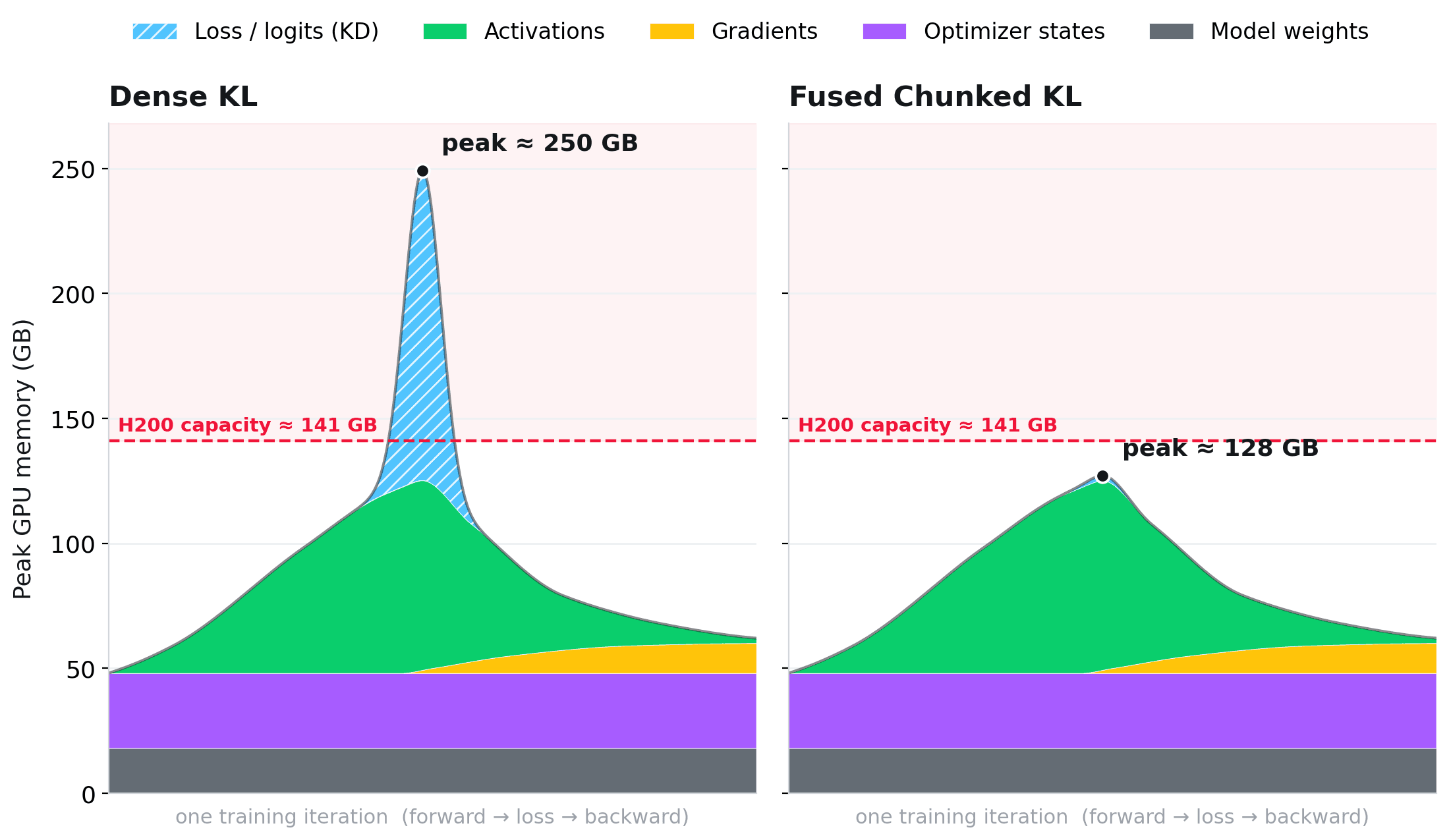
- A fused chunked KL loss processes data in slices, cutting peak memory from 250GB down to 128GB on an H200 GPU.
- The open-sourced method achieves identical loss to online distillation while enabling single-GPU execution.
What happened
A team of researchers has introduced a novel system setup for Large Language Model (LLM) knowledge distillation that significantly mitigates hardware memory bottlenecks. Knowledge distillation transfers capabilities from massive teacher models to smaller, faster student models, but standard online approaches require loading both networks simultaneously.
By precomputing and caching only the top-100 teacher logits per token position once, the original teacher model can be completely removed from memory during subsequent student training runs.
To tackle additional memory spikes caused by standard Kullback-Leibler (KL) divergence calculations, the researchers developed a fused chunked KL loss implementation. Rather than materializing a massive intermediate matrix spanning the full vocabulary size and sequence length—which can easily demand upwards of 250GB of VRAM for models with large vocabularies—the algorithm processes sequence data in smaller, memory-efficient slices. This chunking strategy prevents massive allocation spikes while remaining mathematically equivalent to full dense KL loss.
In benchmarks conducted on a single NVIDIA H200 GPU using Llama 3.1 8B Instruct as a teacher and a 3.2B Llama variant as a student, the chunked offline setup achieved training loss curves nearly identical to conventional online distillation. The research team has open-sourced their custom loss implementation on GitHub to encourage widespread adoption across the machine learning community.
Why it matters
As open-source frontier models expand into multi-trillion parameter architectures requiring terabytes of VRAM just to load weights, model compression has shifted from an optimization luxury to an operational necessity. Knowledge distillation traditionally forms the most capital-intensive phase of model compression, restricting effective distillation to organizations with massive GPU clusters capable of orchestrating complex tensor parallelism.
By lowering peak memory usage from over 250GB to roughly 128GB during long-context training, this technique democratizes advanced model compression by enabling execution on a single high-end accelerator. AI engineering teams can now conduct extensive hyperparameter ablations, long-context adaptation, and domain-specific post-training without relying on multi-node hardware infrastructure.
What to watch
Expect major open-source training frameworks like PyTorch, Megatron-Bridge, and Hugging Face libraries to evaluate and integrate chunked KL loss kernels directly into their core pipelines. As input context windows expand past 32K tokens in production applications, memory-efficient loss kernels will become crucial for preventing out-of-memory errors. Furthermore, monitor how enterprise fine-tuning teams leverage offline logit caching to economically generate lightweight domain-specific student models from large foundation baselines.