

Key takeaways
- Google Analytics introduces Gemini-driven AI Overviews and custom alerts to summarize performance shifts instantly.
- Google Ads features new AI insight cards and a prompt-based generator for custom competitive analyses.
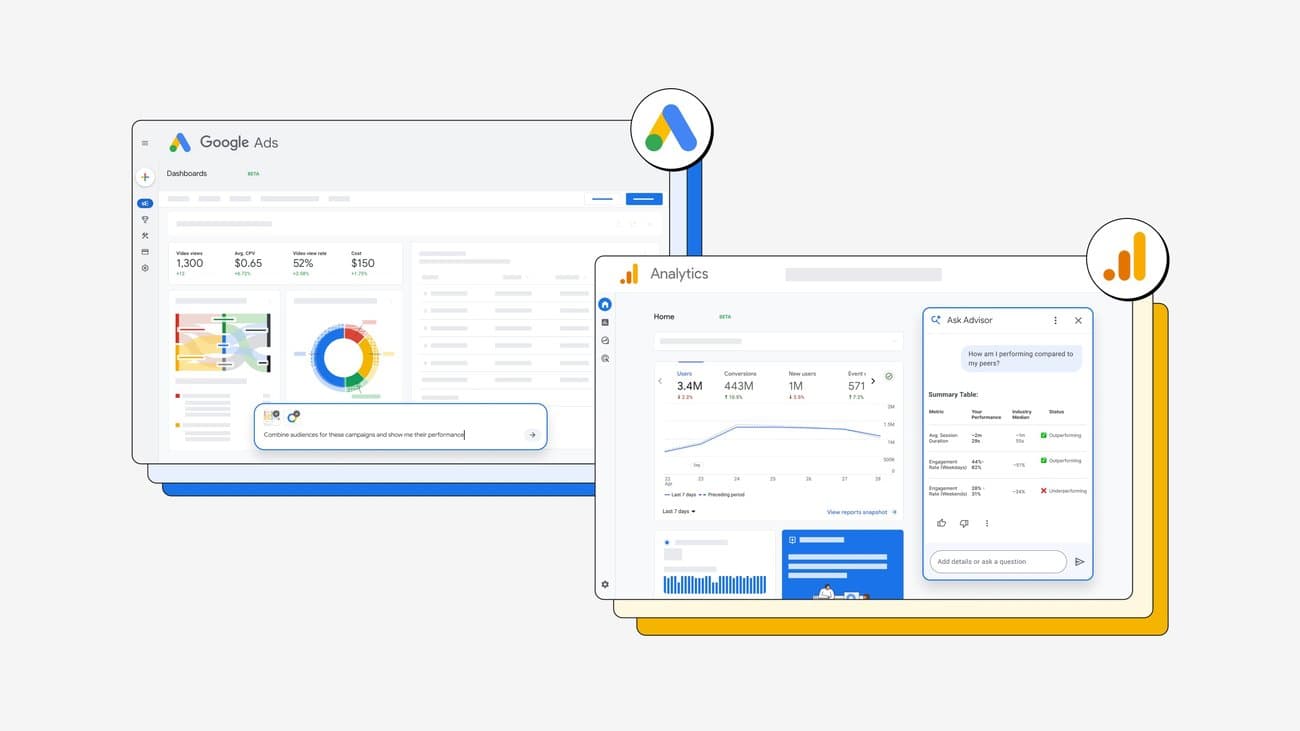
- Google Analytics adds an Ask Advisor benchmarking tool to evaluate campaigns against industry averages.
What happened
Google announced a series of generative AI updates across its primary marketing platforms, Google Analytics and Google Ads. Built using its proprietary Gemini model family, these capabilities aim to help data analysts and digital marketers detect performance anomalies, assess competitive dynamics, and adjust campaign strategies rapidly without requiring extensive manual data extraction.
Key updates in Google Analytics include AI Overviews directly on the user homepage, delivering dynamic summaries of changes in website traffic, sales velocity, and seasonal conversions since the user's previous session. Users can configure customized email or phone notifications to track updates asynchronously at chosen intervals.
Furthermore, the platform seamlessly carries this context straight into Ask Advisor, a conversational interface that now features anonymized peer benchmarking to compare campaign outcomes against aggregate industry standards.
Concurrently, Google Ads has redesigned its central dashboard to surface personalized, AI-powered insight cards tailored to specific business operations. A new interactive prompt box enables advertisers to generate custom analytical reports on competitive impression share and emergent market trends, empowering teams to confidently translate automated recommendations into immediate campaign strategy adjustments.
Why it matters
For enterprise marketing and business intelligence teams, the deep integration of frontier models like Gemini into daily operational dashboards signals a transition from static reporting to active decision support. Historically, identifying critical performance shifts required tedious data slicing across disconnected dimensions, frequently resulting in delayed responses to sudden market shifts.
Automated natural language overviews dramatically reduce the latency between anomaly detection and strategy execution, enabling marketers to capture emerging customer demand in real time.
Furthermore, introducing peer benchmarking into conversational AI interfaces significantly lowers the barrier to sophisticated competitive research. Organizations of all sizes can now receive automated directional guidance and comparative metrics that were previously accessible only to enterprises with dedicated data science capabilities, effectively raising the baseline standards for enterprise SaaS platforms.
What to watch
As Google continues to embed Gemini capabilities across its advertising and analytics stack, industry observers should monitor how competing martech platforms respond to these streamlined workflows. Critical success factors will hinge on the precision of generated insights, the mitigation of model hallucinations, and enterprise trust in automated guidance.
Moving forward, the key development to track is whether Google will expand these capabilities from decision support to fully autonomous campaign management, enabling AI agents to execute media buying adjustments automatically.