NEW DELHI: At first, Rahemath Pasha thought it was fireworks. The 37-year-old Uber driver from Hyderabad was waiting for his ride near Sydney’s famous Bondi Beach on the evening of December 14 when he heard loud bursts followed by screams.
Bondi, usually a place of celebration and families enjoying Sydney’s relaxed seaside life, had suddenly turned violent.For a moment, he told himself it was panic—that something minor had gone wrong and fear was spreading faster than facts. Then he saw people running. “I saw a man walking forward, firing,” he recalled.
Rahemath was about 400 metres from the gunmen, a radicalised and armed father-son duo when they opened fire at a Hanukkah (an eight-day Jewish festival) celebration attended by nearly a thousand Jewish people.“Then I saw people screaming and dropping to the ground,” he told TOI. Rahemath had never seen a gun fired in real life. This was a mass shooting.Mass shootings are rare in Australia, which has some of the world’s strictest gun laws. The country, seen as a world leader in gun reform, had tightened firearm regulations after the 1996 Port Arthur massacre, in which 35 people were killed.This is largely being considered Australia's worst terrorist attack in decades.
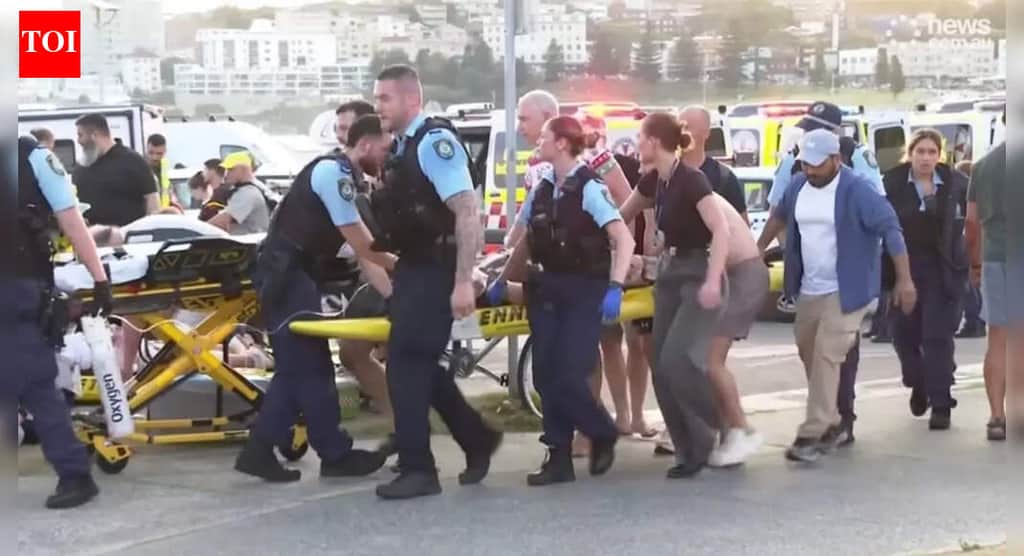
Most people ran. Rahemath could not.He doesn’t remember making a decision. “There was an elderly woman waving for help,” he said. Close to 90, the elderly woman was waving desperately for help. She had been shot in the leg. The bullet had passed through one leg and into the other, leaving her immobile. “She was very frail,” Rahemath says. “If it had been me, I could have managed. But she couldn’t. I couldn’t shake the feeling.”As others scrambled for cover, Rahemath moved toward the scene.“I was terrified,” he says. “This was the first time in my life I had seen something like this. It felt like a movie scene. Blood, bodies, running people. Except people were actually dying.”What stopped him from fleeing was not bravery, he insists, but the sight of those who could not move. “I saw people who were frozen, bleeding, not knowing where to go,” he said.He held this elderly lady’s hand, whispering reassurances as lifeguards turned surfboards into makeshift stretchers. She held on tightly. For 45 minutes, she did not let go. “She told me, she was only sitting on the bench singing songs…she kept saying that she had done nothing wrong, for this to have happened to her,” he recalled.When she was finally taken into an ambulance, she smiled at him and blessed him. Rahemath remembers that smile.
He remembers very little else. “It felt like a mother’s embrace,” he said. “I hope she survived, I am still trying to find out,” he added.Over the next several hours, Rahemath helped more than a dozen people. He guided the injured, sat with those in shock, and assisted police and emergency responders. At one point, he held the hand of a middle-aged man who could not speak. Within minutes, the man lost consciousness and died.
“He just went quiet, right in my arms,” Rahemath recalls, with a long pause in the end.Later, authorities would describe the attack as an act of terrorism motivated by the Islamic State ideology. Fifteen people were killed, including a child, and dozens were injured.Sydney's Bondi beach, designed for leisure, became a site that saw good samaritans like Rahemath lifting the dead and the almost-dead.Like others at the scene, Rahemath too was unarmed and unprepared for a sudden outbreak of deadly violence.
“I am not a doctor, nor do I have any such prior training” Rahemath says. “But at that moment, leaving did not feel like an option.”So he focused on small things. Helping someone stand. Pointing people away from danger. Staying with those who couldn’t yet process what was happening.Around him, bare-chested men in board shorts, officers in bulletproof vests, paramedics, and tourists in holiday clothes formed a procession, as he spent his evening guiding the injured, sitting with those in shock, assisting police and emergency responders.By the time the area was secured and the injured taken away, it was close to midnight. More than five hours had passed.Rahemath had not noticed the time.Only when the noise faded did his body begin to react. “I started shivering,” he says. “That’s when it hit me.” A local journalist at the scene noticed him shaking, sat him down, gave him water and stayed with him until his breathing slowed, he said.Rahemath has lived in Australia since 2019 for his commercial chef course.
He drives Uber mostly to support his family while he hunts for a chef job. His parents, wife and two young children live in India.His parents in Hyderabad saw his images on TV before they heard from him. “They couldn’t believe it was me,” he says. “They were watching the Bondi news and suddenly I was there on the screen.”“They were very scared. I was trying to calm them while I myself was still shaking.”Asked if his faith influenced his response, Rahemath, a Muslim, pauses.
“I believe in humanity first,” he says. “Caste, creed, religion. None of that matters at that moment. Even Islam teaches this. If you save one life, you save all of humankind.” He does not want his actions framed as symbolic. “This should not be about breaking stereotypes,” he says. “This is just what a human being should do.”Three days later, on 17 December, Rahemath returned to Bondi Beach for a memorial. He placed yellow and white Chrysanthemums among hundreds of others and stood there quietly.December 14, 2025, will be hard for him to forget. Sleep has been difficult since.The images return without warning. The screams. The silence between shots.“Sometimes I think—what if something had happened to me? What about my children?” he says. Yet, asked if he would act differently if faced with the same moment again, Rahemath pauses only briefly.Would he run if it happened again?“If someone needs help and you are there, you help.”As Sydney recovers with vigils on the beach, candlelight gatherings, and a fresh nationwide debate on gun reform, Rahemath returns to his Uber shifts and job hunt for his children’s better future.
Editorial Context & Insight
Original analysis & verification
Methodology
This article includes original analysis and synthesis from our editorial team, cross-referenced with primary sources to ensure depth and accuracy.
Primary Source
Times of India