

Key takeaways
- Nowhere is the US data center boom bigger than in Texas.
- ” As an independent system operator, ERCOT oversees a power grid that operates separately from the rest of the United States and provides…
- That puts the state on track to surpass Virginia in becoming the largest US data center market.
What happened
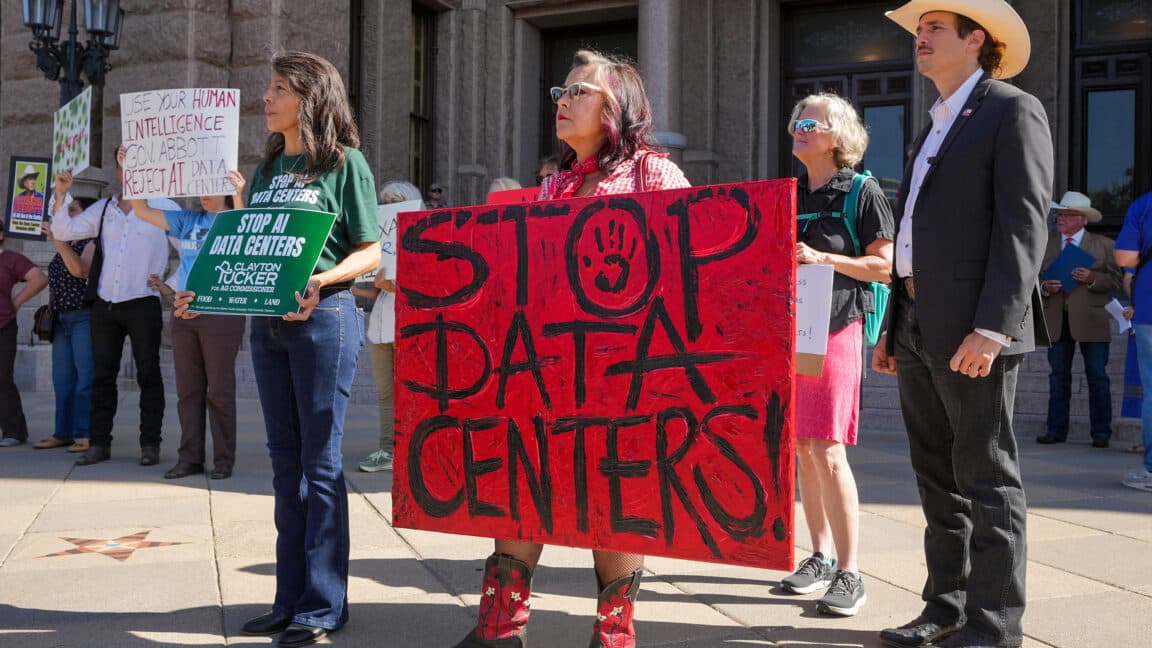
Nowhere is the US data center boom bigger than in Texas. But less than a year after declaring Texas the “epicenter of AI development,” Governor Greg Abbott has declared a moratorium on all new power grid connections for data centers—at least until developers provide more information about their projects’ potential impacts on the grid and communities.
However, the governor’s directive does not mention the fact that data centers often use much more water through their power generation sources than directly through their cooling systems—a fact highlighted by researchers like Shaolei Ren at the University of California, Riverside. Texas communities like Corpus Christi have already been grappling with a yearslong drought.
But their water woes have been compounded by both climate change and large energy and chemical companies’ operations that have “sucked the region dry,” according to San Antonio News. A Sierra Club report looking at federal data showed how Texas natural gas plants used 56 billion gallons of water in 2024, while coal plants consumed an additional 34 billion gallons, and nuclear plants used 26 billion gallons.
By comparison, Texas data centers directly used 8 billion gallons of water for cooling purposes, but many such data centers rely on water-intensive power generation sources. ” But the directive conspicuously neglects to mention local air pollution and greenhouse gas emissions associated with data centers.
Why it matters
” As an independent system operator, ERCOT oversees a power grid that operates separately from the rest of the United States and provides services to most of Texas. Texas has aggressively courted data center development with its availability of cheap land and relatively abundant energy resources, along with offering state incentives, like tax breaks and fewer regulations.
That puts the state on track to surpass Virginia in becoming the largest US data center market. But the recent AI boom and the accompanying frenzy of data center development threaten to overwhelm the Texas grid on paper, despite the state leading the country in adding new power generation.
The ERCOT interconnection queue currently includes more than 1,800 projects representing over 474 gigawatts’ worth of requests to connect to the Texas grid—more than five times Texas’ record peak electricity demand—and about 90 percent of those power connection requests come from data centers. “That unprecedented load growth could endanger the reliability and stability of the Texas electric grid,” according to the statement from Abbott’s office.
Many of those data center projects may never materialize for various reasons. But ERCOT has still forecast that data center demand and other factors could drive statewide electricity demand to double the current demand record by 2032, according to The Texas Tribune. The AI boom has led to additional consequences for Texas. 2 billion in sales tax revenue over the next two years.
The new directive from Abbott requires audits of data center projects that include how much data centers would depend on the ERCOT grid for power, along with obtaining projections of data centers’ annual and peak electricity consumption. The directive further requires information on how much individual data center projects depend on state financial assistance, along with details on each data center project’s ownership and controlling interests.
Abbott also directed state regulators and grid operators to discover the extent to which data centers’ cooling systems and water usage may draw upon local water supplies needed by local communities.
What to watch
Nonprofit newsroom Floodlight has reported that AI companies used a local permit loophole in Texas to install gas-powered turbines and backup diesel generators on site at new data center campuses—all without requiring more extensive environmental reviews or outreach to local communities.
Notably, the Texas pause on data center grid connections does not apply to data center projects that are building their own on-site power generation to get up and running as fast as possible. That “behind-the-meter power” strategy has become increasingly common among tech and AI companies like Meta, Microsoft, Amazon, Oracle, OpenAI, and Anthropic, according to research by market intelligence platform CleanView. Such behind-the-meter power typically relies on natural gas.