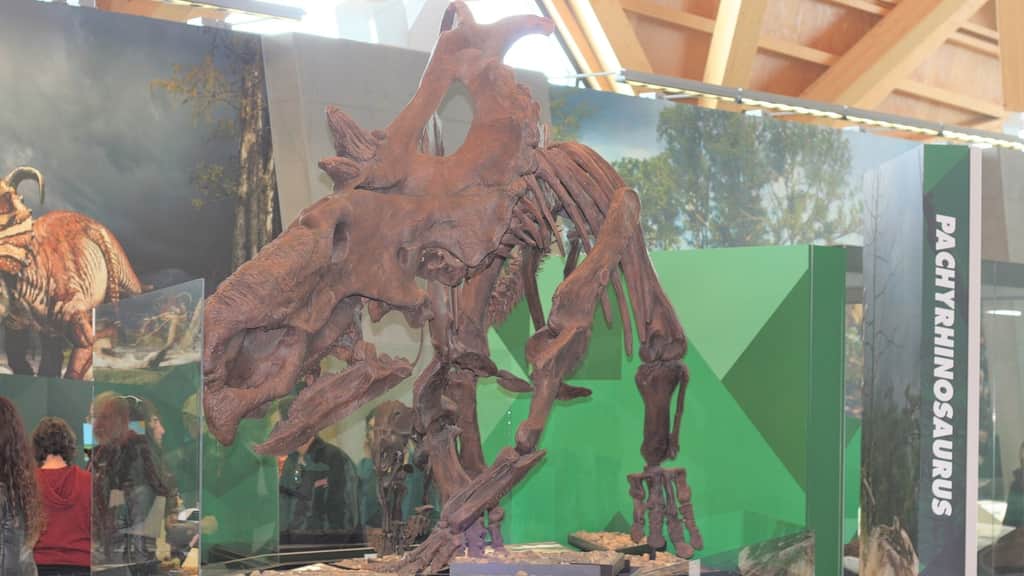
Explore Pipestone Creek bone bed in Alberta—home to tens of thousands of Pachyrhinosaurus fossils. (Source: Wikimedia Commons)
As you wander through an old forest in Alberta, Canada, you’ll probably be soaking in the greenery and the sights, but what you won’t realise is that underneath your feet, the ground is carpeted with dinosaur bones. Welcome to Pipestone Creek bone bed, one of the densest dinosaur fossil sites ever discovered.
Nestled near Wembley in northern Alberta, the bone bed lies within the Pipestone Creek area, part of the Wapiti Formation. It was first found in 1974 by local science teacher Al Lakusta, who spotted a ledge littered with fossils along the creek’s banks. That discovery led to decades of excavation, mainly by the Royal Tyrrell Museum in the late 1980s, with ongoing digs today by the Philip J. Currie Dinosaur Museum.
What makes this spot extraordinary is its scale and uniformity. The entire bone bed consists of fossils from a single species: Pachyrhinosaurus lakustai, a horned dinosaur also called the “boss-nosed lizard.”
“There are upwards of 10,000 individuals preserved here,” Prof Emily Bamforth, a palaeontologist and curator at the Philip. J Currie Dinosaur Museum in Alberta told Science Focus. “It’s one of the densest bone beds in North America – we’re talking 100 to 300 bones per square metre, and the site stretches back into the hill for at least a square kilometre. It’s a hugely dense bone bed that is very, very large – and that makes it tremendously significant.”
Researchers like Bamforth believe a catastrophic flood, perhaps from monsoon rains or a storm surge, swept the herd into the creek channel, drowning the entire group at once, 72 million years ago (File photo)
This ceratopsian, a distant cousin of Triceratops, was about 6–8 metres long and weighed around 2–4 tonnes. Instead of a nose horn, Pachyrhinosaurus had a big bony boss on its snout, a flattened, thickened pad. Livestock ornamentation varied, possibly helping individuals recognise each other.
Fossils span all ages, adults to babies, suggesting these dinosaurs formed tight-knit “megaherds.” Their numbers are likened to huge caribou groups.
Researchers like Bamforth believe a catastrophic flood, perhaps from monsoon rains or a storm surge, swept the herd into the creek channel, drowning the entire group at once, 72 million years ago. This sudden burial, capturing creatures of all ages, created the extraordinary fossil mix preserved today.
Post-flood, scavengers like Albertosaurus picked through the remains, leaving tell-tale bite marks.
New technologies, like 3D scans and DNA analysis, are helping researchers dig deeper into life 70 million years ago.
Just 19 km from the site, the Philip J. Currie Dinosaur Museum in Wembley hosts fossil tours, digs, and even public excavations at Pipestone Creek. Visitors can follow fossil trails, join guided hikes, and experience hands-on paleontology programs designed to connect people to ancient worlds.
Editorial Context & Insight
Original analysis & verification
Methodology
This article includes original analysis and synthesis from our editorial team, cross-referenced with primary sources to ensure depth and accuracy.
Primary Source
The Indian Express