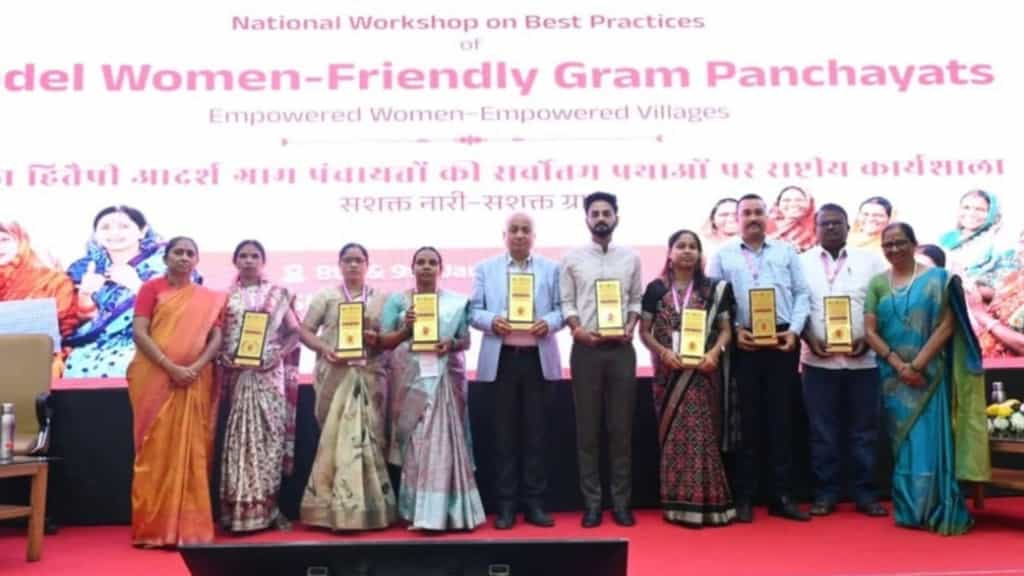
Empowering women at the grassroots has become a key focus in strengthening local governance across the country. From participating in decision-making to leading development initiatives, women are increasingly shaping the way villages grow and thrive. To share experiences that showcase best practices, and train local representatives, a two-day national workshop on Model Women Friendly Gram Panchayats was organized by Ministry of Panchayati Raj at Yashwantrao Chavan Academy of Development (YASHADA ) on January 8 and 9.
In this workshop, Arjuni village set an example with equal pay for equal work and emerged as model women-friendly gram panchayat. In Arjuni village of Kagal taluka in Kolhapur district, a quiet but powerful change is reshaping rural life for women. In a region where agriculture is the primary occupation, women have traditionally worked long hours in the fields but earned less than men for the same labour. Challenging this long-standing inequality, the gram panchayat of Arjuni has taken a historic step by formally implementing the principle of equal pay for equal work, making it a model women-friendly gram panchayat.
The decision was collectively passed in the village gram sabha, where members acknowledged that women and men often perform identical agricultural tasks from sowing and weeding to harvesting, yet women were routinely paid lower wages. The resolution mandated that whenever men and women work together and perform the same work, they must be paid equal wages. More importantly, the decision was not limited to paper. The gram panchayat ensured strict implementation across agricultural activities within its jurisdiction.
“For years, women accepted lower wages as a norm. This resolution has restored a sense of dignity to their labour,” said Pravinsinh Prakash Sulkude, gram panchayat officer.
Women workers say the change has brought not just financial relief, but also confidence and recognition. “Now women’s work is valued equally. It motivates them to work with pride,” said Bapu Rama Yadav, sarpanch of Arjuni village.
Another model gram panchayat is Narada Gram Panchayat in Bhadrak district, Odisha, where women have become the driving force for local economic growth through inclusive and participatory governance. Recognising women as key economic contributors, the panchayat has strengthened livelihoods through 113 women Self Help Groups, engaging over 1,100 women in activities such as animal husbandry, poultry, mushroom cultivation, fisheries, dairying and handicraft. Continuous skill training, access to institutional credit and convergence with government schemes have boosted entrepreneurship. With women also adopting digital platforms to access markets, Narada Gram Panchayat has emerged as a model for sustainable, women-led rural development.
Parule Bazar Gram Panchayat, located in Vengurla taluka, Sindhudurg district of Maharashtra, is an ideal village panchayat nestled in the lap of nature. To enhance women’s dignity and self-respect, the gram panchayat has facilitated the construction of individual household toilets and installed sanitary pad vending machines at various locations in the village. Regular health check-ups are conducted for women and adolescent girls, and continuous efforts are underway to make the village anaemia-free. For wastewater management, greywater treatment projects have been established at multiple sites, along with compost pits and vermicomposting units for solid waste management.
To ensure the productive use of waste generated from coconut, a project worth approximately Rs 1 crore, the Yesu Akka Kathya Industry has been set up with the support of the gram panchayat and the Coir Board and is operated by women’s self-help groups. Products such as cocopeat, kathya, ropes, mats, and decorative items are manufactured under this initiative. After meeting all expenses, women’s self-help groups earn a stable monthly income, and nearly 90% of the village’s women have become self-reliant through the Kathya industry.
Shanmukha Srinivas Pinnapareddy, a panchayat development officer of Davuluru grama panchayat Andhra Pradesh said, “The biggest challenge for us is solid waste management due to rapid urbanisation. We need village level thermal plants to reduce carbonisation. We rejuvenated 100 years old pond under Azadi ka Amrit Sarovar by using NREGA convergence programme. And also proposed to laid walking track around pond. Sent a proposal to create a Miyawaki model biodiversity ecosystem around the pond in our village.”
Editorial Context & Insight
Original analysis & verification
Methodology
This article includes original analysis and synthesis from our editorial team, cross-referenced with primary sources to ensure depth and accuracy.
Primary Source
The Indian Express