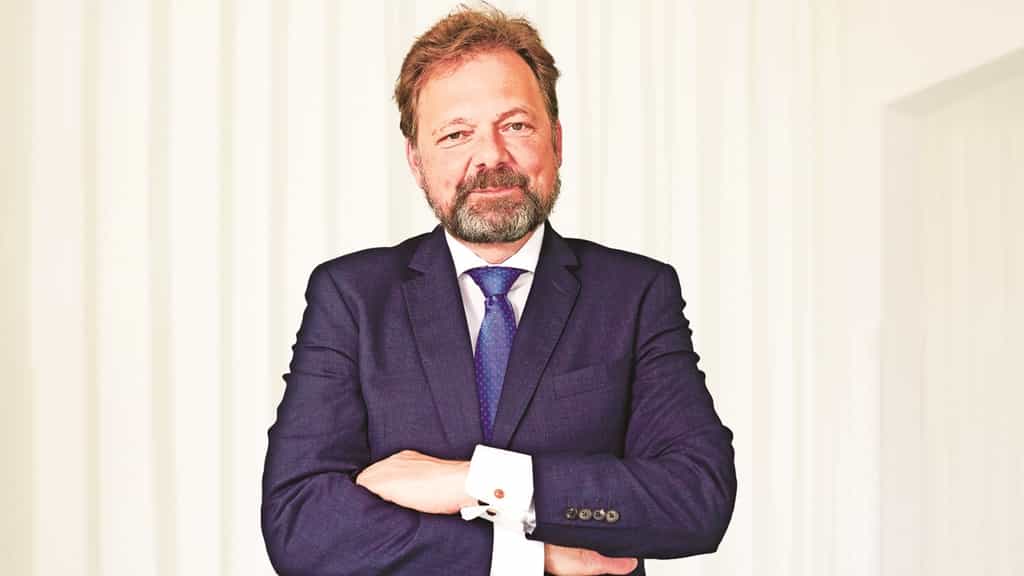
German Chancellor Friedrich Merz’s trip to India beginning Monday is his first bilateral visit outside of NATO and the European Union, a “very strong signal,” of the deepening bilateral relationship across sectors and its potential for the future, German Ambassador to India Philipp Ackermann told The Indian Express in an exclusive interview Saturday.
Merz, whose delegation includes CEOs of 25 German companies, will meet Prime Minister Narendra Modi in Ahmedabad and visit the Sabarmati Ashram. He will head to Bengaluru on January 13 where he will visit the Indian Institute of Science and the campus of German firm Bosch.
This is Chancellor Merz’s first bilateral visit outside of NATO and EU space. It’s a very strong signal that the first time he travels outside of Europe and the United States is to India. He travelled to the G20 in South Africa, but a bilateral visit which is dedicated exclusively to India—that’s a first, and it shows the significance that India has in German politics right now. On the one hand, this visit is about meeting with the Prime Minister of India. On the other hand, there is a whole range of issues to be discussed, from defence to supply lines, technology, education and skilling. The Chancellor is eight months in office, and he will compare notes with the Prime Minister and elevate the partnership, which is already very sound. And he will also discuss, of course, world politics with the Prime Minister.
The invitation to Ahmedabad is a wonderful gesture by the Prime Minister. He invited Chancellor Merz to his hometown. We interpret it as a gesture of friendship and a warm welcome to the Chancellor. The Chancellor appreciates this very much…After Ahmedabad, he will go to Bengaluru, also to see some German businesses. He will be accompanied by a big German delegation of businessmen. We have 25 CEOs from Germany’s big enterprises, but also medium-sized ones.
Business will be a major topic. Last year, we reached a $50-billion trade volume, goods and services combined. This is a very significant level…I’m very impressed…it shows how strongly Germany is engaged in India. We have more than 2,000 companies from Germany here in India. Similarly, 750 Indian companies are invested in Germany. And that’s also something one should not underestimate. It’s a two-way street.
And the trade is relatively balanced. When it comes to goods, Germany has a slight surplus. When it comes to services, India has a slight surplus.
The second item will certainly be migration. We already have a migration agreement with India. Over the last couple of years, Indian migration to Germany—legal and fair migration—has become a success story. Indian workers in Germany earn 20% more on average than their German counterparts. This is fantastic proof of how well this migration partnership works.
Chancellor Merz’s visit comes a month after Russian President Putin’s visit, what will be the conversation on the Russian war in Ukraine?
Chancellor Merz was in Paris for a conference with American and European partners on peace in Ukraine. There is, with all due caution, some dynamism in the peace talks and negotiations. The Chancellor will tell the Prime Minister about his impressions of where that is going… it’s one of Europe’s most urgent problems.
What about the US under President Trump, which has captured the Venezuelan President and withdrawn from over 60 international organizations in the first week of 2026?
I cannot say what’s on the Prime Minister’s agenda, but there will certainly be exchanges on world politics. We see many moves with some surprise.
We don’t set a specific target because we see that the dynamic is there. Next year it will be more than $50 billion. I can guarantee that it will grow from year to year; we see a clear shift of attention towards India. The Indo-German Chamber of Commerce tells me that, on average, two companies a week are trying to reach out to them in order to explore possibilities to set up shop in India. The very fact that 25 top CEOs are accompanying the Chancellor is a sign of how seriously India is taken by the German business community as a potential and future market.
We do hope that the FTA will be concluded; it would be a wonderful opportunity to seal it. The Chancellor coming now, two weeks ahead of that, is also a sign because Germany is a huge supporter of this Free Trade Agreement (FTA). We feel that it will be a very important step towards more business activities from Germany in India and vice versa. We feel it is a huge opportunity for more investment in India. And the Chancellor will make it clear how much we are pushing for it and how much we believe in this FTA. Commerce Minister Piyush Goyal was just in Brussels, sitting down with the European side. Of course, the last miles are always the hardest; the toughest nuts are cracked at the end only. But I keep being optimistic that by January 26-27, we will have something on the table.
We have areas in Germany where we urgently need skilled labour, such as in caregiving, nursing, and craftsmanship. There are not enough young people, and in India, we feel there is a lot of willingness, preparedness, and open-mindedness when it comes to moving to Germany. And there is an ever-growing Indian community in Germany. We have had excellent experiences with Indian skilled labour, and we will continue to recruit in a fair, legal, and very focused way when it comes to those areas in German professional life that need more skilled labour. The Chancellor will be meeting students, engineers, and some people who want to undergo vocational training in Germany.
Higher education is certainly a success story because we see that German universities are very satisfied with their Indian students. They have the reputation of being extremely dedicated, ambitious, and hardworking, and we see that many universities really like to take Indian students on board.
Now, the government cannot interfere; the university landscape is completely autonomous. But there is a growing interest among Indian students in going to Germany. We see a snowball effect. Indian students successfully studying in Germany ensures that others will follow. We have to see that sometimes there are issues, specifically when it comes to certain agents. We feel that there are some agents who only offer one possibility for going to Germany. They have only one school in their portfolio. And that, I would say, is not enough. I’d advise every student to look twice. If somebody only offers you two or three universities, you should change your agent. If the university says, “We offer hybrid courses,” you better double-check whether the hybrid courses are actually just online courses, because if the model turns out to be purely about distance learning, this will not be sufficient to secure a student visa.
The submarines will not figure very prominently in this visit because the talks have not been concluded yet. Negotiations are going on between the stakeholders on this item, and it seems that we are on a good path, but we won’t be finished by next Monday. Next to that, we will certainly initiate a process for a roadmap for defence cooperation, along with other deliverables.
Editorial Context & Insight
Original analysis & verification
Methodology
This article includes original analysis and synthesis from our editorial team, cross-referenced with primary sources to ensure depth and accuracy.
Primary Source
The Indian Express