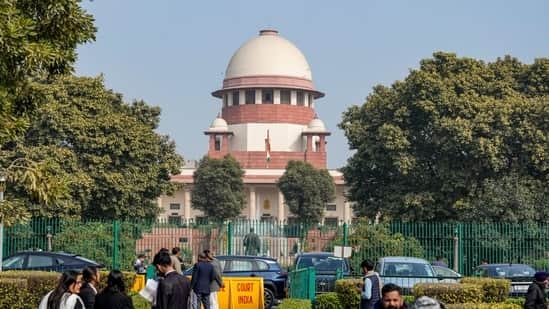
The Supreme Court on Monday denied bail to jailed activists Sharjeel Imam and Umar Khalid for their alleged role in the 2020 Delhi riots.
However the top court ordered the release of five co-accused, which are Gulfisha Fatima, Meeran Haider, Shifa Ur Rehman, Mohd. Saleem Khan, and Shadab Ahmad.
The riots in 2020 in parts of northeast Delhi followed weeks of tension after the around protests against the Citizenship (Amendment) Act (CAA), and resulted in multiple deaths, with large scale damage to homes, shops, and places of worship. Khalid has been in custody since September 13, 2020, and Imam since January 28, 2020.
While delivering the verdict, the SC noted that the prosecution materials prima facie disclosed “a central and formative role” of the accused and “involvement in the level of planning, mobilisation and strategic direction extending beyond episodic and localised acts”, Live Law reported.
However, the SC Bench comprising Justices Aravind Kumar and NV Anjaria drew a distinction between Khalid and Imam, and the other five co-accused.
“To disregard the distinction between the central roles played by some accused and the facilitatory role played by other accused would itself result in arbitrariness,” the court said, according to Bar and Bench. The court said that Imam and Khalid “stand on a qualitatively different footing as compared to other accused.”
“The UAPA as a special statute represents a legislative judgement as to the conditions on which bail may be granted in pre trial stage,” the court noted.
On the arguments put forward by the defense regarding the delay in trial, the court said that in prosecutions under the UAPA, it does not operate as a “trump card” which would displace statutory safeguards, according to Live Law.
The court further observed that Section 43D(5) of UAPA departs from general provisions in grant of bail, adding that it does not exclude judicial scrutiny or mandate denial of bail in default.
The SC bench said the court would have to conduct a structured enquiry into whether the prosecution material, is accepted, constitutes a prima facie case, and whether the specific role attributed to the accused crosses the statutory threshold, Live Law reported.
“On completion of examination of protected witnesses or completion of one year from this order these appellants may be at liberty to move an application for grant of bail,” the court said, according to Bar and Bench.
While granting conditional bail to the five co-accused, the SC said this does not show a dilution of the allegations against them. “If conditions are violated, the trial court will be at liberty to cancel the bail after hearing the accused,” the SC Bench stated.
Editorial Context & Insight
Original analysis & verification
Methodology
This article includes original analysis and synthesis from our editorial team, cross-referenced with primary sources to ensure depth and accuracy.