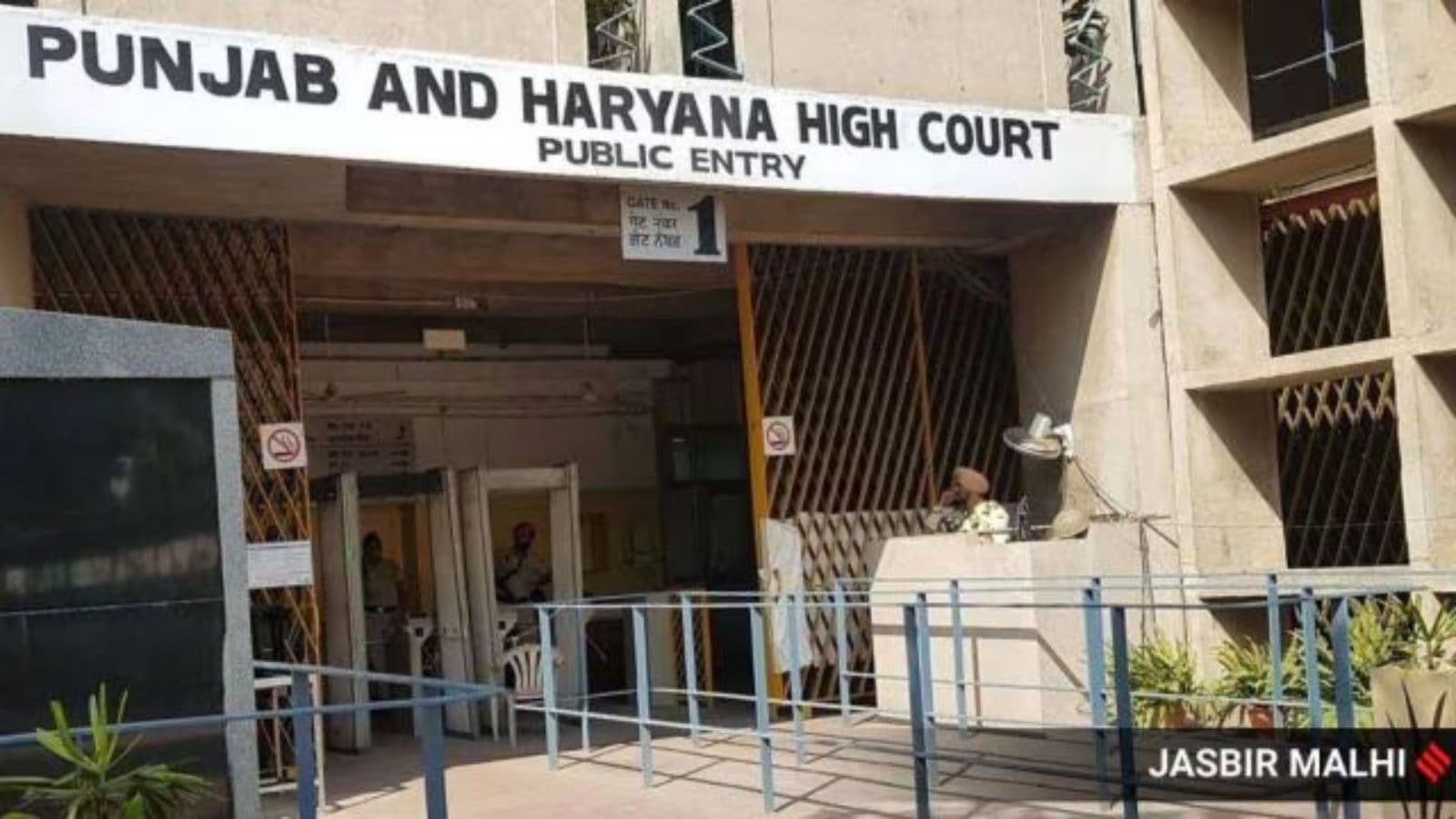
In a far-reaching interim order with statewide implications, the Punjab and Haryana High Court Wednesday directed that no trees shall be felled anywhere in Punjab until the next date of hearing, while hearing two Public Interest Litigations (PIL) challenging tree felling in Mohali.
The direction was issued by a division bench of Chief Justice Sheel Nagu and Justice Sanjiv Berry, which also asked the state counsel to immediately inform all concerned authorities to halt tree felling across Punjab.
The PILs were filed by Parneet Kaur and Shubh Sekhon, both residents of Mohali, raising concerns over large-scale tree cutting and diversion of protected forest land for development projects.
Kaur’s petition slammed the proposed felling of 251 trees for the construction of three roundabouts or rotaries at existing traffic junctions in sectors 67, 68, 79, and 80, as well as at the Sohana Junction on PR-7 Road in SAS Nagar (Mohali) district. The court recorded that a tender had been issued for auctioning 251 trees, with the last date for submission being December 9, and that tree cutting had commenced barely two days before the matter was taken up.
Appearing for Kaur, advocate Jatin Bansal relied on the tender documents and news reports to argue that the trees were being cut in the name of development without adequate environmental assessment at a time when Punjab’s forest and tree cover was among the lowest in the country.
The bench took note of official data from the Union Ministry of Environment, Forest and Climate Change (MoEFCC) showing that Punjab’s forest cover stands at only 3.67 per cent of its geographical area, observing that even Rajasthan had a better forest cover of around 4.87 per cent. He remarked that existing policies appeared insufficiently conscious of the environmental degradation underway.
In the second PIL, advocate Harlove Singh Rajput, appearing for petitioner Sekhon, challenged the proposed diversion, cutting and relocation of a 23-acre fully grown forest in Sector 90, Mohali, which is notified and protected under the Punjab Land Preservation Act (PLPA), 1900.
It was submitted that the authorities had initiated steps to swap the protected forest land with an alternative site in Ludhiana to facilitate large-scale residential, commercial, and institutional development. The scheme was formulated in September 2025, cleared by the Forest Department in November 2025, and is presently pending final approval, after which deforestation would commence imminently.
Rajput argued that the proposed land swap was impermissible under PLPA, which contains no provision allowing relocation or exchange of protected forest land. He further submitted that the move violated the National Forest Policy, 1988, which treats forest land as a national asset requiring the highest degree of protection.
The petition warned of irreversible ecological damage, aggravation of already critical pollution levels, with several districts in Punjab recording AQI levels close to 250, and destruction of a mature forest ecosystem that could not be replaced for decades through compensatory afforestation. It was also contended that the land had been declared vulnerable to soil erosion and ecological instability, rendering the proposed development violative of the Building Rules, 2021.
The bench observed that authorities could reach a point of no return, beyond which restoration of environmental and ecological balance would be extremely difficult. “The drastic steps taken by the respondents require drastic measures from this court,” the bench remarked.
Punjab Deputy Advocate General Salil Sabhlok objected to the maintainability of the PILs, contending that no specific statutory permissions had been challenged and that reliance was being placed on news reports. However, in view of the gravity of the environmental concerns raised, the court proceeded to restrain tree felling across the state.
The matters will now be heard in January after the vacation.