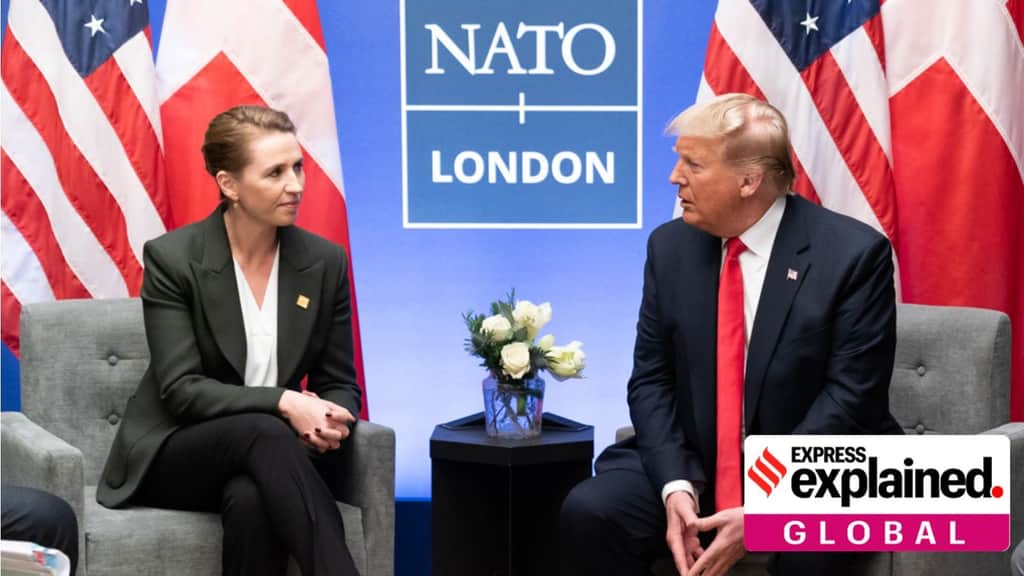
The leaders of Denmark and Greenland responded strongly to US President Donald Trump’s comments on Sunday, saying the US needed Greenland “for defence”.
“It makes absolutely no sense to talk about the U.S. needing to take over Greenland. The U.S. has no right to annex any of the three countries in the Danish Kingdom,” Danish Prime Minister Mette Frederiksen said in a statement on Sunday.
This rebuttal marks the latest response in a year-long campaign by the US to annexe the autonomous Danish province. Trump has repeatedly expressed an interest in “purchasing” and taking control of the Arctic island from Denmark, and showed willingness to use force to this end.
The diplomatic crisis was ignited after the US president, emboldened by the fall of the Venezuelan regime, doubled down on his claim that the U.S. “absolutely needs” Greenland for defense, while his aides posted provocative “SOON” maps of the island draped in the American flag.
Over the past year, Denmark has accused the US of attempting to bolster a secessionist movement in Greenland. Here is what to know in four points.
American interest in Greenland is rooted in geostrategy.
From a military standpoint, Greenland’s location is significant, serving as a vital base of operations during the Cold War (1945-91). The US operates the sprawling Pituffik Space Base (formerly the Thule Air Base) in the province. From Greenland, the US can monitor and prevent any missile coming towards it from Russia, China, or even North Korea. Similarly, it can launch missiles and ships towards Asia or Europe easily from Greenland. In recent years, China and Russia have reportedly scaled up their military capabilities in the Arctic, according to an Arctic Institute research paper.
Greenland also has a vast repository of rare earth minerals, which are extensively used in mobile phones, electric vehicles and other consumer electronics, as well as in bombs and other weapons. China is currently the leading supplier of these minerals. In 2021, Greenland passed a law banning uranium mining.
2 – Has the US tried to ‘acquire’ the state?
The US has long expressed varying degrees of interest in possessing and controlling the territory. In 1867, the US State Department observed that Greenland’s strategic location and abundant natural resources make it ideal for acquisition, but made no formal effort to move on the suggestion.
During World War II, the US invaded it just as Nazi Germany occupied Denmark. After the war ended, US President Harry S Truman in 1946 offered $100 million to Denmark for Greenland, after previously considering exchanging some portions of Alaska for parts of Greenland.
In 1951, the US entered into a defence agreement with Denmark, allowing it the right to build and maintain military bases in Greenland. Thus, American forces remained in the region, building military broadcasting stations across the region.
In his first term (2017-21), Trump proposed buying Greenland in what he called a “large real estate deal”. When the Danish PM, Mette Frederiksen, called the idea absurd, Trump cancelled a scheduled visit to Denmark.
3 – Why are Denmark and Greenland wary?
Trump’s latest remarks, coming after invading Venezuela and deposing its leader, Nicolas Maduro, have added impetus to Denmark’s and Greenland’s concerns over sovereignty.
In August, the Danish Broadcasting Corporation (DR) published a report stating that three men with connections to Trump, including one who had recently been elevated to a top US security post, had embarked on covert influence operations in Greenland.
According to the report, the Trump administration had embarked on a three-phase strategy to take over Greenland – a charm offensive including sending Donald Trump Jr to the province, exerting direct pressure on Denmark, with US Vice President JD Vance travelling to Greenland and criticising Denmark.
The report said that the top security official had compiled lists of Greenlandic citizens who supported Trump’s endeavour to take over the territory, and could eventually be recruited by the US for a secession movement. This infiltration attempt is the third phase of this strategy, according to the report.
The two other men were identified by the report as people who previously worked for Trump and have travelled regularly between Greenland and the US. The two sought to network with local politicians, businesspeople and citizens, the DR reported, adding that the sources expressed concern about these contacts being used to support a takeover attempt by Trump.
The Danish Police Intelligence Service (PET), which assessed the situation, told the DR that “Greenland, especially in the current situation, is a target for influence campaigns of various kinds.”
4 – Has the US bought territories before this?
Yes. In 1867, the US purchased Alaska from the Russian empire for $7.2 million, expanding US territory by about 1.5 million sq km of land to the US. In 1959, the modern state of Alaska was created.
In 1803, the US bought more than 2 million sq km of land from France in what is known as the Louisiana Purchase. The acquisition of Louisiana happened when Thomas Jefferson was President, and the US paid $ 15 million for the deal.
In 1917, the US bought the Danish West Indies, a group of islands in the Caribbean, and called them the US Virgin Islands.
Editorial Context & Insight
Original analysis & verification
Methodology
This article includes original analysis and synthesis from our editorial team, cross-referenced with primary sources to ensure depth and accuracy.
Primary Source
The Indian Express