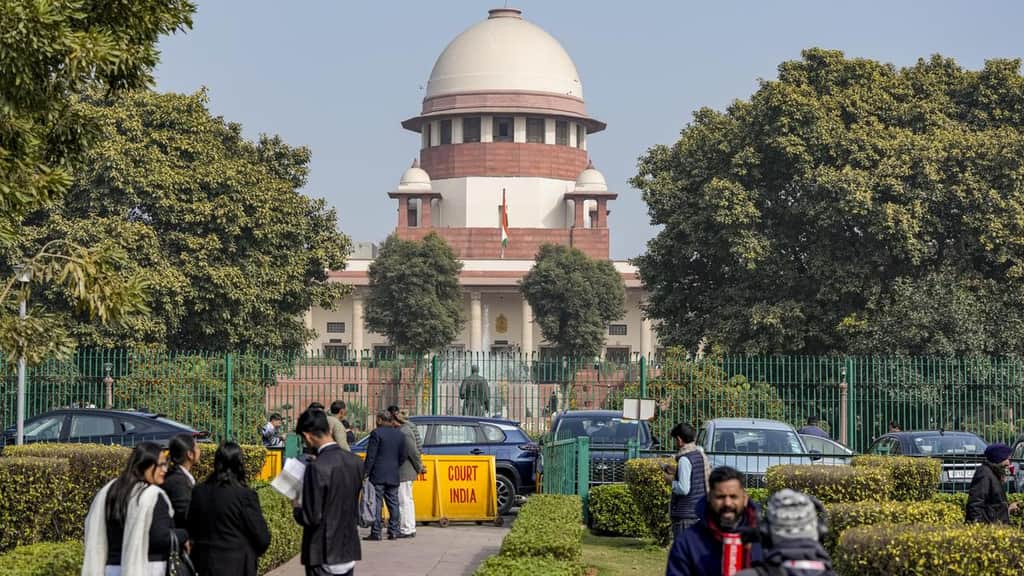
The Supreme Court on Wednesday (January 7, 2026) dismissed a petition seeking a court-monitored investigation into the alleged leak of the Common Law Admission Test (CLAT) 2026 question paper on the eve of the examination.
A Bench comprising Justices P. S. Narasimha and Alok Aradhe declined to entertain the plea, noting that the examination process had already concluded and questioning the need for judicial intervention at such a belated stage.
Addressing advocate Malvika Kapila, appearing for the petitioners, the Bench questioned why the apex court had not been approached before the declaration of results on December 16, 2025. “You say the paper was leaked on December 6. Why did you wait until December 16 to approach this court? Had the petition been filed before the declaration of results, we would have appreciated it,” the Bench observed.
The petition, filed by a group of law aspirants from socio-economically disadvantaged backgrounds, alleged that screen recordings and screenshots of the CLAT 2026 question paper began circulating on social media platforms, including Telegram, around 10:15 p.m. on December 6—nearly 15 hours before the examination was scheduled to begin. It further pointed out that while Telegram allows users to edit previously uploaded media—a process that usually triggers an automatic “edited” label—no such marker was visible on the material in circulation.
Ms. Kapila submitted that the plea had been filed within a reasonable time and clarified that the petitioners were not seeking a direction to conduct the examination afresh. The Bench, however, remained unconvinced and declined to intervene.
The CLAT 2026, a national-level entrance examination for admission to undergraduate and postgraduate law programmes across 25 National Law Universities (NLUs), was held on December 7, 2025, in offline mode between 2 p.m. and 4 p.m. at 156 centres across 25 States and four Union Territories.
The examination was conducted by the Consortium of National Law Universities (CNLUs), established in 2017. According to the consortium, 92,344 candidates applied for the examination, competing for just over 3,500 undergraduate seats and around 1,500 postgraduate seats across the NLUs. The results were declared on December 16 and published on the consortium’s official website.
The petition contended that the alleged leak had compromised the sanctity of the examination and “vitiated the level-playing field”, thereby prejudicing the sincere efforts of genuine candidates. It further pointed out that judicial intervention was “urgent” since the first allotment list was scheduled to be published on Wednesday (January 7, 2026).
“Proceeding with counselling and seat allotment based on the results of a prima facie compromised examination, without a conclusive and independent investigation into the alleged paper leak, would lead to irreversible consequences,” the plea, filed through advocate Malvika Kapila, stated.
The court was also informed that screenshots and videos circulating on Telegram groups included claims by individuals that they had accessed the question paper before the examination, suggesting an organised leak. The material also allegedly included messages from individuals offering access to the paper in exchange for payment.
The aspirants further pointed out that although the consortium had operationalised a grievance redressal portal to address complaints relating to the conduct of the examination, grievances raised through the portal concerning the alleged leak had remained unaddressed. This inaction, the petitioners contended, had led to an “irreparable erosion” of public trust in the examination process, thereby necessitating judicial intervention.
“The videos, images, and news reports clearly indicate that the examination process has been compromised, thereby infringing the fundamental rights of genuine candidates. A paper leak strikes at the core of constitutional guarantees of fairness, equality, transparency, and dignity inherent in any public examination,” the plea added.
Editorial Context & Insight
Original analysis & verification
Methodology
This article includes original analysis and synthesis from our editorial team, cross-referenced with primary sources to ensure depth and accuracy.