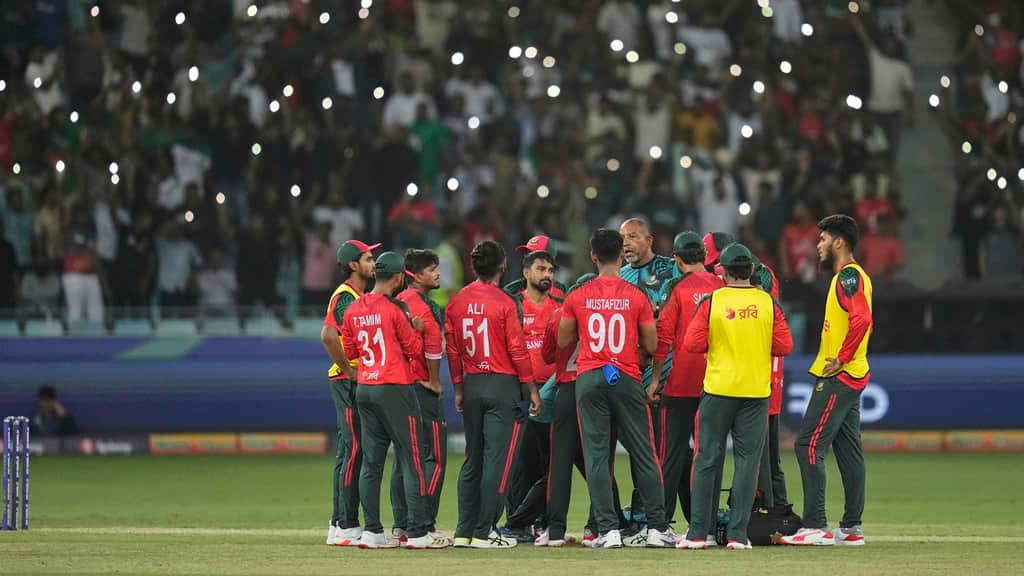
FILE picture of Bangladesh cricket team. (PHOTO: AP)
The decision by Bangladesh Cricket Board to not send its team India for the upcoming T20 World Cup beginning February 7 isn’t a one-off incident. In recent times, the cricketing world has witnessed diplomatic tensions between countries disrupting its schedule. From the Asia Cup in 2023 to the upcoming World Cup there have been multiple instances. Here is a look at those.
In 2023, when Pakistan were scheduled to host the Asia Cup, the BCCI refused to send its team across the border citing security reasons. It meant, the Asian Cricket Council, then headed by Jay Shah, came up with a hybrid model for the tournament, where all of India’s matches happened in Sri Lanka. As a result, teams criss-crossed between Sri Lanka and Pakistan, a tournament that India eventually won.
Though India had refused to travel to Pakistan, the story was different a month later when the 50-over World Cup came calling. With India being the lone hosts, PCB were left with no option to travel across the border. While the team played its matches in Kolkata, Hyderabad, Chennai and Ahmedabad and Bengaluru, there were tensions between the two boards when visa access was delayed for visiting Pakistan journalists. Fans also didn’t get a chance to cross the border like they did during the 2011 World Cup.
Although Pakistan had travelled to India in 2023 in the hope that their neighbours would return the favour next year. The Champions Trophy, which was the first ICC event to take place in Pakistan since the 1996 World Cup, faced roadblocks months before the start with India refusing to travel. It resulted in boardroom talks at the ICC and with the PCB not relenting, an arrangement was made. It meant, going forward India and Pakistan won’t travel to each other’s country and should there be any ICC event that they host, their matches will be held in a neutral venue. As a result, India camped in UAE, while all other matches happened in Pakistan. The tournament wasn’t a big success for Pakistan as the team crashed out in the group stages with India going all the way to the title as teams had to cope up with uncertainty in their venues till the final.
With tensions remaining high in the sub-continent, the ACC’s flagship event once again found a home in the UAE. But, with the tournament happening soon after the Pahalgam terror strikes, Indian players refused to shake hands with Pakistan players. In each of the three matches there were ugly exchanges between both sets of players which resulted in Haris Rauf suspended for two matches and Suryakumar Yadav receiving a fine. After the final, which India won, they refused to take the trophy from ACC chief Mohsin Naqvi, who also happened to be Pakistan’s Interior Minister.
Like the Champions Trophy, a hybrid model was put in place for the women’s 50-over World Cup which India hosted. Colombo, the chosen neutral venue, hosted Pakistan’s matches as well as a few others involving the rest. With Pakistan making a group-stage exit, there was no uncertainty with regards to the venues as India went on to win its first major ICC event.
With India and Sri Lanka being co-hosts, the scheduling wasn’t a nightmare. All of Pakistan’s matches were allotted to Sri Lanka. Even in the case of them qualifying for the semi-final and final, two venues have been short-listed with Colombo being the back-up. If Pakistan doesn’t make the knockouts, the business end is scheduled to take place in India. Now with Bangladesh refusing to travel to India, it remains to be seen if a new schedule is drawn up or any other plan is put in place.
Editorial Context & Insight
Original analysis & verification
Methodology
This article includes original analysis and synthesis from our editorial team, cross-referenced with primary sources to ensure depth and accuracy.
Primary Source
The Indian Express