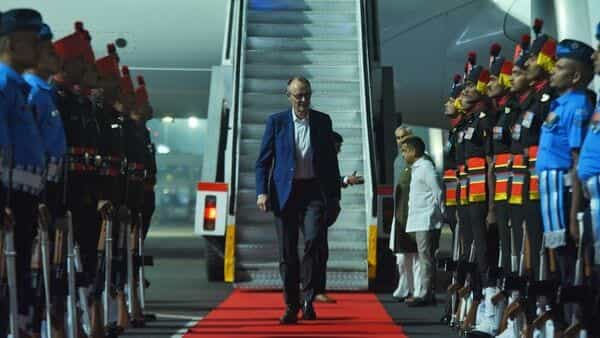
German Chancellor Friedrich Merz visited India on Monday as part of a trip aimed at strengthening economic and security cooperation between the European Union's largest economy and the populous Asian nation.
Berlin and New Delhi are both navigating an increasingly unstable global environment, facing economic and geopolitical pressures stemming from the world’s two biggest economies, the United States and China.
The Ministry of External Affairs spokesperson Randhir Jaiswal said Merz will meet Prime Minister Narendra Modi in Ahmedabad on Monday.
The high-profile visit is an opportunity for the two leaders to showcase stronger economic and security ties amid strained relations with the US under President Donald Trump.
The US leader's repeated threats to annexe Greenland have shocked European allies, while India remains saddled with one of the highest US tariff rates of 50%.
During Merz’s two-day trip, Germany and India are expected to finalise deals covering business collaboration, semiconductor development, and defence initiatives, according to a Bloomberg report.
Germany is also seeking improved access to India's critical minerals, with both countries likely to sign a memorandum of understanding on the issue. Berlin is working to lessen its dependence on China for rare earths and other key raw materials, the report stated.
Furthermore, the two countries are also expected to sign a deal aimed at easing barriers for Indian healthcare professionals seeking to work in Germany, where labour shortages across multiple industries are weighing on economic growth, Bloomberg reported.
Merz will travel with a sizable delegation of German business leaders, including the CEOs of Siemens, DHL Group, Infineon Technologies, Uniper, and Airbus Defence and Space.
The group will also include executives from numerous small and mid-sized companies from the Mittelstand, the core of Germany’s manufacturing base, which was once strong but is now under strain, the report stated.
According to a report by Bloomberg, Merz will likely use his meeting with Modi to speed up negotiations between the European Union and India on a free-trade agreement.
Negotiators are rushing to finalise a deal by the time EU President Ursula von der Leyen heads to India later in January, with talks stuck on a few key issues like steel and automobiles, Bloomberg previously reported.
As the world’s third- and fifth-largest economies respectively, Germany and India maintain a strong partnership in economic and development cooperation.
PM Modi last visited Berlin in 2022 to co-chair the 6th IGC with Chancellor Olaf Scholz, where several agreements were signed in diverse fields such as agroecology, forest landscape restoration, renewable energy, triangular development cooperation, migration and mobility, and health, according to MEA.
As the fastest-growing economy in the G20, India is a key economic partner in the Indo-Pacific region for Germany. More than 2,000 German companies are doing business in India, and more than 700 Indian companies invest in Germany. With a bilateral trade volume of almost $50 billion, Germany is India’s most important partner in the European Union.
In the defense sector, Germany and India are currently hammering out the details of a submarine manufacturing deal worth at least $8 billion — the largest-ever defense agreement for New Delhi, Bloomberg News reported last week.
Germany’s Thyssenkrupp Marine Systems GmbH and Indian state-owned Mazagon Dock Shipbuilders Ltd. are negotiating the details of an agreement that would include technology transfer for submarine production, people familiar with the matter told Bloomberg.
It’s unclear if the agreement will be announced during Merz’s visit.
India’s navy currently operates around a dozen older Russian submarines alongside six newer French-made vessels. The country still depends heavily on Russia for military hardware, and Germany views the submarine deal as an opportunity to help India reduce that reliance.
During Merz’s visit, India’s relationship with Russia—whose invasion of Ukraine in 2022 has drawn global scrutiny—is also expected to be discussed. India ramped up oil imports from Russia after the invasion but has recently scaled them back following U.S. sanctions on major Russian energy producers.
Editorial Context & Insight
Original analysis and synthesis with multi-source verification
Methodology
This article includes original analysis and synthesis from our editorial team, cross-referenced with multiple primary sources to ensure depth, accuracy, and balanced perspective. All claims are fact-checked and verified before publication.
Primary Source
Verified Source
mint - news
Editorial Team
Senior Editor
Maria Santos
Specializes in Business coverage
Quality Assurance
Associate Editor
Fact-checking and editorial standards compliance