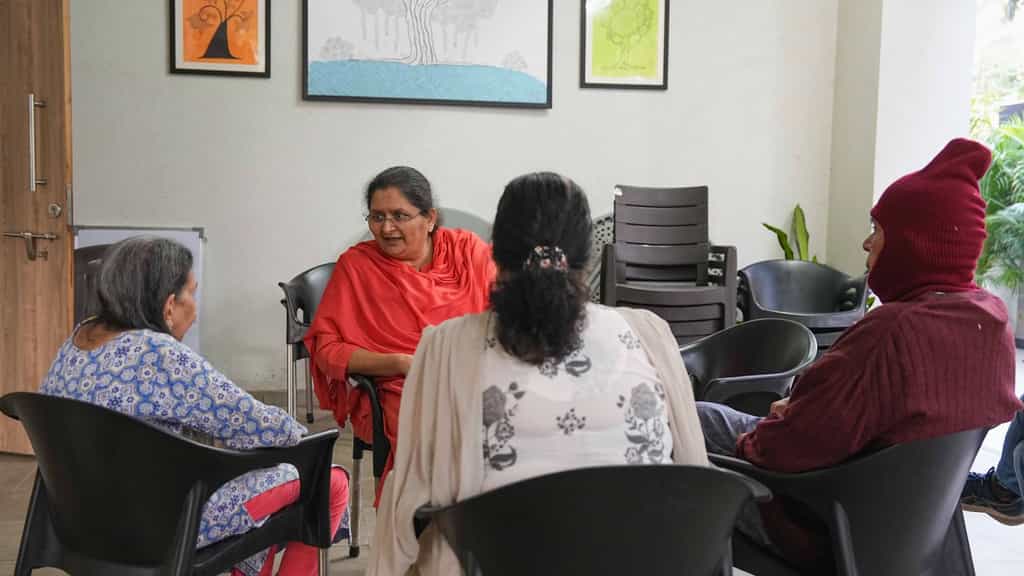
Revati, 70, still remembers the day her husband was suddenly forced to retire during the COVID-19 pandemic. The change was abrupt and deeply unsettling for him and the family. “I could see the worry lines on his face,” she recalls. “In the days that followed, he grew irritable and withdrawn. He lost interest in the things that once brought him joy. At first, I thought it was depression. But it turned out to be much more than that.”
Living in Mumbai at the time, Revati consulted a psychiatrist when her husband began forgetting simple things and repeating questions. A neuro-cognitive assessment soon revealed the truth: he had developed dementia. For Revati, the diagnosis was heartbreaking but it was also painfully familiar. Just a year earlier, her sister-in-law had slipped into an advanced stage of the same condition. “My husband had taken her to Pratiti Elder Care Home in Pune. I never imagined that I would be bringing him here too,” she says. “I tried caring for him at home, but it was not easy.”
Dementia is a progressive condition that alters personality, behaviour and physical ability. Patients often experience agitation, aggression, paranoia, hallucinations, disorientation and wandering. As confusion increases, mobility declines and the risk of falls rises. Even basic personal hygiene becomes a challenge.
For caregivers, the emotional and physical toll is immense. “When my children saw how exhausted I had become, they knew it was time to step in,” says Revati, who is now a regular visitor at Pratiti. “When I sit beside him, he seems calm — if only for a while. But on the phone or video calls, he feels distant, as though he no longer recognises me.”
One of the most difficult aspects of dementia is behavioural change. Patients often become uninhibited and may make socially inappropriate comments or gestures they would once have suppressed. “A patient may hold an unrelated person’s hand or make an inappropriate remark without any harmful intent. These behaviours often lead to misunderstandings and family conflicts. Hence, doctors must sit with families and explain why these are part of the degenerative process. Early discussion can help families respond with patience and care rather than frustration or anger. They can also understand why their loved ones deserve dignity with a specific care protocol, which may not be possible in a home setting,” says Dr Rajas Deshpande, director of neurology, Jupiter Hospital, Pune.
According to Dr Deshpande, caregiving education is crucial — especially in India, where nearly nine million people are living with dementia.
A patient finds solace in music therapy. (Photo by Arul Horizon)
One of the biggest misconceptions is that memory loss and dementia are the same. “They are not,” says Dr Deshpande. “The brain performs many cognitive functions beyond memory — reasoning, calculation, visual recognition, understanding language, interpreting body language and processing emotions. Dementia affects all of these.”
In the early stages, patients may withdraw socially, lose interest in conversations and struggle with tasks that were once effortless. This decline in responsiveness is often mistaken for depression, laziness, or simply old age.“Many people believe memory loss is a natural part of ageing. This is a myth,” Dr Deshpande explains. “Even at 90 or 100, normal cognition should remain intact. Some slowing of processing speed is expected, but not memory failure.”
Early signs of dementia include apathy, difficulty multitasking, misplacing objects, repetitive questioning, repeating actions and a noticeable decline in efficiency. Someone may ask for tea repeatedly despite having just had it or forget recent conversations while recalling events from decades ago with clarity.
More worrying is the rise of early-onset dementia. “Earlier, we saw dementia mostly after the age of 65. Today, we see symptoms as early as 45 or 48,” says Dr Deshpande. Pollution, stressful lifestyles, poor diet, and long-term medication use are contributing factors.
He emphasises the importance of early neurological evaluation. “It’s similar to an IQ test, but it evaluates many more cognitive functions. Some conditions mimic dementia and are reversible such as vitamin B12 deficiency, thyroid disorders, depression, and metabolic imbalances. Early diagnosis can make a huge difference.”
At Pratiti Elder Care Home, winter afternoons are gentle and slow-paced. Caregivers wrap residents in woollens and cosy caps. After tea, some seniors gather outdoors for games designed to exercise the brain. Word puzzles, card games and memory exercises help stimulate neuron formation and slow cognitive decline.
In one corner, 82-year-old Manini sits in a circle as a volunteer asks her to sing a bhajan. Another volunteer brings a tanpura so she can strum along. Manini experiences mood swings, but music is her solace. Nearby, Neela*, 68, who has early-onset dementia and has lived at the home for five months, grows restless. “Doctors say my memory is weak. But I’m not anxious about it,” she says. “Why should I be sitting here? I still have my wits about me.”
Her agitation reflects another painful reality. Dementia patients are often aware, at least initially, that they are losing parts of themselves.
Sushupti Sathe, Director of Pratiti, explains that while most families prefer home care, sometimes additional support becomes necessary. “When physical caregiving is taken over by trained staff, families can focus on emotional bonding and quality time,” she says. “That’s why we even allow couples who have shared a long journey to stay together.”
Though dementia is irreversible, Sathe believes deeply in improving the quality of life. “It’s about adding life to their years, not just years to their life. We use neurocognitive exercises, memory games, motor-skill training, art therapy, drama, music, reminiscence therapy, yoga and visual arts. Every activity has a therapeutic goal.” Residents solve puzzles, play matching games, sing together and engage in everyday tasks like threading beads, watering plants, folding clothes and organising shelves. These simple routines enhance coordination, independence and self-worth.
At Tapas Elder Care Home, founder Prajakta Wadhavkar sees another side of dementia — the guilt families carry when they make the decision to seek institutional care.
“One family had a 75-year-old patient who locked herself out on the balcony and couldn’t open the latch. They had to call the fire brigade,” she recalls. “In a care home, no one has to face such terrifying situations alone.” Constant supervision ensures safety. If a resident takes up painting, a volunteer sits beside them to prevent accidental ingestion of paint. Others are monitored to ensure they don’t wander off, fall, or forget their way to the washroom.
“Some elders may be tricked into transferring property. Others may get disoriented and walk out of the house,” says Wadhavkar. “We also counsel families, helping them process their guilt and understand that choosing professional care is an act of responsibility, not abandonment.”
With India’s ageing population growing rapidly, dementia care is becoming one of the country’s biggest healthcare challenges. Yet awareness remains low and stigma remains high. Families struggle in silence, unsure whether their loved one is ill or simply ageing.
For Revati, the journey has been one of heartbreak, acceptance and quiet resilience. But as she holds her husband’s hand and he smiles back in response, she knows that he is there, somewhere, something she never understood in the middle of caregiving duties.
Dementia may erase memories but it does not erase humanity. And in a society that often turns away from ageing and illness, the greatest gift we can offer is dignity, compassion and care.
Editorial Context & Insight
Original analysis & verification
Methodology
This article includes original analysis and synthesis from our editorial team, cross-referenced with primary sources to ensure depth and accuracy.
Primary Source
The Indian Express