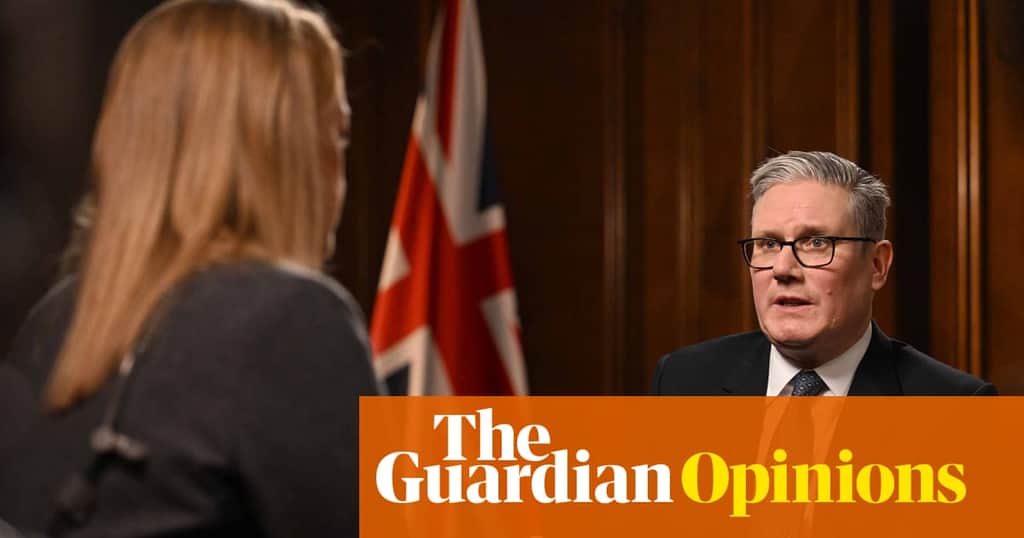
Keir Starmer kicked off the political new year with a fascinating and revealing 45-minute-long interview with the BBC’s Laura Kuenssberg. The format was another sign of the No 10 comms team changing up its game – it was the nearest thing that public service broadcasting gets to an ask me anything (AMA). Throughout the lengthy exchange the real Starmer was on show as he calmly and doggedly fielded all questions.
And that was the problem. This wasn’t an attempt to reframe the political narrative for the coming year, nor was it a clear exposition of Labour’s “soft left” political economy – nationalisation, workers’ rights and the green transition. There was a complete absence of storytelling, just reliance on a handful of carefully practised phrases, the abiding sin of this Labour government: the elevation of tactics above strategy.
Responding to questions about his own, and his government’s, deep unpopularity, Starmer planted himself firmly – and repeatedly – on a “five-year mandate” that he argued was “in the national interest” for him to see through. Growth was mentioned as a touchstone, but without any analysis of “growth for what or for whom”, even though distributional consequences are the modern religion of socialism. A variety of questions about voters’ frustrations met the same response: the country is “turning a corner”. The possibility that the Labour government is actually about to turn into heavy oncoming traffic hovered over the discussion of the coming May elections in Scotland, Wales, London and councils across England, our very own version of the US midterms. For the prime minister these were just local votes, not a national referendum.
What was revealing wasn’t the bloodlessness of the prime minister’s language: no one is ever going to rise from their seat shouting, “Preach, brother, preach!” after any of Starmer’s performances. Instead, what was fascinating were the few flashes of passion. Asked about the real changes that people should feel during the coming year, he kept returning to “bearing down on child poverty”. And you could tell he meant it. Which is, at the very least, ironic given that he and his chancellor, Rachel Reeves, only came to the conclusion that the two-child cap should be lifted when the parliamentary Labour party took direct political control of welfare policy.
As we know from his airmiles, it’s geopolitics that really brings Starmer to life. He was willing to talk to Kuenssberg compellingly and at length about his achievements in bringing the UK closer to the European Union and his determination to continue deepening those relations. He showed a desire not just to engage in this discussion but also to argue for increasingly aligning with the single market in contrast with rejoining the customs union.
This, though, was “Not Here Keir”: the technocrat who is more suited to being a foreign secretary or a trade minister. The devil was in the details, and he was willing to go there. What there was no evidence of was a political argument in favour of this approach. The government was “quietly, seriously getting on with the diplomacy” and any changes would be “sovereign decisions” in the UK’s economic interests. Brutal, street-fighting politics was absolutely absent. The best reason to talk about the EU is that it is “punching the bruise” – it is the one subject that Nigel Farage and his fellow travellers, such as Robert Jenrick, are absolutely desperate to never ever discuss.
There was passion, too, over defence and security. The need for European leadership in security, the cause of a “just and lasting peace” in Ukraine. But when this unlawful invasion was compared to the kidnapping and rendition of Venezuela’s president, Nicolás Maduro, Starmer reverted to his inner securocrat who wanted to “establish all the facts” before commenting on the record. Again, a desperate lack of political antennae. It is an iron law that Donald Trump destroys all in his orbit. Yet, rather than distance himself from the US administration, the prime minister chose to emphasise: “I do get on with President Trump.” A line that highlights London Labour activists’ wry observation that the Green party won’t need to do much campaigning this May, since “Keir Starmer is on the ballot”.
In the end, what the prime minister effectively said was meet the new year, same as the old year. A politics of relentless process rather than any elevated purpose.
The best way to summarise where we are would be to adapt former Labour prime minister Harold Wilson’s dictum “the Labour party is a crusade, or it is nothing”. For Starmer, “the Labour party is a PowerPoint presentation, or it is nothing”. We hoped for better, and still do.
Editorial Context & Insight
Original analysis & verification
Methodology
This article includes original analysis and synthesis from our editorial team, cross-referenced with primary sources to ensure depth and accuracy.
Primary Source
Opinion | The Guardian