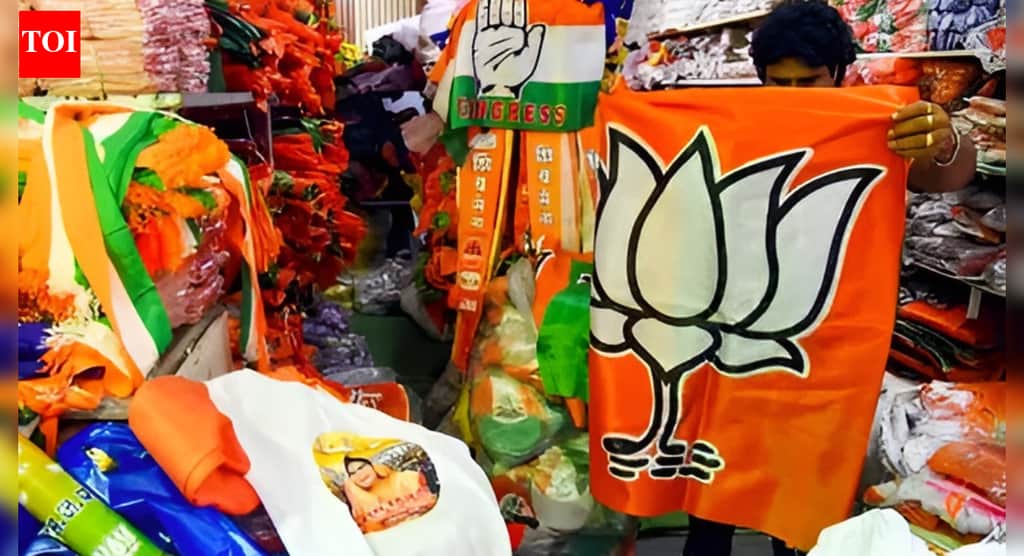
NEW DELHI: The stage is set for the first electoral showdown of 2026 as elections for 29 local bodies in Maharashtra are scheduled for January 15. These elections were long overdue because of legal battles.According to the Maharashtra Election Commission, polls for these corporations were held on different dates between 2015 and 2018. Elections for the Brihanmumbai Municipal Corporation (BMC), which governs Mumbai, and 17 other major cities were last held in 2017. Five municipal corporations, including Vasai-Virar, Kolhapur, Aurangabad, Navi Mumbai and Kalyan-Dombivli, went to the polls in 2015, while four others — Dhule, Jalgaon, Ahmednagar and Sangli-Miraj-Kupwad — had elected their mayors in 2018.
Interestingly, many tectonic shifts were witnessed in the run-up to the elections. While the Thackeray and Pawar families ironed out alliances, many corporators from various parties jumped ship just ahead of the polls.What is at stakeThe BMC has a budget of more than Rs 74,000 crore -- larger than the GDP of many states in the country and several countries across the world.Geographically, Mumbai, along with its suburbs, Pune and Nashik do not even constitute one-fourth of Maharashtra’s total area.
However, this region is significant because of its wealth and the industries it hosts. Therefore, the corporations in these areas are highly important for political parties.It is thus inevitable that these elections become testing grounds for parties and alliances. The Mahayuti and the opposition Maha Vikas Aghadi (MVA) are the main contenders, but regional and smaller parties are also in the fray and determined to make their presence felt at the local level of urban governance.
The BJP and Shiv Sena, constituents of the Mahayuti, are contesting 137 and 90 seats, respectively. The third Mahayuti ally, the
, is fighting independently and has fielded 94 candidates, meaning the party will take on its state-level partners in nearly 100 seats if no nominations are withdrawn.The opposition
has put up 143 candidates, while its new ally, the Vanchit Bahujan Aghadi (VBA), led by former MP Prakash Ambedkar, has fielded 42 contestants even though it was allotted 62 seats in a pre-poll pact with the national party.The Rashtriya Samaj Paksh (RSP), a Congress ally, has fielded six candidates.The Shiv Sena (UBT), led by former chief minister Uddhav Thackeray, is contesting over 150 seats, the NCP (SP) 11, and Raj Thackeray’s Maharashtra Navnirman Sena (MNS) the rest.Thackeray brothers uniteIn the upcoming elections, the Thackeray brothers - Uddhav and Raj Thackeray - have decided to join hands after 20 years and are contesting the elections on the plank of “Maratha pride”.
“We will make sure that Marathi people get what they want,” Raj Thackeray said while announcing the alliance between Shiv Sena (UBT) and the Maharashtra Navnirman Sena.
‘Pawar’ allianceMeanwhile, the Ajit Pawar-led NCP also announced that it will contest the Pimpri-Chinchwad and Pune local body elections together with the NCP (Sharad Pawar faction).“For the sake of the Pimpri-Chinchwad Municipal Corporation elections, the ‘clock’ and the ‘tutari’ (trumpet) have united.
The parivar has come together,” deputy chief minister Ajit Pawar said while announcing the alliance.The announcement, however, came with a rider -- the decision has been taken only for Pune and Pimpri-Chinchwad, and family patriarch Sharad Pawar was not involved in the decision-making process.
This comes two years after Ajit Pawar, along with a group of senior leaders, split from his uncle Sharad Pawar and joined hands with the BJP and Eknath Shinde’s Shiv Sena in Maharashtra.
He had raised objections to Sharad Pawar continuing to lead the party despite his age.Ajit Pawar was sworn in as deputy chief minister under the new alliance. He favoured aligning with the ruling coalition, while Sharad Pawar’s faction insisted on remaining with the opposition.The Election Commission later recognised Ajit Pawar’s faction as the legitimate NCP, retaining the ‘clock’ symbol. Sharad Pawar’s faction, NCP (SP), adopted the ‘tutari’ (curved trumpet) symbol.Both factions contested elections separately. After the 2024 Lok Sabha elections, where his faction faced setbacks, Ajit Pawar acknowledged that turning his back on family had been a “mistake”.In the 2024 Maharashtra assembly elections, Ajit Pawar’s NCP increased its tally from just six Assembly segment leads in the Lok Sabha elections to 41 MLAs, defeating the senior Pawar’s nominees in 27 head-to-head contests; the latter won seven.NCP (SP) to join NDA?During the campaign, Shiv Sena minister Sanjay Shirsat floated speculation over the possibility of the NCP (SP) joining the BJP-led NDA government.He said that local-level adjustments could be a precursor to a broader political understanding.“In the coming future, there is a possibility that Sharad Pawar could join the NDA. Did anyone believe that he would join hands with Uddhav Thackeray? But he did, and they were in power for two-and-a-half years,” Shirsat said.“He opposed Sonia Gandhi and left the Congress, and then immediately made an alliance with them. It would not be surprising if he joins the NDA. If you study politics, this has been his career pattern,” he added.Will MVA disintegrate?The coming together of the Thackeray brothers and the senior and junior Pawars signals a silent end of the Maha Vikas Aghadi (MVA) -- the opposition front that Uddhav Thackeray formed with the Congress and Sharad Pawar’s NCP in 2019 to keep the BJP out of power after the assembly elections.The opposition coalition performed strongly in the 2024 Lok Sabha elections, winning 30 of the 48 seats in the state. The glory, however, was short-lived as the MVA was decimated in the Assembly elections held later in the year, collectively winning only 46 of the 288 seats.In the run-up to the local body polls, the Congress has been left out of alliances after it refused to join hands with Raj Thackeray’s MNS, given his aggressive “outsiders” pitch against north Indians.The grand old party, which had earlier asserted it would contest the January 15 polls solo on all 227 wards, has now joined hands with Prakash Ambedkar-led VBA, allocating it 62 seats.Apart from the VBA, the Congress has allocated 10 seats to the RSP and two to the Republican Party of India (Gavai faction), unsettling functionaries of the party’s city unit, leaders said.The Congress move to chart its own course in Maharashtra is a bold gambit.
The party, which had a fairly strong presence in state politics till 2009, has since seen its electoral fortunes decline.In the 2024 assembly elections, the Congress won only 16 of the 101 seats it contested. Its vote share stood at 12.42% — the lowest for the party in Maharashtra, though still higher than all other players except the BJP.However, this solo fight pits the Congress directly against the BJP, which has been the undisputed winner in recent electoral contests.
The move also divides the opposition space in the civic polls, giving the BJP-led Mahayuti an advantage.Who won the last local body elections?The last elections in the municipal corporations were largely dominated by the BJP and the Shiv Sena, which formed governments in 15 municipal corporations, including Mumbai and Thane.The BJP secured a majority in 13 corporations on its own, including Pune, Jalgaon, Mira-Bhayandar, Nagpur and Pimpri-Chinchwad.
The Shiv Sena achieved a majority in its stronghold, Thane. In Mumbai, they ruled as partners until the tenure ended in 2022.Who dominated municipal council polls?The BJP-led Mahayuti delivered a sweeping verdict after two rounds of the first phase of Maharashtra’s civic elections, winning presidents’ posts in nearly 207 of 288 municipal councils and nagar panchayats.The BJP emerged as the biggest gainer with victories in over 117 local bodies, while the MVA was reduced to 44 posts.
Despite emerging as a distant challenger statewide, the Congress checked the BJP's advances in parts of Vidarbha. Western Maharashtra saw Mahayuti allies battling each other as the Congress and NCP (SP) struggled to hold ground.Meanwhile, the BJP made gains in Mumbai and Konkan, encroaching into traditional Shiv Sena, PWP and NCP pockets. The Shinde-led Sena expanded its footprint beyond the Mumbai Metropolitan Region (MMR), finishing second across the state.
Editorial Context & Insight
Original analysis & verification
Methodology
This article includes original analysis and synthesis from our editorial team, cross-referenced with primary sources to ensure depth and accuracy.
Primary Source
Times of India