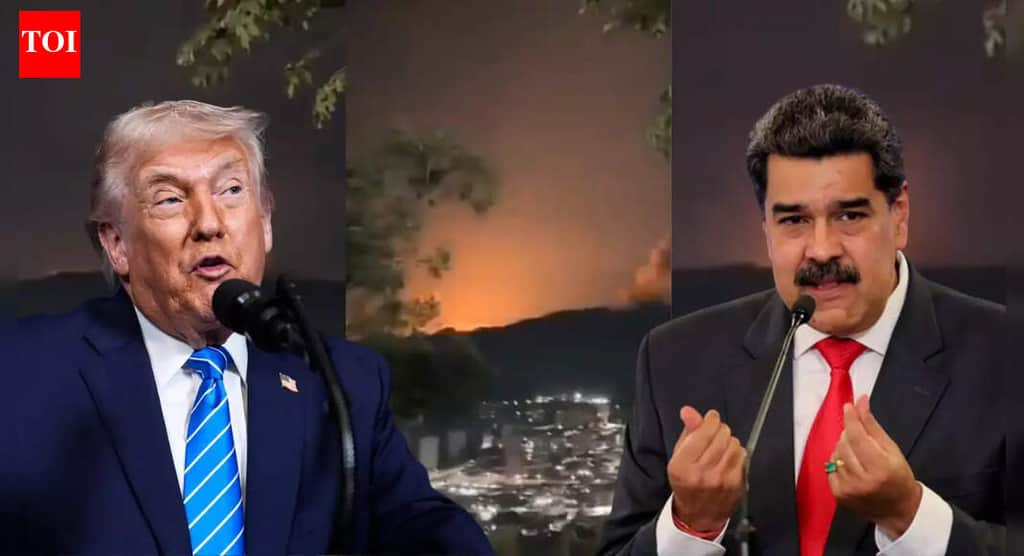
Months of clandestine intelligence-gathering by the CIA, followed by detailed military rehearsals and last-minute weather-related delays, preceded what US officials described as a “flawless” operation to capture Venezuelan President Nicolás Maduro in a high-risk pre-dawn raid on Saturday.The operation, named ‘Operation Absolute Resolve,’ culminated in Maduro being extracted from Venezuela by US special forces and flown to the United States to face federal drug trafficking charges.
According to officials familiar with the mission, a covert CIA team entered Venezuela in August to gather intelligence on Maduro, whom the Trump administration had designated a narco-terrorist. With the US embassy in Caracas closed, the officers operated without diplomatic cover and remained undetected for months, reported NYT. Earlier, Trump has publicly stated he authorised the CIA to carry out covert action in Venezuela. Asked if the agency had been instructed to “take out Maduro,” the president replied that answering would be “ridiculous.” The agency combined intelligence from a human source close to Maduro with surveillance from stealth drones operating over Caracas to build a detailed picture of his daily movements. Together, the inputs enabled US agencies to map the Venezuelan leader’s movements in detail, including his daily routinesGeneral Dan Caine, chairman of the Joint Chiefs of Staff, later said the intelligence allowed the US to map Mr.
Maduro’s routines with precision, what he ate and even what pets he kept. Officials said this information became critical to planning the eventual military operation.
As intelligence accumulated, Delta Force commandos began rehearsing a potential extraction at a full-scale replica of Maduro’s compound built in Kentucky by the joint special operations command. The drills focused on rapid entry, breaching reinforced steel doors and clearing the structure within minutes. According to NYT the mission posed significant challenges. Maduro frequently rotated between six and eight locations, often deciding where he would stay late in the evening. This meant US planners did not always have confirmation of his whereabouts until shortly before nightfall, complicating targeting decisions.The military also sought to minimise civilian casualties, narrowing the window in which the operation could be launched.
In the months leading up to the raid, the US stepped up pressure on Maduro. A week before the operation, the CIA carried out a drone strike on a Venezuelan port facility. Separately, the US military has for months conducted a legally disputed campaign in the Caribbean and eastern Pacific that destroyed dozens of boats and killed at least 115 people.According to US officials, Maduro attempted to avert an American raid by offering access to Venezuelan oil, reported NYT.
A US official said a proposal conveyed on December 23 would have required Maduro to leave the country for Turkey. The offer was ultimately rejected, and officials said it became clear the talks would not succeed.
President Donald Trump authorised the military to proceed as early as December 25 but left the final timing to Pentagon officials and Special Operations planners. The holiday period was seen as favourable, because many Venezuelan officials and military personnel were on leave.In the days before the raid, the US deployed additional special operations aircraft, electronic warfare planes, Reaper drones, search-and-rescue helicopters and fighter jets to the region. Analysts said the scale of the deployment suggested military action was imminent.Unseasonably poor weather delayed the operation by several days. Trump while speaking at the press conference at Mar-a-Lago said the operation was delayed by four days due to bad weather conditions. Once conditions improved, commanders monitored a “rolling window” of targeting opportunities. Trump issued the final go-ahead at 10.46 pm Friday (local time) while monitoring developments from Mar-a-Lago.
The operation formally began around 4.30 pm Friday (local time), when US officials approved the launch of certain air assets. For the next several hours, they continued monitoring weather conditions and Maduro’s location.
Trump spent the evening at Mar-a-Lago, where aides informed him he would be contacted later for final approval. He gave the order by phone and then joined senior national security officials in a secure room on the property, and saw the operation unfolding live.Inside Venezuela, the operation opened with a cyberattack that cut power across large parts of Caracas, US officials said, allowing aircraft and helicopters to approach with reduced detection.
More than 150 US aircraft, including drones, fighters and bombers, took off from 20 bases and naval vessels. As they advanced, officials determined that tactical surprise had been maintained.Early Saturday, US warplanes struck Venezuelan radar and air defence installations. A senior Venezuelan official said at least 40 people, including civilians and military personnel, were killed during the attacks.Despite the suppression of air defences, US helicopters came under fire as they approached Maduro’s compound at around 2.01 am (local time).
One helicopter was hit, and about half a dozen US soldiers were injured, officials said. The Delta Force operators, flown in by the Army’s 160th special operations aviation regiment, breached the compound using explosives and reached Maduro within minutes. An FBI hostage negotiator was on hand but was not required. “I watched it literally like I was watching a television show,” Trump later said on Fox News, describing how he monitored the raid in real time.
Within five minutes of entering the building, Delta Force reported that Maduro was in custody. He and his wife were flown out by helicopter and transferred by 4.29 am Caracas time to the USS Iwo Jima, positioned in the Caribbean. From there, they were taken to Guantánamo Bay and then flown to a military-controlled airport near New York. Trump watched the operation until US forces exited Venezuelan airspace, officials said.The president in the news conference said the US was prepared to carry out further strikes if necessary and warned other Venezuelan leaders they could also be targeted.At the same time Trump also said for now US would be running Venezuela, until as such a "proper, safe transition takes place." He also mentioned the vast oil reserves of Venezuela which he said now will be tapped by US.
While US officials described the mission as tactically successful, it has raised broader questions about civilian casualties, legality and Washington’s long-term role in Venezuela.
Editorial Context & Insight
Original analysis & verification
Methodology
This article includes original analysis and synthesis from our editorial team, cross-referenced with primary sources to ensure depth and accuracy.
Primary Source
Times of India