



Key takeaways
- With many homegrown foundation model initiatives competing for talent, compute and enterprise mindshare, the question of who will define…
- 6 Cr in funding from the IndiaAI Mission — the largest single allocation under the government’s ₹1,500 Cr AI push — it is building…
- But unlike for-profit challengers such as Sarvam AI or Tech Mahindra’s Project Indus, BharatGen operates as a non-profit with a mission…
What happened
With many homegrown foundation model initiatives competing for talent, compute and enterprise mindshare, the question of who will define the country’s AI future is becoming increasingly consequential. Enter BharatGen. Launched as a non-profit consortium anchored at IIT Bombay and backed by the Department of Science and Technology, BharatGen is not your typical AI startup.
From Hindi to Marathi, Telugu, Tamil, Punjabi, Bengali, one more order of magnitude. The rest are even further behind. You have to convert them into native digital text, and that is hard and expensive. We have set up a world-class pipeline that converts scanned documents to digital text.
We offer this pipeline to heritage preservation groups, we convert their material for free, and if they’re okay with it, we keep one copy to train our models. We don’t republish or sell it. We also offer content-as-a-service and quid-pro-quo arrangements where enterprises get access to our models in return for data. Inc42: What does the cost structure look like?
How much of your spending goes into training versus data collection? Rishi Bal: Data collection is labour-intensive, and luckily in India that is relatively cheap. It takes a lot of time and effort — we have people based in different parts of the country going out and meeting publishers and digitisation partners, but it is not capital intensive.
The capital intensive part is training the models, and that is the bulk of the expenses for anybody building foundation models. Roughly 80% goes into training and 20% into data collection is a good way of looking at it. Inc42: What are the top two challenges BharatGen is facing in developing these models? Rishi Bal: One is the talent ecosystem. LLM building is fundamentally a people business.
It is quite challenging to hire, train, and retain the kind of talent needed for this work, especially as a non-profit. The second is a more systemic challenge. Because we are not a typical AI startup with a product-launch-and-revenue trajectory, what we are trying to do is grow an ecosystem. And growing an ecosystem requires patience. Inc42: How does the non-profit structure affect your revenue model and commercial strategy?
Why it matters
6 Cr in funding from the IndiaAI Mission — the largest single allocation under the government’s ₹1,500 Cr AI push — it is building multilingual and multimodal AI models across all 22 scheduled Indian languages. Its model families — Param, Patram, Sooktam and Shrutam — span text, vision and speech, and its open-source releases have already crossed 1 lakh downloads.
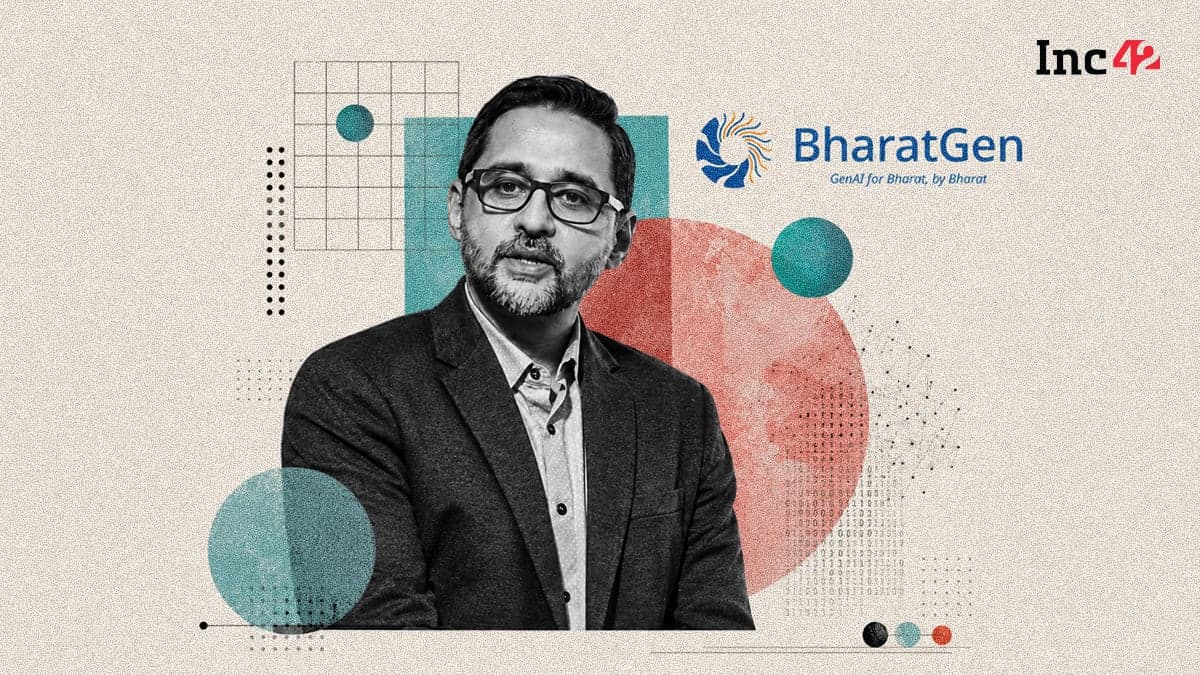
But unlike for-profit challengers such as Sarvam AI or Tech Mahindra’s Project Indus, BharatGen operates as a non-profit with a mission that extends beyond model releases. In an interaction with Inc42, BharatGen CEO Rishi Bal laid out the organisation’s roadmap for the next 12 to 18 months.
He spoke about the challenges of building AI for India’s underserved languages, and explained why the non-profit model is a feature, not a limitation, for India’s sovereign AI ambitions. Inc42: What does the roadmap for BharatGen models look like over the next 12 to 18 months? Rishi Bal: Let me start with context. BharatGen is not a typical startup. We chose not to set it up as a for-profit company.
We set it up as a non-profit. Our goal is to contribute to growing the whole AI ecosystem in India. We also build models. But if you think of an iceberg, the models and applications are the visible part. The invisible part is significantly larger.
If you don’t have a core group doing deep research across India, you’re not going to have the people who can create this next generation of AI. Our team has published over 30 papers in the past 18 months across top global journals. That’s an important piece because without a robust research ecosystem, you can’t be a global player as a country.
On the application side, we are also building purpose-driven AI tools for India’s specific needs. Krishi Sathi, for instance, is a farm bot equipped with text-to-speech and data-driven insights to guide farmers. e-VikrAI is an AI assistant for Indian sellers to support and elevate their business operations. These are not just proofs of concept, they are live products reflecting the kind of real-world impact we are aiming for.
Inc42: How are you approaching data collection, especially for languages where digital text is scarce? Rishi Bal: There is a massive data unlock that has to happen. When you go from English to even a European language like Spanish or French, there’s a big drop in data availability. From there to Hindi, there’s another order of magnitude drop.
What to watch
Rishi Bal: As a non-profit, I don’t have to return 10x capital to investors. But over time, I do want BharatGen to reach self-sustenance. Foundational model building is very expensive, so I think it will take about five years to get to that point. The first 18 months were focused on model building. Once we proved these models are excellent, demand started emerging organically.
Companies routinely approach us saying they’ve tried open-source and commercial models but are running into challenges. That is where we create custom models, custom solutions, and applications. We are working with a nationalised bank on a range of solutions, with a couple of state governments on paid commercial projects, not just proofs of concept, and with educational institutes. These are all committed, paid engagements.