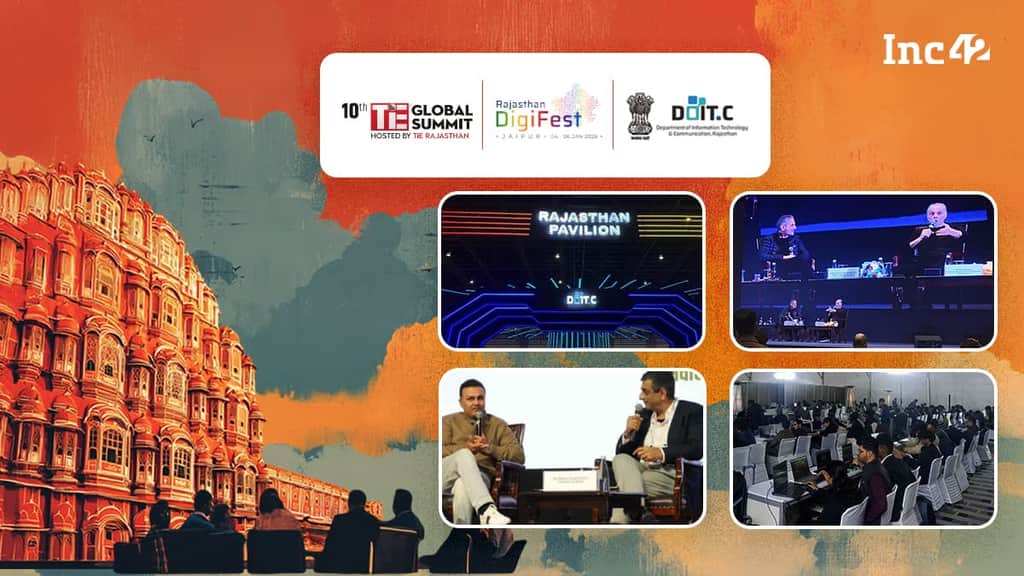
On the second day of Rajasthan DigiFest X TiE Global Summit 2026, TiE announced a plan to work towards creating 100 Mn jobs in India over the next decade
Policymakers, global tech leaders, investors and founders discussed AI, capital access, policy reform and scaling startups beyond metros on the second day
Speakers underlined the need for simpler regulations, sovereign AI infrastructure and stronger ecosystem partnerships to enable long-term job creation
The second day of the Rajasthan DigiFest X TiE Global Summit 2026 shifted focus to employment generation, with TiE announcing a long-term push to create 100 Mn jobs in India over the next decade. Entrepreneurship, skills development and India-first innovation were positioned as the primary levers for economic growth.
The job creation roadmap outlined during Day 2 sessions included data-led identification of employment potential across sectors, deeper utilisation of existing industrial and digital infrastructure in states such as Gujarat and Haryana, and large-scale skill training aligned with emerging technologies.
The day also saw participation from a wide cross-section of policymakers, industry leaders, investors and global technology experts, including Mohan Yadav, chief minister of Madhya Pradesh; Smriti Irani, former Union cabinet minister; Navneet Munot, MD and CEO of HDFC Asset Management; Nilesh Shah, MD of Kotak Mahindra Asset Management; Shanker Trivedi, senior vice president of NVIDIA; Fadi Ghandour, founder of Aramex and executive chairman of Wamda Capital; and Pramod Bhasin, chairman of ICRIER and founder of Genpact, among several other key voices.
The broader focus of the Summit remained on enabling ecosystem partnerships, with an emphasis on collaborations with global organisations to support capital access, market linkages and business communication.
Policy reforms featured prominently across discussions, with speakers calling for a simpler GST structure, reduced compliance friction for startups and MSMEs, and greater government procurement from young companies.
Addressing the ‘Destination Madhya Pradesh’ session at the 10th edition of the TiE Global Summit, CM Yadav pitched the state as a fast-emerging investment destination.
Yadav said sustained policy support has helped position Madhya Pradesh among the top three states in India for investments. “If you invest INR 100 Cr in Madhya Pradesh, the government is prepared to extend close to INR 30 Cr in support and subsidies,” he said.
Former Union minister Irani kicked off the second day by sharing insights from her work impacting women entrepreneurs across India’s 700+ cities. Reflecting on her career across media, politics and social impact, Irani said, “Every choice comes with the probability of failure, but that cannot stop the choice from being made.”
She added that conversations around women-led enterprises must move beyond intent to outcomes, arguing that “the economics of equity” would determine whether women entrepreneurs meaningfully contribute to employment growth. Irani also spoke about efforts to bridge credit gaps for women-led micro enterprises, noting that improved access to formal finance could unlock significant economic potential, particularly in tier II & III cities and rural markets.
AI and global market access emerged as central themes during the Summit. Ammar Al Malik, executive vice president of TECOM Group and MD of Dubai Internet City, highlighted the growing depth of India-UAE economic ties. He said non-oil trade between India and the UAE has grown substantially, creating expansion opportunities for Indian startups that look to the Middle East as a launchpad.
“Dubai Internet City today is the largest technology ecosystem in the region, and Indian startups already form one of our biggest applicant bases,” Malik said, adding that access to global talent, AI infrastructure and regulatory sandboxes could help Indian companies scale faster.
On the technology front, NVIDIA’s Trivedi took an optimistic view of AI’s impact on employment. While acknowledging that some roles would become redundant, Trivedi argued that every major technology shift historically created more jobs than it displaced.
“Every single person will be more informed and more capable because of AI,” he said, urging policymakers to invest in sovereign AI infrastructure and local data ecosystems to ensure India captures value domestically.
MIT professor Ramesh Raskar also spoke about Project NANDA, a global initiative focused on building AI systems capable of reasoning, planning and acting on behalf of humans using local data and context. He linked this to agentic AI, arguing that such systems could enable scalable problem-solving across healthcare, education and public services.
Veteran entrepreneur Ghandour urged founders to keep building even as regulation struggles to keep pace with technology. “Regulators do not move at the speed of innovation. Entrepreneurs have to continue building while frameworks catch up,” he said.
Genpact founder Bhasin said that while access to capital for Indian entrepreneurs has improved over the years, startups continue to face challenges around market access and compliance complexity. He called on the government to become a more active buyer of deeptech and AI solutions, allowing startups to scale through real demand rather than subsidies.
Asset managers Munot and Shah discussed personal finance fundamentals and the growing global relevance of Indian entrepreneurship during a light-hearted panel session.
HDFC Asset Management Company’s Munot shared a bullish view on India’s growth prospects, drawing on Warren Buffett’s long-held belief about being in the right place at the right time. “Everyone who is in India today is at the right place at the right time. We are only constrained by our imagination,” he said.
Kotak Mahindra Asset Management’s Shah spoke about investor discipline and behaviour, drawing from an example in the Mahabharata. “Everyone knows what the right thing to do is. The challenge is controlling the Duryodhana within us and actually doing it,” he said.
Editorial Context & Insight
Original analysis & verification
Methodology
This article includes original analysis and synthesis from our editorial team, cross-referenced with primary sources to ensure depth and accuracy.
Primary Source
Inc42 Media