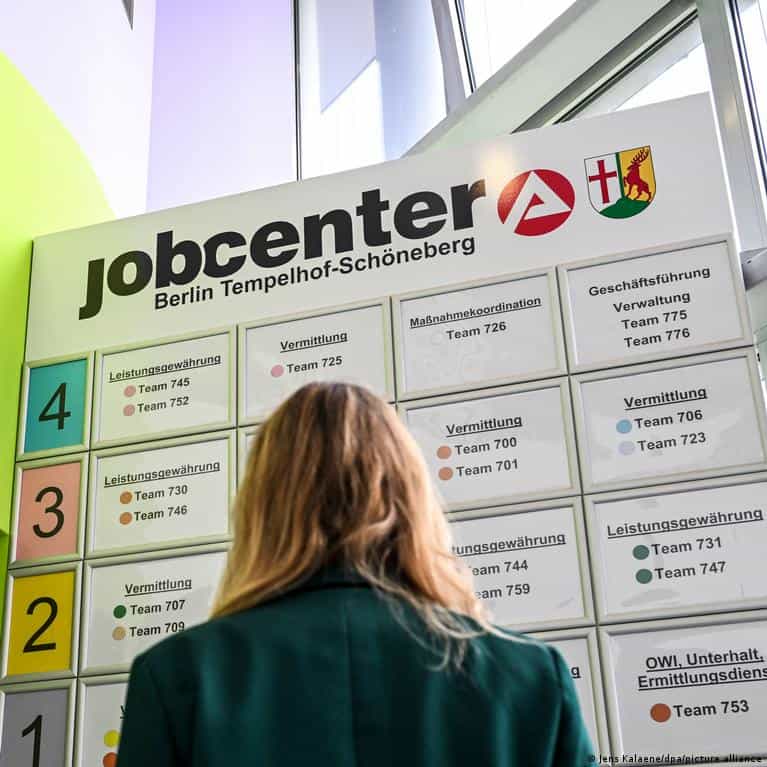
For a short time during and after COVID, Europe's workers enjoyed rare leverage over their employers. Generous furlough and reduced working-hour programs, like Germany's Kurzarbeit, helped companies offset their staffing costs. Offices became optional thanks to remote work.
Coming out of the pandemic, headlines about the so-called Great Resignation reflected a global labor shortage that sharply increased demand for talent. Workplace burnout gave rise to another new phrase, Quiet Quitting, as employees rejected overdelivering in pursuit of a healthier work-life balance.
Research by McKinsey consultancy in 2022 found that a third of European workers were considering quitting their jobs within three to six months, which Angelika Reich, leadership advisor at the executive recruitment firm Spencer Stuart, told DW was a "striking figure for a region with a traditionally low [staff] turnover."
With the continent's industrial sector now under pressure, wage growth slowing and the threat of artificial intelligence (AI) replacing human work, that moment has quickly reversed.
Reich noted how Europe's labor market has "cooled down" and how "fewer job vacancies and a tougher economic climate naturally make employees more cautious about switching jobs."
Despite remaining resilient, the 21-member eurozone's labor market is projected to grow more slowly this year at 0.6% compared to 0.7% in 2025, according to the European Central Bank (ECB).
Although that drop seems tiny, each 0.1 percentage point difference amounts to around 163,000 fewer new jobs being created. Just three years ago, the eurozone created some 2.76 million new jobs while growing at a robust rate of 1.7%.
Migration has also played a major role in shaping Europe's labor supply, helping to ease acute worker shortages and support job growth in many countries. However, net migration is now stabilizing or falling.
In Germany, more than one in three companies plans to cut jobs this year, according to the Cologne-based IW economic think tank.
The Bank of France expects French unemployment to climb to 7.8%, while in the UK, two-thirds of economists questioned by The Times newspaper think unemployment could rise to as high as 5.5% from the current 5.1%.
Unemployment in Poland — the European Union's growing economic powerhouse — is edging higher, reaching 5.6% in November compared to 5% a year earlier. Romania and the Czech Republic are also seeing similar upticks in joblessness.
The softening of the labor market has prompted new terms, like the Great Hesitation, where companies think twice about hiring and workers are cautious about quitting stressful jobs, and Career Cushioning — quietly preparing a backup plan in case of layoffs.
Across Europe, however, the overall picture remains far from bleak. Spain, which is benefitting from a post-COVID tourism boom, is set for another bumper year of jobs growth, along with Luxembourg, Ireland, Croatia, Portugal and Greece, according to the European Centre for the Development of Vocational Training, an official EU agency. Even in countries experiencing weaker growth, pockets of strong worker demand remain.
"What felt like a widespread scarcity of workers during the Great Resignation has become more sector-specific," Julian Stahl, labor market expert for the online recruiter XING, told DW. "There are still serious shortages in retail, health care, logistics, engineering and other highly specialized roles."
Germany's industrial base has borne the brunt of the job losses in recent months, particularly in the automotive, machinery, metals and textiles sectors. High energy costs, weak export demand and fierce competition from China have erased more than 120,000 positions, government data show.
To view this video please enable JavaScript, and consider upgrading to a web browser that supports HTML5 video
Those same pressures are hitting manufacturers in France, Italy and Poland just as hard, pushing the eurozone's Manufacturing Purchasing Managers' Index (PMI) down to 48.8 in December, its lowest reading in nine months. Readings above 50.0 indicate growth in activity, while those below point to contraction.
"Most firms are aiming to hold the line or shrink slightly rather than grow," said Stahl, adding that hiring hasn't "stopped completely."
Negative headlines about manufacturing job cuts appear to be causing reputational damage among Europe's most treasured industries, says Bettina Schaller Bossert, president of the World Employment Confederation, a global nonprofit representing the private employment services industry and based in Brussels, Belgium.
"A lot of young graduates believe there is no future in the automotive sector. They're not interested in pursuing careers [with European carmakers] even though there are fantastic new opportunities," Schaller Bossert told DW.
Europe has rolled out AI far more slowly than the United States and China, held back by lower investment, stricter regulation and lagging adoption. But that hasn't eased employee anxiety that automation will quickly replace humans at work, especially after negative predictions of millions of job losses ahead.
A study by consulting giant EY published in July found that a quarter of Europe's workers fear AI could put their own jobs at risk, while 74% believe firms will need a smaller headcount as a result of the technology.
In November, the Nuremberg-based Institute for Employment Research (IAB) projected that 1.6 million jobs in Germany alone could be reshaped by or lost to AI by 2040. The agency of the German labor office foresees that high-skilled positions will be disproportionately hit, although the tech sector could create around 110,000 new jobs.
Enzo Webe, head of the IAB's forecasting department, said in the rport AI would lead to a "transformation" of the labor market, but "not less work."
Other predictions range from the emergence of a so-called AI precariat — entire populations that are not just jobless or underemployed, but have lost their purpose, identity and social belonging — to more optimistic views that argue AI will redistribute work, not eliminate whole professions.
"A lot of drudge tasks can be pushed to AI to free up human labor," John Springford, a labor market expert at the Centre for European Reform, told DW. "But there's a good reason to believe that professional, knowledge work won't shrink."
Anthony Klotz, the University College London professor who coined the term the Great Resignation, argues in his upcoming book "Jolted" that quitting jobs is less about long-term dissatisfaction and more about sudden moments of clarity.
For many European workers, the rapid advance of AI could become exactly that kind of jolt, a catalyst that prompts them to move preemptively, before automation reshapes their roles for them.
Editorial Context & Insight
Original analysis and synthesis with multi-source verification
Methodology
This article includes original analysis and synthesis from our editorial team, cross-referenced with multiple primary sources to ensure depth, accuracy, and balanced perspective. All claims are fact-checked and verified before publication.
Primary Source
Verified Source
Deutsche Welle
Editorial Team
Senior Editor
Fatima Al-Hassan
Specializes in World coverage
Quality Assurance
Associate Editor
Fact-checking and editorial standards compliance