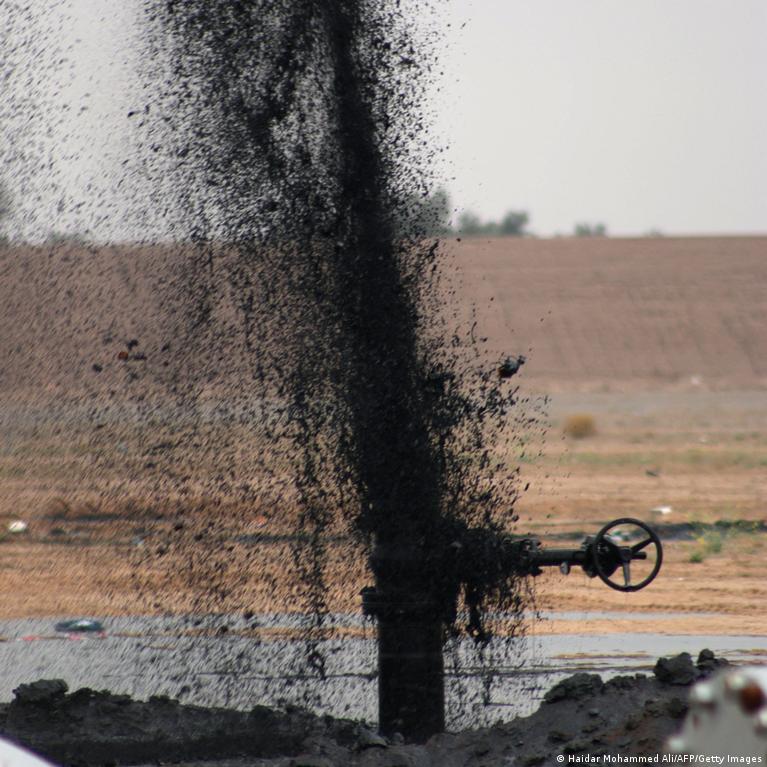
Peak Oil once struck fear into policymakers, businesses and consumers as a looming moment when the world might suck the last drops of black gold from the ground, like a straw reaching the bottom of a milkshake.
The idea was popularized in the 1950s by geologist M. King Hubbert, who warned that US oil production would follow a bell‑shaped curve and eventually hit an unavoidable peak as fields matured and declined.
Climate change has flipped the narrative in recent years. Instead of fearing scarcity, the debate now centers on when demand will finally peak, as the shift to electric vehicles (EV) and other clean energy gathers pace.
At the same time, political pushback, from delays to combustion‑engine car bans to rollbacks of EV subsidies, is casting doubt on how fast that transition from fossil fuels will actually happen.
To view this video please enable JavaScript, and consider upgrading to a web browser that supports HTML5 video
Two opposing views have emerged about when global oil demand will start to decline.
The International Energy Agency (IEA), a Paris-based body representing major oil-consuming nations, projects that demand will flatten to around 102 million barrels per day (bpd) by 2030. In its World Energy Outlook 2025, published last month, the IEA's main Stated Policies Scenario assumes governments follow through on ambitious energy and climate goals.
OPEC, the Organization of the Petroleum Exporting Countries, takes the opposite view. In its latest long‑term outlook, the oil producer group forecasts that demand will continue to rise for decades and sees no peak before 2050, projecting consumption will reach nearly 123 million bpd by mid‑century.
The two organizations do, however, share one underlying concern: supply is becoming harder to sustain. OPEC believes robust demand growth will justify steady investment to ensure ample reserves from its members for decades to come. The IEA, by contrast, offers a more restrained outlook.
Under pressure from the Trump administration, the agency reinstated its more conservative Current Policies Scenario, which was dropped in 2020 and is based on current laws and observable trends that fall far short of climate ambitions.
This scenario suggests supply growth will slow after 2028 as non-OPEC sources like the United States, Brazil, Guyana and Canada wane. That would leave supply reliant on Middle East OPEC countries like Saudi Arabia, the United Arab Emirates and Iraq.
Oil demand could, meanwhile, rise to 113 million bpd by 2050 if climate pledges remain unimplemented, the IEA warned.
Franziska Holz, deputy head of the energy, transportation and environment department at the German Institute for Economic Research (DIW Berlin), thinks reinstating the conservative scenario is a "positive" as it proves that the world is "not on track with our climate targets ...[and] not fast enough in replacing fossil fuels in our energy mix."
Holz quipped that the "Americans had probably not intended that" when they leaned on the IEA to reinstate the more cautious scenario.
When it comes to Peak Oil, both organizations point to the same underlying risk: oil supply won't take care of itself. Older fields are declining fast and without steady investment, production from existing sites will drop by about 8% a year, the IEA warned last month.
Huge amounts of new output is required just to keep the global oil supply flat. Yet most spending is devoted to offsetting declines from aging fields rather than bringing significant new production online.
With discoveries at historic lows and growing reliance on fast‑depleting shale and deepwater wells, the oil sector is increasingly running just to stay still.
Antonio Turiel, a physicist and Peak Oil researcher at Spain’s CSIC institute, argues that the US fracking boom, the engine of non‑OPEC growth, is already nearing exhaustion. The best drilling spots in the Permian Basin, in Texas and New Mexico, have been tapped and decline rates are accelerating.
"After 15 intense years, we are arriving at the end of the fracking road," Turiel told DW. "We can keep up the mirage for an additional year or two, but afterwards the fall is going to be incredibly fast."
Turiel believes the world is approaching a far earlier Peak Oil than most agencies are willing to acknowledge, noting that 80% of all oil fields "are already past their peak production."
As well as shale, he added that the world has been too reliant on aging supergiant fields for stability, whose fastest phase of decline is about to commence.
"Most likely, we will start having strong annual declines — circa 5% annually — even before 2030," he told DW. "After that point, expect a decline in the gross amount of oil extracted yearly of about 50% in 20 years."
Turiel noted that from 2020 to 2025, an average of 3 billion bpd of oil was discovered — 12 times less than global consumption. And while OPEC doesn't foresee Peak Oil and IEA's worst-case scenario sees none by 2050, Turiel's timeline is stark: "Most probably by 2027, in any case before 2030. Even sooner if some undesirable geopolitical problems unfold."
For all the debate about when oil demand will top out, the distance between governments' climate promises and the policies they are actually delivering remains wide and growing. Only a handful of countries have built durable frameworks to accelerate the shift to clean energy, including Norway’s EV policies,China’s clean‑tech industrial strategy and the European Union’s climate laws.
By contrast, the US under President Donald Trump has moved to expand domestic oil and gas production, weaken federal climate regulations and scale back support for EVs, which analysts say will likely slow the global shift away from fossil fuels.
Jeff Colgan, a political science professor at Brown University, Rhode Island, thinks the Trump administration was not only undoing his predecessor Joe Biden's efforts to support US green industrial policy. More fundamentally, the Trump administration has been "attacking" the science and institutions in the US government that have fostered climate policy, he told DW.
"That has implications not only for US environmental policy, but will have ripple effects around the world," he said.