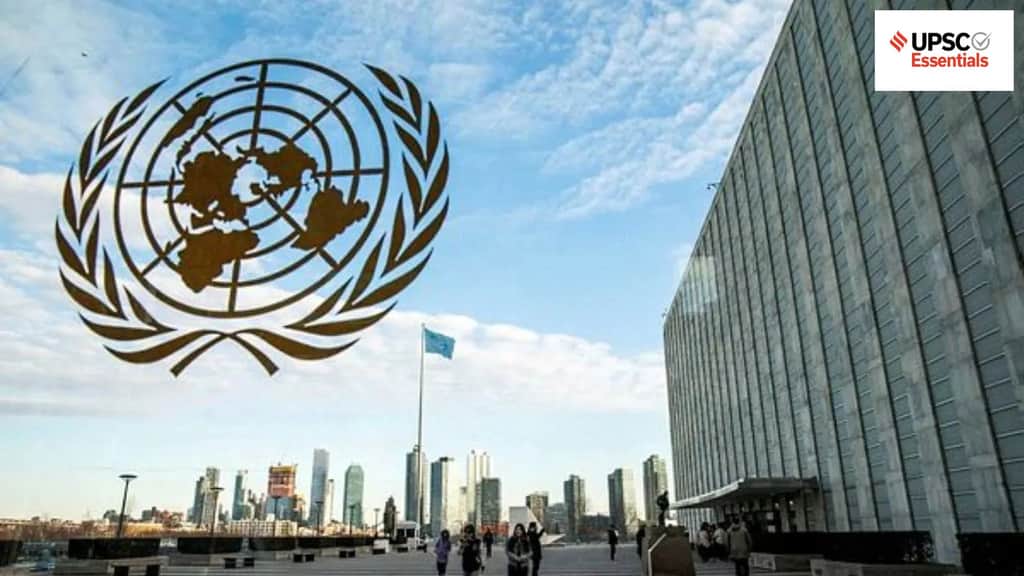
UPSC Essentials brings to you its initiative of subject-wise quizzes. These quizzes are designed to help you revise some of the most important topics from the static part of the syllabus. Attempt today’s subject quiz on International Relations to check your progress.
🚨 Click Here to read the UPSC Essentials magazine for December 2025. Share your views and suggestions in the comment box or at manas.srivastava@indianexpress.com🚨
With reference to the United Nations, consider the following statements: 2. States are admitted to membership by a decision of the General Assembly upon the recommendation of the Security Council.
3. The Secretary-General is appointed by the General Assembly for a 2-year term.
4. The International Criminal Court is among the main bodies of the United Nations.
How many of the statements given above are correct?
Relevance: This question tests foundational knowledge of the UN system, including membership procedures, tenure of key officials, and distinction between UN organs and associated institutions.
— The United Nations is an international organisation established in 1945. The United Nations, which currently has 193 member states, is driven by the aims and ideals outlined in its founding Charter. The UN has developed over time to keep up with a continually changing globe. Hence, statement 1 is correct.
— All UN Member States are members of the General Assembly. States are admitted to membership by a decision of the General Assembly upon the recommendation of the Security Council. Hence, statement 2 is correct.
— The Secretary-General is appointed by the General Assembly on the Security Council’s recommendation for a five-year, renewable term. Hence, statement 3 is not correct.
— The United Nations’ primary bodies are the General Assembly, Security Council, Economic and Social Council, Trusteeship Council, International Court of Justice, and UN Secretariat. All were formed in accordance with the UN Charter when the Organisation was founded in 1945. Hence, statement 4 is not correct.
Therefore, option (b) is the correct answer. Which of the following countries borders the Baltic Sea?
Relevance: This type of question tests candidates’ conceptual clarity of world geography, especially European seas and bordering countries, a recurring theme in UPSC Prelims. It also helps in eliminating options involving landlocked states and distant maritime regions, strengthening map-based MCQ accuracy.
— Finnish authorities boarded and seized a cargo vessel called Fitburg, after it was suspected of having damaged underwater cables in the Baltic Sea, Finnish police told a press conference.
(Photo: X/@FaytuksNetwork)
— The Baltic Sea is bordered by nine countries: Denmark, Sweden, Finland, Russia, Estonia, Latvia, Lithuania, Poland, and Germany.
— The Baltic Sea is a crucial waterway in Northern Europe, with significant commerce and geopolitical importance. It is connected to the Atlantic Ocean by the Danish Straits.
Relevance: This question tests awareness of UN agency–programme mapping, a recurring UPSC theme in environment, culture, and sustainable development.
— UNESCO’s Local and Indigenous Knowledge Systems (LINKS) programme assists Indigenous Peoples and local communities in studying and articulating the importance of their knowledge systems within a holistic framework that includes livelihoods, languages, cultural and spiritual systems, social organisation, values, and the daily management and governance of landscapes and seascapes.
— East Rennell, located in the southern Solomon Islands, is the world’s largest elevated coral atoll. It encompasses 37,000 hectares, including Lake Tegano, the adjacent woodlands, and coastal ecosystems. In 1998, it was designated a UNESCO World Heritage Site. For generations, the people of East Rennell have lived in harmony with nature, surviving on fishing, subsistence cultivation, and traditional resource management practices.
Which of the following countries dominates the production of rare earth metals?
Relevance: This question tests awareness of strategic minerals and global resource dominance, a frequent UPSC theme linked with geopolitics and supply chains.
— It was April 1964 and Chinese geologists had discovered that the mine also held the world’s largest deposit of rare earths, a set of 17 metals that have become essential ingredients for today’s global economy.
— Rare-earth metals and the magnets made from them are widely used in a long list of civilian and military applications, from cars to fighter jets. China’s position as the leading supplier has given it enormous leverage over manufacturing and leadership in clean energy technologies like electric cars and wind turbines. Companies all over the world depend on Chinese exports of those magnets.
Recently, the Mwazindika spiritual dance has been included in UNESCO’s List of Intangible Cultural Heritage in Need of Urgent Safeguarding. This spiritual dance belongs to: Relevance: This question highlights the UNESCO practice of safeguarding endangered cultural traditions — a part of Intangible Cultural Heritage, which is often asked in static GK and culture-related questions.
— The country is celebrating a landmark cultural achievement following the inscription of the “Mwazindika spiritual dance of the Dawida community of Kenya” on UNESCO’s List of Intangible Cultural Heritage in Need of Urgent Safeguarding.
— The announcement was made during the 20th Session of the Intergovernmental Committee for the Safeguarding of the Intangible Cultural Heritage, held in New Delhi, India, on 9 December 2025. This milestone crowns the effort rooted in preserving living traditions and strengthening cultural identity.
— Mwazindika is a ritual – a profound spiritual invocation, a dance of healing, and a vessel for intergenerational wisdom. Practiced by the Dawida community of Taita, the ceremony blends movement, rhythm, and prayer to guide the community through moments of transition and challenge.
Stay updated with the latest UPSC articles by joining our Telegram channel – IndianExpress UPSC Hub, and follow us on Instagram and X.
Editorial Context & Insight
Original analysis & verification
Methodology
This article includes original analysis and synthesis from our editorial team, cross-referenced with primary sources to ensure depth and accuracy.
Primary Source
The Indian Express