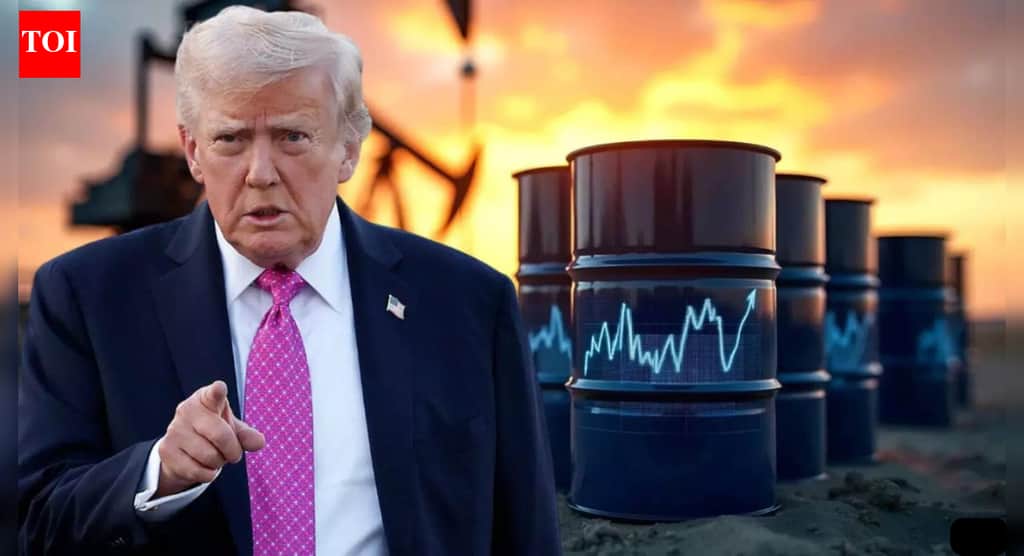
India is watching developments in Venezuela with a mix of caution and concern as geopolitical churn around the oil-rich nation raises questions about global supply, price volatility and long-term energy security.Driving the newsPresident Donald Trump said on Saturday that the United States would take temporary control of Venezuela and tap its vast oil reserves for sale to other countries. Trump said he was “designating people” from his cabinet to oversee Venezuela but offered no further details.In a separate and unexpected remark, Trump suggested US troops could be deployed, saying Washington is “not afraid of boots on the ground.”
The United States’ capture of Venezuelan President Nicolás Maduro has revived expectations that Venezuela’s oil sector could be “opened up” after years of isolation. The country holds the world’s largest proven crude reserves, yet produces only a fraction of what it once did.“Gaining control over Venezuelan crude oil lay at the core of the US operation. Venezuela holds about 18% of the world’s oil reserves, more than Saudi Arabia (around 16%), Russia (about 5–6%), or the United States (around 4%).
Venezuela alone has more crude oil reserves than the US and Russia combined,” the GTRI said in its report."We're going to have our very large United States oil companies... go in, spend billions of dollars, fix the badly broken infrastructure," President Donald Trump said at a Mar-a-Lago news conference said.
However, as per a Reuters report, Venezuela is unlikely to see a meaningful boost in crude output for years even if US oil majors invest billions of dollars.
Political instability, sanctions uncertainty, decaying infrastructure and legal risks continue to deter large-scale capital inflows.As one analyst told Reuters, American firms “won’t return until they know for sure they will be paid and will have at least a minimal amount of security,” underlining why regime change does not automatically translate into higher barrels.
Venezuela’s oil decline is structural, not cyclical.
Output has collapsed over the past two decades following nationalisation, underinvestment and the hollowing out of state oil company PDVSA. Infrastructure across the Orinoco Belt is badly degraded, skilled manpower has fled, and supply chains for equipment and diluents remain broken.Thomas O’Donnell, an energy and geopolitical strategist, told Reuters that “if Trump et al can produce a peaceful transition with little resistance, then in five to seven years there is a significant oil-production ramp up as infrastructure is repaired and investments get sorted out.”
He cautioned, however, that “there’s a lot that could go wrong.”Those risks include armed resistance, a prolonged political transition, and the perception of US dominance - factors that could delay investment decisions well beyond the current decade.
At present, Chevron is the only American major operating in Venezuela, exporting roughly 150,000 barrels per day to the U.S. Gulf Coast under carefully calibrated sanctions waivers.Chevron CEO Mike Wirth said in December that he had spoken with the Trump administration about the importance of maintaining an American presence across political cycles. The company said it continues to operate “in full compliance with all relevant laws and regulations.”Francisco Monaldi of Rice University told Reuters that Chevron is best positioned to benefit from any opening, while other firms would wait for clarity on contracts and stability.
He added that ConocoPhillips may be especially interested because it is owed more than $10 billion from past expropriations.Still, history offers little comfort. Ed Hirs of the University of Houston warned that previous US-backed regime changes in oil-rich states have not translated into tangible gains for American energy companies. “In those cases, the United States has received zero benefit from the oil,” he said, adding, “I’m afraid that history will repeat itself in Venezuela.”
Despite Venezuela’s reserves, markets are not pricing in a near-term supply surge. Most of its current output flows to China and Cuba, while sanctions and logistics constrain exports.This matters for India because global crude prices - not Venezuelan barrels per se - are the key transmission channel. With no rapid increase in Venezuelan supply, there is little reason to expect a price shock that could alter India’s inflation or current account trajectory in the near term.
An analysis by the Global Trade Research Initiative (GTRI) argues that while control over crude oil is the strategic prize in Venezuela, India’s exposure is now minimal after years of sanctions-driven disengagement.According to the GTRI report, India’s crude imports from Venezuela collapsed by 81.3% in FY2025 to just $255.3 million, from $1.4 billion the previous year. Total imports from Venezuela stood at $364.5 million, while exports were a modest $95.3 million, led by pharmaceuticals .This is a far cry from the 2000s and early 2010s, when India was a major buyer of Venezuelan heavy crude and Indian firms such as ONGC Videsh held upstream stakes in the Orinoco Belt.US sanctions after 2019 forced India to sharply cut oil imports to avoid secondary penalties, effectively severing energy ties.
Basically, there are three main factors that limit the impact on India’s economy and energy security: As GTRI notes, “given the low trade volumes, existing sanctions constraints, and the large geographical distance, the current developments in Venezuela are not expected to have any meaningful impact on India’s economy or energy security.”
Still, Venezuela’s turmoil highlights a broader shift.GTRI argues that the episode reflects an emerging “might is right” global order, where access to raw materials and energy increasingly shapes geopolitics. With international institutions muted and most countries silent, resource-driven interventions may become more frequent.For India, the episode underscores the importance of strategic autonomy: securing energy and critical minerals without becoming hostage to great-power rivalries.(With inputs from agencies)
Editorial Context & Insight
Original analysis & verification
Methodology
This article includes original analysis and synthesis from our editorial team, cross-referenced with primary sources to ensure depth and accuracy.
Primary Source
Times of India