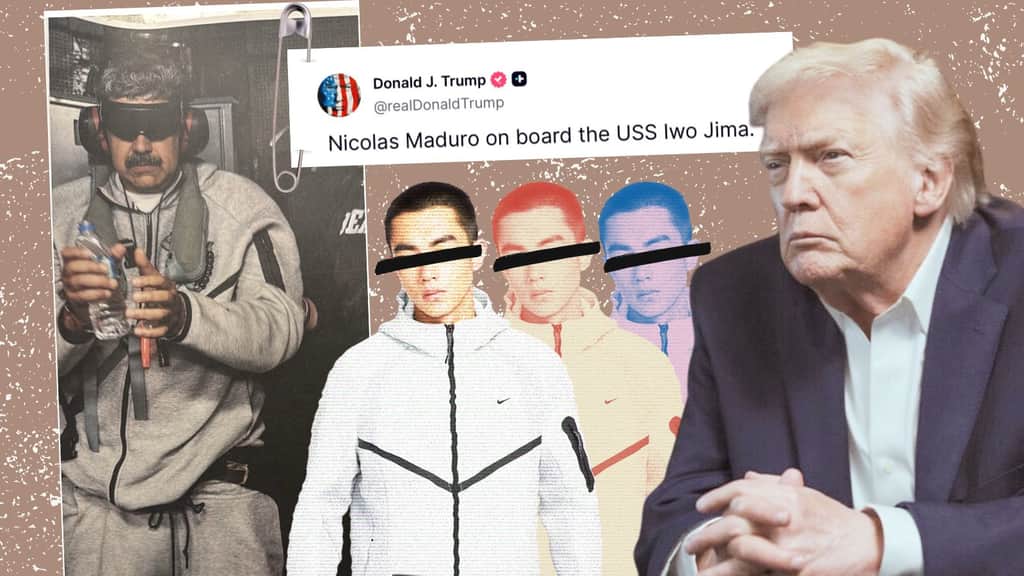
The script writes itself. It reads like dystopian fiction. A mercurial leader of a country captures a strongman autocrat of another country. The latter is charged with narco-terrorism and awaits a trial. In the backdrop, there is an oil industry that needs “fixing”, decidedly so by American hands.
Amid all this geopolitical theatre, one detail hijacks the spotlight. A photo shared by United States President Donald Trump announcing Venezuelan President Nicolas Maduro’s capture goes viral for a completely different reason: his Nike Tech sweatsuit, the unofficial uniform of gym bros and fitness influencers.
We were barely three days into the New Year, and we already had a “not on my bingo card” moment. The implications of Maduro’s arrest for the rules-based international order and territorial integrity were much debated among experts, in the media, and on online forums. Meanwhile, a parallel discourse dissected Maduro’s outfit, supposedly the grey Nike Tech Fleece jacket and joggers.
Nicolas Maduro on board the USS Iwo Jima. pic.twitter.com/omF2UpDJhA
— The White House (@WhiteHouse) January 3, 2026
The moment was iconic, to say the least, capturing the imagination of millions of internet users. As is now customary with breaking news, memes raced across social media far faster than the facts ever could.
Soon enough, AI-generated, altered images of Maduro flooded the internet. One showed him smoking a cigarette on the sidewalk, dressed in his Nike Tech sweatsuit, the giant headphones, and the eyecover, much like the original photo.
Screenshot/X
Memes had captions like, “steal his look” or “just coup it”, a nod to Nike’s slogan “just do it”. Another showed Trump shopping for the same fit. Then there was a video of Maduro dancing in a prison cell.
Imagine telling someone ten years ago that one day people would be posting fake videos of Nicolás Maduro in a prison cell with Diddy, dancing to a TikTok trend set to a popular Brazilian song.
And that he’d be wearing the same sweatsuit that Donald J. Trump, the sitting… pic.twitter.com/it55Umzdbs
— Yashar Ali 🐘 (@yashar) January 7, 2026
Funnily enough, Nike Tech was already a subject of memes in the US and UK, with young men debating whether the quarter-zip style sweatshirt was better than the sportswear brand’s sweatsuits.
In The Guardian, freelance writer Xaymaca Awoyungbo wrote that the quarter-zip movement was a way to attach more “professionalism,” and liken oneself to “white, middle-class finance bros – or Rishi Sunak”. Whereas, the Nike Tech sweatsuit was considered more “hoodlum”, associated with “black, working-class men living in cities”, and represented “criminality”.
Pop culture has reinforced the association of sweatsuits with criminals time and again, whether it’s Tony Soprano, a mob boss in the HBO crime drama The Sopranos, or Henry Hill’s famous Adidas tracksuit from Martin Scorsese’s Goodfellas.
The trend came full circle and turned into an instant meme when Maduro, widely considered somewhat of a “mob boss” himself, was seen donning a sweatsuit.
But there’s more to the sweatsuit memes than just hilarity and absurdity. It signals a digital space where serious news is met with trivialising reactions. A few months ago, when burglars broke into the iconic Louvre Museum in Paris, the internet reacted with apathy. The crime quickly became a comedic pastime. Users posted videos bejewelled from head to toe, claiming to have robbed the museum. In fact, the criminals’ all-black outfits were once again a topic of discussion, as many turned them into their Halloween costumes.
Earlier, when Luigi Mangione was arrested for allegedly assassinating the United Healthcare CEO Brian Thompson, much of the internet was obsessed with his chiselled jawline and manicured eyebrows. His courtroom outfits were discussed on Instagram reels and Reddit threads. Even today, comments on updates related to his case have users jokingly giving alibis for Mangione, claiming, “he was with me” at the time of the incident.
We saw a similar wave of memes during the recent India–Pakistan tensions, with jokes ranging from water scarcity in Pakistan after New Delhi suspended the Indus Waters Treaty to quips about navigating government-mandated mock drills.
Experts suggest that memes help people cope with stressful situations like geopolitical crises, wars, or inflation through humour. Human beings find connection when they create, like, or proliferate memes, building a community through shared context. Humour makes news palatable.
Yet the transformation of significant real-world developments into throwaway memes points to something more troubling. When empathy and compassion give way to ridicule and performative irony, we risk breaking down the social order. Online, almost anything can be excused under the safety net of “dark humour”. Many often fall back to the familiar argument, “it’s not that deep.”
But perhaps that is precisely what demands deeper introspection. What moments are grave enough to warrant our full attention? And in a fugue-like state of endless doomscrolling, what can still break through the noise?
In the era of rage-baiting and engagement farming, memeification goes beyond just a coping strategy. It becomes a means to hijack attention and distract from the crux of the matter. The effect is more pronounced when the administration itself busies itself in “content creation”.
Trump has repeatedly shared AI slop, reimagining conflict-torn Gaza as the “Riviera of the Middle East” or of him in a plane dumping faeces on the protests against him. Shortly after the Maduro capture, the official handle of the White House shared an image of Trump with the words “FAFO” (an acronym for the phrase “f*** around and find out”) shortly after Maduro was captured.
The Department of State said, “Don’t play games with President Trump,” supposedly as a warning to other nations.
President Trump is a man of action. If you don’t know, now you know. pic.twitter.com/G8DH20m9Dm
— Department of State (@StateDept) January 3, 2026
When leaders govern through memes and audiences consume crises as entertainment, we risk something more fundamental than just being uninformed. We risk becoming unable to distinguish between spectacle and substance, between performance and policy.
There are already indications of what could come next. The White House is reportedly deliberating acquiring Greenland, but the news was suspiciously foreshadowed by Katie Miller, wife of Trump aide Stephen Miller, who shared an image of Greenland’s map draped in US flag colours, captioned “Soon”.
Denmark issued a strong rebuke, but was Miller joking or issuing a threat? In our meme-saturated landscape, the answer hardly matters. The confusion is the point.
Editorial Context & Insight
Original analysis & verification
Methodology
This article includes original analysis and synthesis from our editorial team, cross-referenced with primary sources to ensure depth and accuracy.
Primary Source
The Indian Express