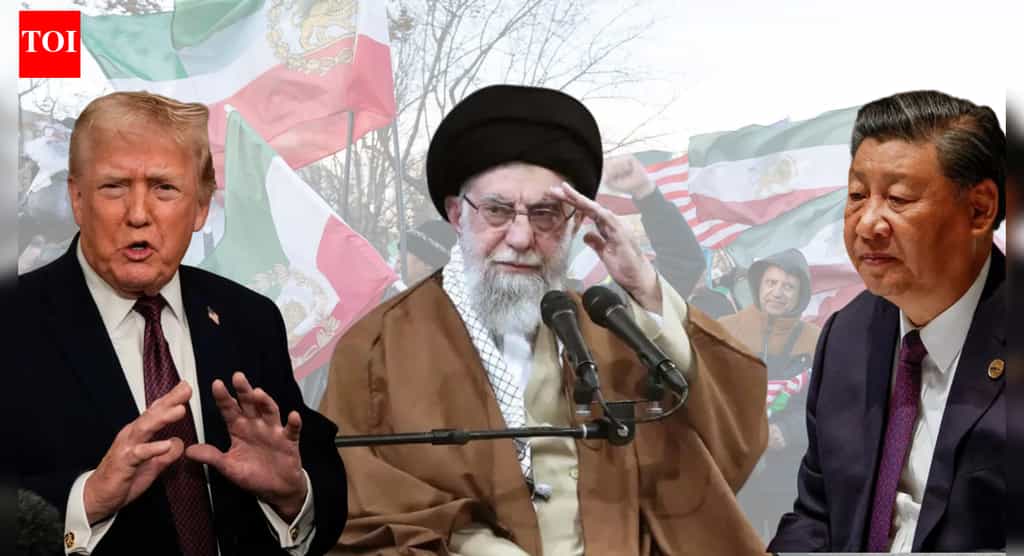
US President Donald Trump’s favorite economic weapon is back on the table, but this time it’s pointed in an unexpected direction: Iran.Tl;DR: Driving the news
The context: Iran is on edgeIran is entering its third week of unrest with the kind of grim arithmetic that changes diplomatic equations: activists say over 600 people have been killed and more than 10,000 detained, while the state has tightened an information blackout that makes verification harder and escalation easier.Now the crisis is spilling outward - into the familiar geometry of US-Iran brinkmanship - with President claiming Tehran is looking for a way out, even as he threatens new punishment and keeps military options on the table.
Trump told reporters his administration is preparing for talks but may not wait: “A meeting is being set up, but we may have to act because of what is happening before the meeting,” he said on Air Force One..
He also framed Iran’s posture as weakness under pressure: “I think they’re tired of being beat up by the United States,” Trump said. “Iran wants to negotiate.”Iran’s public tone suggests defiance, not retreat. Yet Iranian officials are also carefully signaling that diplomacy is not off the table - so long as it doesn’t look like capitulation.Iranian foreign ministry spokesman Esmail Baghaei said a channel to the US remained open, but talks must be “based on the acceptance of mutual interests and concerns, not a negotiation that is one-sided, unilateral and based on dictation.”
Zoom in: China-Iran trade exposureWhile Iran looms large strategically, its economic footprint in China’s overall trade picture is relatively small - but highly concentrated.Reuters data show that China is Iran’s largest trading partner. Iranian exports to China totaled about $22 billion in 2022, with fuels accounting for more than half. Imports from China stood at roughly $15 billion.In 2025, China bought more than 80% of Iran’s shipped oil, according to Kpler data cited by Reuters, reflecting Tehran’s dependence on Beijing as sanctions have narrowed its customer base.For China, that discounted oil is essential. It fuels private refiners that operate on thin margins and supports an economy already grappling with slowing growth, property-sector stress and weak consumer confidence.Beyond oil, China exports machinery, vehicles, electronics, refrigeration equipment and industrial components to Iran. Those sectors could face indirect exposure if US tariffs were applied broadly to countries trading with Tehran.Still, two-way trade with Iran accounts for less than 0.2% of China’s total trade, Bloomberg notes - limiting the macroeconomic hit, but not the strategic implications.Iran tariff threat: What it means for India and othersWhile China sits at the center of the Iran trade nexus, Trump’s 25% tariff threat casts a much wider net- putting pressure on a diverse group of US partners and rivals with very different exposure to Tehran.1. India is among the most sensitive cases. Reuters reports that India’s bilateral trade with Iran totaled about $1.34 billion in the first 10 months of 2025, dominated by Indian exports such as basmati rice, pharmaceuticals, fruits and vegetables. New Delhi sharply reduced Iranian oil imports in recent years due to international sanctions, but it still relies on Iran for regional connectivity projects and limited trade flows.
A blanket tariff threat could complicate India’s effort to balance strategic ties with Washington against regional interests in the Middle East.
2. For Japan and South Korea, the risk is less about volume and more about precedent. Both countries maintain only modest trade with Iran- mostly machinery, vehicle parts and small volumes of food products - and both finalized trade arrangements with the US last year. Reuters reports that officials in Tokyo and Seoul said they are closely monitoring the situation, signaling concern that secondary tariffs could undercut hard-won trade stability with Washington.3. Turkey faces a different dilemma. As a major regional trading partner of Iran, Turkey imported and exported billions of dollars’ worth of goods in 2022, according to World Bank data cited by Reuters. Ankara has historically resisted US pressure to fully sever economic ties with Tehran, and Trump’s threat raises the prospect of renewed friction between Nato allies over sanctions enforcement and trade retaliation.4. Beyond those countries, Reuters notes that Iran trades with more than 140 partners globally, including the United Arab Emirates and Iraq. Many of those economies act as transit hubs or intermediaries rather than direct end-users - raising complex questions about how Washington would define “doing business” with Iran, and whether indirect trade could also trigger penalties. Trump’s threat doesn’t just target Iran’s biggest buyers - it tests how far US allies and partners are willing to align with Washington’s Iran strategy when the cost could be tariffs on all their US-bound exports.The US-China trade truce under strainThe October agreement between Trump and Xi was narrowly constructed and always vulnerable to external shocks.It did not resolve deeper disputes over industrial policy, technology transfer or national security. Instead, it focused on freezing tariffs at current levels and restoring access to strategic materials - particularly rare earths, which China dominates globally.During the earlier trade dispute, Beijing imposed export curbs on rare earths, highlighting a choke point Washington is keenly aware of. The truce ensured US companies could again source those minerals, which are vital for everything from smartphones to fighter jets.Bloomberg Economics data underscore how meaningful the détente was: a nearly 10 percentage-point drop in average US tariffs on Chinese imports translated into billions of dollars in avoided costs for US firms.Trump’s Iran tariff threat jeopardizes that stability by introducing uncertainty over whether China could once again become a target - this time indirectly, via its ties to Tehran.What they are saying
Between the linesTrump’s Iran tariff threat highlights a recurring pattern in his trade and foreign policy: maximalist rhetoric paired with ambiguous follow-through.Bloomberg points out that just months earlier, in June, Trump surprised oil traders and officials within his own administration by signaling that China could continue buying Iranian oil - a move that appeared to undercut Washington’s longstanding Iran policy.That mixed messaging reflects competing priorities. On one hand, Trump wants to squeeze Tehran amid domestic unrest and geopolitical confrontation. On the other, he is wary of actions that could spike oil prices, hurt US consumers, or destabilize relations with Beijing.History offers a clue. In August last year, White House adviser Peter Navarro downplayed the idea of further tariffs on China over its purchases of Russian oil. “We have over 50% tariffs on China,” Navarro said at the time, according to Bloomberg. “We don’t want to get to a point where we hurt ourselves.”The Iran tariff threat revives that same tension - between leverage and self-inflicted damage.What’s next
Editorial Context & Insight
Original analysis and synthesis with multi-source verification
Methodology
This article includes original analysis and synthesis from our editorial team, cross-referenced with multiple primary sources to ensure depth, accuracy, and balanced perspective. All claims are fact-checked and verified before publication.
Primary Source
Verified Source
Times of India
Editorial Team
Senior Editor
Shiv Shakti Mishra
Specializes in India coverage
Quality Assurance
Associate Editor
Fact-checking and editorial standards compliance