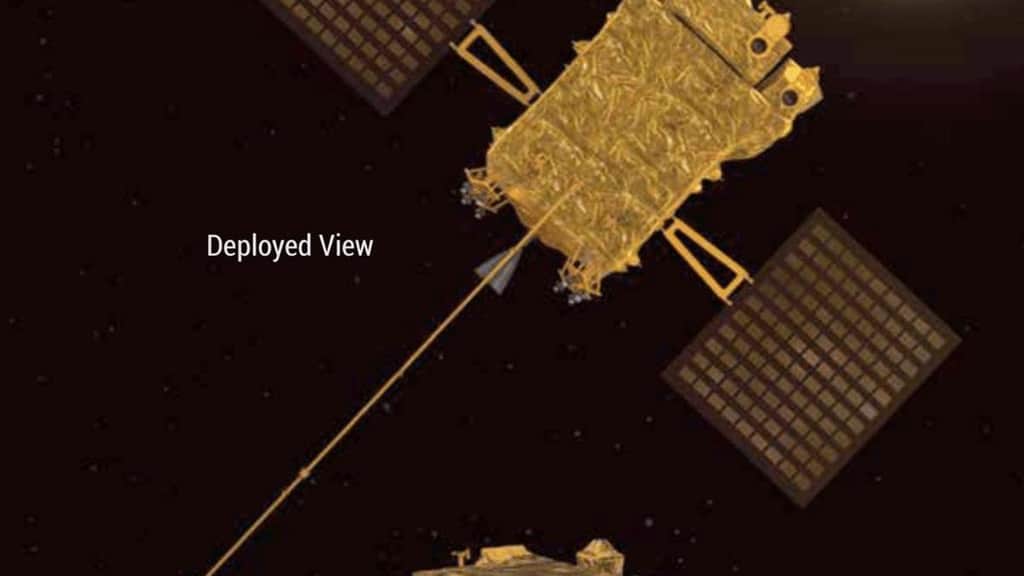
On the second anniversary of India’s maiden solar mission, Aditya-L1 reaching the Lagrangian point (L1), the Indian Space Research Organisation (ISRO) on Tuesday (January 6, 2026) made the Announcement of Opportunity (AO) soliciting proposals for the first AO cycle observations.
The Aditya-L1 spacecraft reached the L1 point on January 6, 2024, 127 days after it was launched on September 2, 2023, and since then has been making continuous and comprehensive observations of the Sun from the Sun–Earth L1 point.
According to ISRO scientific data from the mission are regularly released in public domain for global scientific utilization.
“At present there are more than 23 TB data in public domain and several important scientific results have been published in International peer reviewed journals. To further maximise the scientific return from this unique mission, the ISRO has released the first AO inviting proposals from the Indian solar physics community for Aditya-L1 observation time,” ISRO said.
It added that this L1 point, located approximately 1.5 million kilometers away from Earth, offers the unique advantage of continuous, uninterrupted observation of the Sun, free from eclipses or occultation.
This announcement soliciting proposals for Aditya-L1 observation is open to Indian scientists and researchers residing and working at institutes, universities and colleges in India who are involved in research in the area of solar science and are equipped to submit proposals as Principal Investigators (PIs) for solar observations with necessary scientific and technical justification and can analyse the data, if observation is made based on approvals.
Under the first AdityaL1 AO, eligible candidates can utilize observation time from the VELC and the SUIT payloads. For this, proposals must be submitted electronically through the Aditya-L1 Proposal Processing System (ALPPS) hosted at the Indian Space Science Data Centre (ISSDC).
Approved observations for this first AO cycle will be conducted between April 2026 and June 2026.
Editorial Context & Insight
Original analysis & verification
Methodology
This article includes original analysis and synthesis from our editorial team, cross-referenced with primary sources to ensure depth and accuracy.