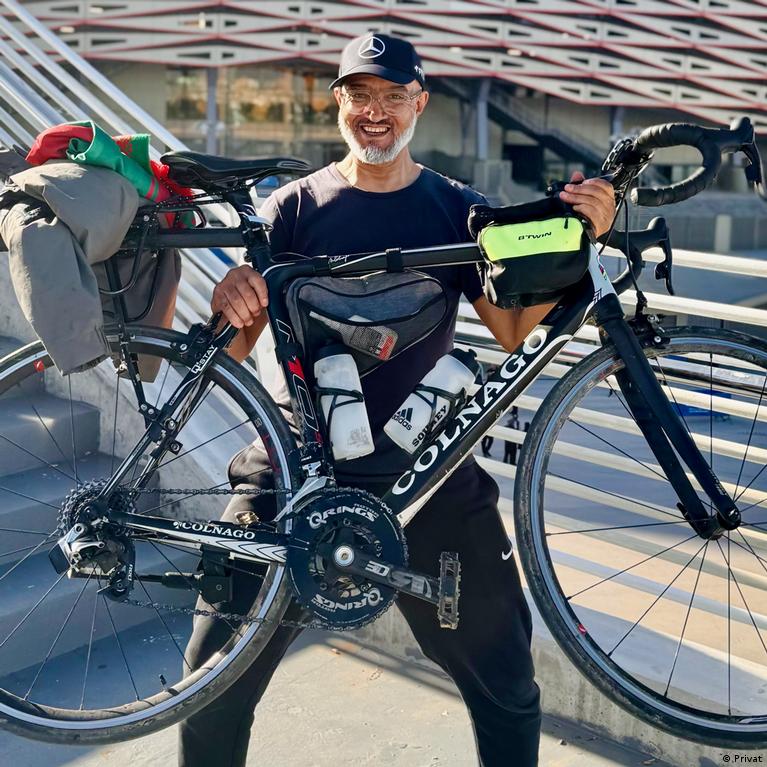
Ismail Skira looked relieved, a little exhausted, but very happy as he parked his bicycle in the coastal city of Agadir in southern Morocco – at the end of a more than 3,000-kilometer (1,864-mile) journey from France that took him four weeks to complete.
The Morocco-born football fan, who has lived in Paris since he was 21, was determined to support the Atlas Lions in person at the Africa Cup of Nations (AFCON).
But, traveling by car or plane would have been too easy for the 59-year-old.
"When I was at the Africa Cup of Nations in Ivory Coast (2024), the fans were singing a song in support of the national team," Skira told DW.
"It said that some had come by plane, others by car, some by bicycle, and still others on foot. I picked out the word 'bicycle' – and that's how I came here."
Skira is one of hundreds of thousands of fans who will travel to Morocco in the coming weeks for AFCON, the continent's biggest tournament. Organizers announced before the start of the tournament that more than a million tickets had been sold – more than for any previous AFCON.
The tournament is setting new standards in other ways too, since for the first time each participating team is accommodated in a five-star hotel. The matches are to be played in nine stadiums across six cities, and the tournament is being broadcast by more than 30 European media outlets.
The four-week-long competition is considered a dress rehearsal for the 2030 FIFA World Cup, which is to be held on three continents, with Morocco, Spain and Portugal being the main hosts. This has ramped up the pressure not only on the Moroccan FA (FRMF) but also on the players.
"That's the responsibility we have," said Achraf Hakimi of Champions League titleholders Paris Saint-Germain.
"It's a positive responsibility that motivates us to be ready for this tournament."
As special as this tournament is, so too is the journey Ismael Skira has undertaken. He has been a huge fan of the Moroccan national team since he was a boy and regularly travels to matches in his native country – but until now, never by bicycle. His journey here was quite eventful.
"In Seville, part of my bike broke, and I couldn't find any spare parts," Skira said. "I had to stay in Seville for three days until I found a Spaniard who helped me repair my bike."
Skira used the time while his bike was being repaired to visit the home stadium of Real Betis, where he had the opportunity to speak briefly with Morocco player Ez Abde, Spain international Isco, and Betis coach Manuel Pellegrini.
But what has stayed with Skira most are some other personal encounters.
"I met people I didn't know before, and yet they helped me a lot. Some even invited me into their homes."
Morocco's match against the Comoros in Prince Moulay Abdellah Stadium in Rabat didn't start the way Skira or the rest of the home supporters would have hoped.
The first half was notable mainly by a missed penalty by Soufiane Rahimi and an injury to defender Romain Saiss. It wasn't until after the break that coach Walid Regragui's side started to live up to their billing as favorites.
Brahim Diaz opened the scoring in the 55th minute, knocking home a low ball through the box from Noussair Mazraoui. After Ayoub El Kaabi's bicycle kick doubled Morocco's tally in the 74th minute, the 60,000 mostly home fans really came to life.
"The atmosphere was fantastic and very special," Skira said.
"Compared to the AFCON in Ivory Coast, the African and especially Moroccan culture is really on full display here."
While Morocco failed to add a third goal, the victory was well-deserved – something that filled Skira with confidence going forward.
"I pray to God that the Moroccan national team will have good luck, that they will bring us joy and win the Africa Cup," Skira said.
"If life allows, I'll arrange to meet you for the 2030 World Cup in Morocco – again by bicycle."
This article was originally published in German.