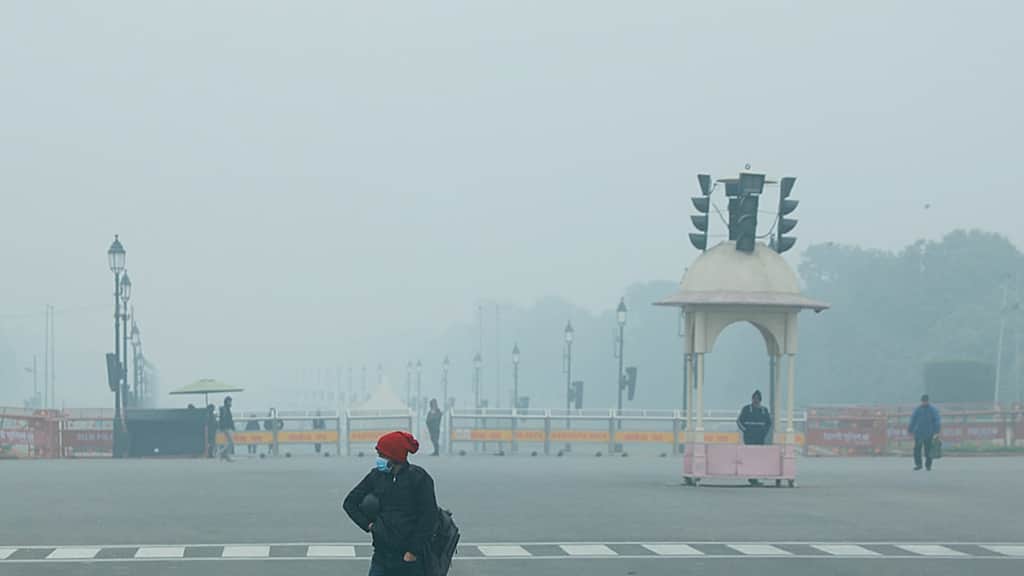
The India Meteorological Department (IMD) has issued a yellow alert for a moderate fog at many places in the Capital on Sunday with dense fog at isolated places.
Delhi’s air quality remained in the ‘Poor’ category on Saturday as the city recorded an average Air Quality Index (AQI) of 276 against Friday’s 236. In the neighbouring Noida, the AQI settled at 242 on Saturday, worsening as compared to Friday’s 229. Gurgaon, where the air quality had improved to ‘Moderate’ category on Friday, recorded an AQI of 244 on Saturday, as compared to Friday’s 178. The air quality in Delhi-NCR is likely to deteriorate further in the coming days, according to the forecast.
Meanwhile, an analysis by the Centre for Research on Energy and Clean Air (CREA), a nonprofit, has found that about 65% of Delhi’s air pollution in 2025 originated from outside the city — largely from the other NCR districts and neighbouring states. Local sources accounted for the remaining 35%. As per experts, Despite modest year-on-year improvements in average PM2.5 and PM10 concentrations during 2025, Delhi did not record a single ‘good’ air quality day over the year. Experts cited in the analysis stressed that Delhi’s geographical position makes it especially vulnerable to polluted air carried by northerly and north-westerly winds, reinforcing the need for coordinated, airshed-level interventions rather than city-specific measures alone.
Winter-period data showed that pollution transported into the city outweighed emissions generated within the city, underscoring the role of regional factors. Vehicular emissions emerged as the single largest local contributor to PM2.5 pollution, accounting for nearly half of the locally generated fine particulate matter. Vehicular emissions are ahead of industry, construction and other combustion sources. The analysis also recorded a significant decline in the contribution of stubble burning, which fell to an average of 4.9 per cent during the 2025 crop-residue-burning period, compared to 15.5 per cent in 2024.
According to the IMD, meteorological conditions remain unfavourable for pollutant dispersion. Winds had been calm and predominantly westerly, with speeds mostly below 15 kmph and dropping below 5 kmph during night hours. The predicted mixing depth is expected to decline from about 1,400 metres on Saturday to around 1,000 metres by January 5 and 6. The ventilation index is projected to stay below or near the threshold considered adequate for dispersal, indicating a continued build-up of pollutants near the surface.
The bulletin forecasts that the air quality in the Capital is likely to deteriorate again to the ‘Very Poor’ category Sunday onwards.
Shallow to moderate fog is expected during night and morning hours over the next several days, with dense fog at isolated locations, further exacerbating pollution levels. Maximum temperatures are likely to remain near or slightly below normal, while minimum temperatures may rise above normal during some parts of the coming week, the Indian Institute of Tropical Meteorology (IITM) Pune noted.
Editorial Context & Insight
Original analysis & verification
Methodology
This article includes original analysis and synthesis from our editorial team, cross-referenced with primary sources to ensure depth and accuracy.
Primary Source
The Indian Express