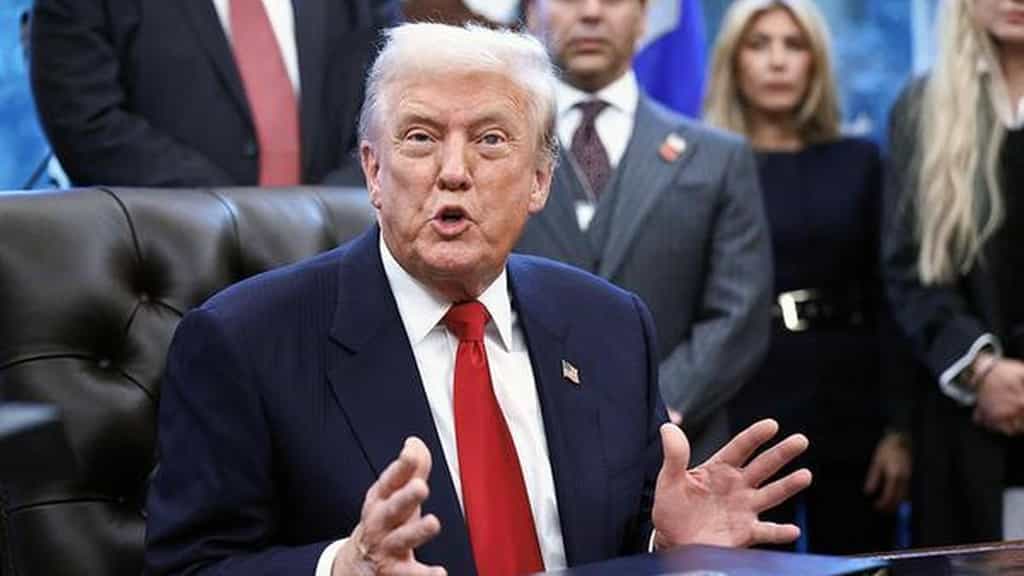
India faced double-pressure over energy on Thursday (January 8, 2026) from U.S. President Donald Trump’s decisions to back a Bill mandating up to “500% tariffs” on countries buying Russian oil, and to withdraw the U.S. from the India-led International Solar Alliance (ISA) amongst dozens of other international organisations.
The announcements came just ahead of the arrival of U.S. Ambassador-designate Sergio Gor to Delhi this weekend, who said in September that ensuring India ends its import of Russian oil is a “top priority”. Mr. Gor, who was confirmed and sworn in to the position months ago will begin his tenure in Delhi as Ambassador to Delhi and “Special envoy to South and Central Asia” on January 12, 2026, and is expected to make a public address.
Meanwhile in Paris, Polish Foreign Minister Radoslow Sikorski expressed “satisfaction” that India has reduced its oil imports from Russia, during a joint press appearance with External Affairs Minister S. Jaishankar and Foreign Ministers of France and Germany.
“Relations between the European Union and strategic partners such as India are very important to us and I express my satisfaction regarding the reduction of import of Russian oil to India because this is financing the war machine of [Russian President] Putin,” Mr. Sikorski in remarks Mr. Jaishankar, who spoke directly after him, did not contradict.
In a statement, U.S. Senator Lindsey Graham, a close associate of Mr. Trump, said the U.S. President on Wednesday (January 7, 2026) has “greenlit” the Russia Sanctions Bill, which could be voted in Congress “as early as next week”.
“This Bill would give President Trump tremendous leverage against countries such as China, India and Brazil to incentivise them to stop buying the cheap Russian oil that provides the financing for Putin’s bloodbath against Ukraine.”
The Russia Sanctions Act, a bipartisan Bill introduced in the Senate in April has thus far got 84 co-sponsors (out of a total of 100 Senate members), and 151 co-sponsors in the U.S. House of Representatives, suggesting it will be passed smoothly once brought to a vote.
Earlier this week Mr. Trump, who had jointly addressed the press along with Mr. Graham, called it a “great legislation” that was coming, as Mr. Graham said the Bill would give the U.S. President discretion to choose the figure of the tariffs over and above 25% penalty tariffs already imposed on India.
In September, during his Senate Foreign Relations Committee confirmation hearings, Mr. Gor said Mr. Trump had been “crystal clear” on the issue of India’s oil purchases.
“They [India] must stop buying Russian oil. And I believe almost every single member of this committee has co-sponsored Senator Graham’s legislation which has proposed a 500% tariff on secondary purchase and reselling of Russian oil. The President has only imposed a 25% tariff [thus far],” he added referring to the Russia Sanctions Act.
As a result, Mr. Gor’s first order of business in Delhi would likely be to push for a full stop to Indian oil imports from Russia, amidst signs that these have been reduced already. This week, Reliance announced that it has not received any cargo of Russian oil at its Jamnagar refinery through most of December, and does not expect any in January, indicating that it has stopped orders of the oil for now.
Indian PSUs increased their intake sharply in November 2025, but with Reliance stopping all such imports and Nayara Energy, the other big importer under sanctions from western countries unable to import, it is unlikely that India’s Russian oil purchases can recover to previous levels. In 2018, under similar pressure from the previous Trump administration, India had “zeroed out” its oil imports from two key suppliers Iran and Venezuela as well.
The government did not react to Mr. Trump’s other decision, to walk out of ISA, an alliance founded by India and France and headquartered in Delhi that has more than 90 members.
The alliance meant to promote solar power technology and adoption was launched in 2015 on the side-lines of the Paris COP Climate summit. When the U.S. joined the alliance in 2021, an official release had called it a “big boost” to the global adoption of solar energy efforts. The U.S. move to withdraw from the ISA, as well as the UN Framework Convention on Climate Change, as well as more than 60 different UN and non-UN international agencies is being seen as a major blow to multilateralism and particularly to global missions for increasing renewable energy and countering climate change.
Editorial Context & Insight
Original analysis & verification
Methodology
This article includes original analysis and synthesis from our editorial team, cross-referenced with primary sources to ensure depth and accuracy.