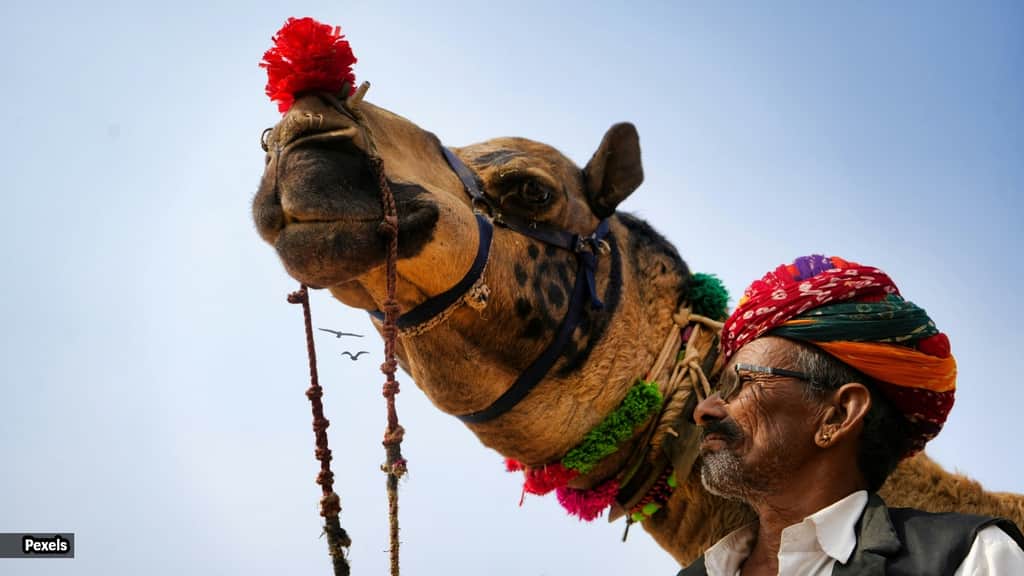
Jaipur has a lot more to explore beyond the itinerary staples Hawa Mahal and Amer Fort. The colourful city offers a plethora of offbeat destinations and experiences which’ll refresh your idea of a holiday in Jaipur. Here are some of these offbeat spots which offer a slower, more intimate way to experience the Pink City.
A beautifully symmetrical stepwell near Amer, Panna Meena ka Kund once served as a community gathering space and water source. Its criss-crossing staircases create striking visual geometry and a welcome sense of calm.
Best time to visit: Early morning (7–9 am), especially in winter
Panna Meena Ka Kund was built in the 16th century to collect monsoon rainwater for drier months (image: pexels)
Nestled in a quiet valley, this royal cremation ground features intricately carved cenotaphs of Jaipur’s rulers. The silence, birdsong and surrounding hills make it one of the city’s most contemplative heritage sites.
Distance & entry fee: ~6 km from city centre | ₹50 (Indians), ₹100 (foreigners)
Best time to visit: Morning or late afternoon, October to March
Gaitore Ki Chhatriyan is Jaipur’s royal crematorium for Kachwaha Rajput rulers, featuring intricate marble chhatris (cenotaphs) blending Rajasthani and Mughal styles (image: pexels)
Designed by Charles Correa, this cultural complex hosts exhibitions, theatre, film screenings and literary events. Even on quiet days, its architecture and courtyards are worth exploring.
Jawahar Kala Kendra is based on Jaipur’s original nine-square grid plan, symbolising planets and designed as a metaphysical echo of the city (Image Credit: Jaipur Tourism)
A terraced garden built as a romantic retreat, this site features painted pavilions, fountains and murals inspired by Radha-Krishna legends. It remains far less crowded than other gardens in Jaipur.
Distance & entry fee: ~6 km from city centre | ₹50 (Indians), ₹200 (foreigners)
Best time to visit: Morning hours, especially in winter and early spring
Sisodia Garden has Indo-Persian and Rajasthani architectural influences, inspired by the Mughal Charbagh (four-part garden) concept (Image Credit: Wikimedia Commons)
Stretching across the Aravalli hills, this park offers safari routes through dry deciduous forests and grasslands. It reveals Jaipur’s lesser-known wildlife side beyond its historic forts.
Best time to visit: Morning safaris, October to March
Nahargarh Biological Park has many animals, including Asiatic lions, Bengal tigers, panthers, hyenas, wolves, deer, crocodiles, sloth bear, Himalayan black bear, wild boar, etc (image: pexels)
Housed in a restored haveli near Amer, the museum documents Rajasthan’s block-printing traditions through tools, textiles and demonstrations. It’s both educational and visually engaging.
Distance & entry fee: ~16 km from city centre | ₹80 (Indians), ₹150 (foreigners)
Anokhi Museum’s restored building earned a UNESCO award for heritage conservation (image: wikimedia commons)
One of India’s deepest and most dramatic stepwells, Chand Baori’s thousands of steps form hypnotic patterns. Though outside Jaipur, it makes for a rewarding half-day excursion.
Best time to visit: Morning hours, October to February
Chand Baori is one of the world’s largest and deepest stepwells, featuring 3,500 symmetrical steps over 13 levels descending 100 feet (image: wikimedia commons)
Neighbourhoods like Sanganer and parts of the old city house generations of craftsmen working with blue pottery, lac bangles and hand printing. These living workshops offer an unfiltered look at Jaipur’s creative economy.
Editorial Context & Insight
Original analysis & verification
Methodology
This article includes original analysis and synthesis from our editorial team, cross-referenced with primary sources to ensure depth and accuracy.
Primary Source
The Indian Express