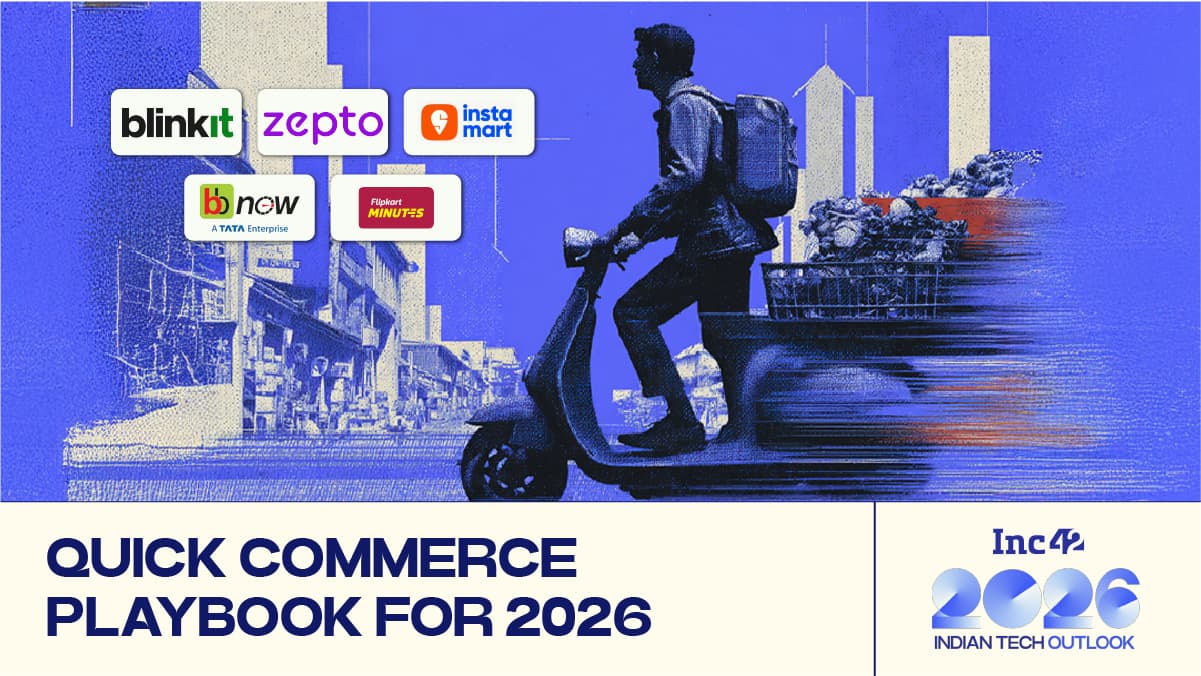
If 2024 still had a few naysayers believing that the quick commerce wave wouldn’t last, the past 12 months have proven them wrong. It was no longer about whether consumers would adopt quick commerce — they already have, and in a big way.
This pushed platforms like Blinkit, Zepto, and Instamart to aggressively chase new users and expand rapidly into categories such as pharmaceuticals, while also capitalising on festive demand. Indeed, the year marked several key milestones for the sector.
Beyond the pure-play giants, vertical quick commerce players also gained prominence this year. House-help startup Snabbit saw rising traction, and new players emerged in niche segments such as fashion, babycare, and premium grocery.
Meanwhile, the horizontal quick commerce players secured substantial fresh capital. Zepto raised $400 Mn in a funding round led by the California Public Employees’ Retirement System this October. Swiggy raised about INR 10,000 Cr (around $1.2 Bn) through a qualified institutional placement (QIP) by issuing 26.7 Cr equity shares, with a major portion earmarked for expanding and operating its quick commerce fulfilment network.
The year also saw competition intensifying in the quick commerce space. Smaller players such as Flipkart Minutes, Amazon Fresh and BB Now were seen ramping up their operations. Their rivalry is only set to escalate in 2026.
“Competition will stay aggressive as players expand into new cities, add more dark stores, and push into fresh categories to win more household spending. Right now, there’s virtually no loyalty in this space… consumers keep multiple apps and switch based on availability and discounts, which means the pressure to compete remains high,” said Neil Shah, the cofounder & VP of research at Counterpoint Research.
Moreover, the expert added that in 2026, quick commerce players will focus more on improving store efficiency, optimising delivery routes, and pushing higher-margin categories such as beauty, medicines, and electronics accessories.
Growth will come more from getting current customers to order more often, rather than expanding to new cities. Subscriptions, faster delivery for premium users and private labels will be key levers.
Now, as we bid adieu to 2025, we have zeroed in on key trends that are expected to shape India’s quick commerce landscape in 2026.
According to analysts Inc42 spoke with, Blinkit, Instamart, Zepto, and others are expected to add nearly 2,000-2,500 new dark stores next year across top metros, tier I suburbs and high-income micro-markets. In 2026, expanding dark stores and delivery networks will decide who stays ahead.
“2026 is the last window to build a defensible scale. Whoever delays infra capex now will never catch up,” said Lloyd Mathias, an angel investor and a brand strategist.
Besides geographic expansion, the platforms will focus on deeper penetration into the top eight cities, namely Delhi NCR, Mumbai, Bengaluru, Hyderabad, Pune, Chennai, Kolkata and Ahmedabad, which remain behaviourally aligned markets for 10-20 minute delivery.
“Even though the infrastructure push is capital-intensive, the TAM (total addressable market) justifies the burn,” said Satish Meena, founder of Datum Intelligence.
But, the growth in 2026 won’t come from adding stores in random towns just to show size, an executive at a leading quick commerce player said, adding that the quick commerce players will focus on areas that actually make money, places with higher incomes, strong order demand, available warehouse space, and easy delivery routes.
“So, most new dark stores will open in premium neighbourhoods, IT hubs, and busy commercial zones,” the executive added.
The strategy is clear — win the most valuable urban markets first, and think about profitability later.
With Blinkit entering 2026 as the clear market leader, the real action will be in the race for second place. Swiggy’s Instamart and Zepto are gearing up for an aggressive year, each trying to strengthen its position in top metros where quick commerce behaviour is most entrenched. Instamart has the advantage of Swiggy’s existing customer base and bundled subscription play, while Zepto’s edge lies in its dense dark-store network and premium urban consumer appeal.
Amazon gets a wildcard entry here. Its renewed push into rapid delivery, backed by Prime loyalty and a strong logistics backbone, could shift momentum. As Shah notes, “Amazon still owns trust and reliability for many Prime households. If they start matching speed, Blinkit’s premium customer base won’t be untouchable.”
The battle for the second spot is not only about delivery times but also customer retention, subscription perks, and selective discounting. Instamart may rely more on integrating Swiggy One to lock users in, while Zepto will likely double down on convenience and proximity.
“No platform can afford to slow down right now. The player that blinks risks losing the spot,” the quick commerce executive quoted above said.
Next year, the non-grocery category is expected to shift from being an add-on to becoming the main driver of GMV growth. Personal care, toys, stationery, gifting, home cleaning and even small appliances are seeing strong adoption, driven by higher margins and impulse-led demand. Festivals will only supercharge this trend.
“Non-grocery is no longer just incremental… it’s the reason for new orders and higher baskets,” said Shah of Counterpoint Research.
The reason this matters is simple — groceries brought consumers to quick commerce, but lifestyle and convenience categories are what keep them there. Higher average selling price items improve margins and turn the platform into a weekly habit rather than a backup option.
From curated gifting boxes to electronics accessories and festival-led assortments, non-grocery could be the real engine that pushes the sector towards sustainable economics, even if full profitability remains a few years away.
Private labels will continue to play a strategic role in quick commerce. Analysts estimate that private labels will contribute 5-10% of GMV, constrained by strong brand loyalty in FMCG. Consumers tend to stick to their preferred brands for everyday essentials like milk, detergent, and packaged foods, limiting how much private labels can scale.
Platforms will increasingly experiment with private labels in categories where loyalty is low and where they can stand out. Per industry experts, home cleaning products, tissues, wipes, gifting, ready-to-eat meals, and bakery items are seeing more curated private-label SKUs, designed to capture incremental household spend.
In 2026, overall, brands will use private labels to fill gaps, expand margins, and drive trials in high-frequency, high-margin categories.
While large quick commerce platforms race to expand dark stores and deepen city penetration, a parallel story is unfolding in this space. Startups focussed on specific categories like fashion, premium grocery and baby care are experimenting with hyper-specialisation, delivering curated products in 10-20 minutes.
“Some of these micro-verticals will grow rapidly, especially in fashion and premium lifestyle categories. Others will either merge with bigger players or exit, depending on how well they scale and differentiate,” said Shah.
However, the challenge is scale. Vertical players can capture niche demand, but sustaining unit economics at high frequency and wide coverage remains difficult.
Lloyd Mathias echoes this view. “These startups are either going to be acquired by the bigger platforms or grow to become specialised category leaders. The next two years will see a lot of consolidation in this space,” he said.
Despite these challenges, vertical players will continue to push innovation, test new categories, and influence consumer expectations around speed, convenience, and assortment.
As quick commerce heads into 2026, the focus is shifting from proving demand to building durable, efficient businesses. With competition intensifying and margins under pressure, scale, execution, and category depth will matter more than ever. For now, the question is who can grow fast without breaking the economics?