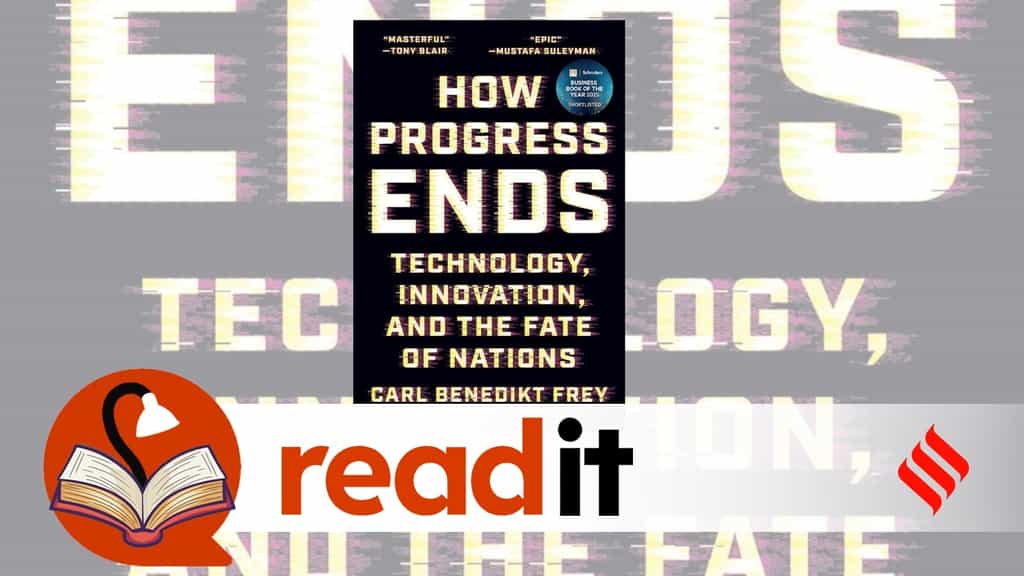
They say there are two kinds of people in the book world: those who think that Stephen Witt’s The Thinking Machine about NVIDIA and its founder Jensen Huang was the best business book of 2025, and those who have read Carl Benedikt Frey’s How Progress Ends. Both books were in contention for the prestigious Financial Times and Schroders Business Book of the Year Award 2025, and although Witt emerged the winner in that contest, Frey’s book is no less important.
How Progress Ends: Technology, Innovation and the Fate of Nations (to use its rather long name) is actually a look at the economic progress of nations and regions down the years. But unlike economists who tend to highlight economic and social parameters, Frey focuses on technology as a key driver of progress. Spanning more than 500 pages, the book takes us on a journey across different periods of time and cultures, highlighting the role played by technological innovation in each of them. He starts with the ancient Chinese and Roman civilizations, covers the Industrial Revolution in Europe, moves to the modern world, and ends with a look at what the (AI-laden) future has in store for us. India does not get a separate chapter to itself, although Frey mentions it from time to time.
What Frey unveils is that the progress of most civilizations and cultures actually depends on how they handle technological innovation. He points out that innovation almost always starts at a small or micro level and then gets adopted at a higher or larger scale. It is this stage which is critical because as bigger organizations and institutions get involved in handling the technology, matters become more bureaucratic, and the focus shifts from being innovative to protecting what one has and keeping competitors out. This inevitably leads to progress ending and stagnation setting in.
In many ways, How Progress Ends is about how technological innovation is handled by a decentralised (largely capitalist) system and a centralized (communist or socialist) one. Frey shows that while most cutting-edge and radical innovation comes from decentralized systems, centralized ones are much better at adopting it and spreading it among a large number of people. In fact, in many cases, a centralized system is necessary for pushing technologies that are important but are not being adopted on a large scale. Progress therefore results from a blend of both systems, but technological innovation is driven mainly by decentralized societies and systems.
“A recurring theme of this book is that decentralization is necessary for further progress as a country approaches the technological frontier, but this is rarely in the interest of incumbents who dislike competition and favour the status quo.”
A key component of technology as a driver of progress is its propagation. Frey points out how China, in spite of making a number of inventions, fell behind the West as it tried to hem itself in and developed a formidable bureaucracy, and how the computer revolution succeeded in the U.S. because of its extremely federal structure, which gave individuals not just the space to be creative but also to move freely.
“While Boston and Detroit—once at the forefront of the Second Industrial Revolution—were dominated by hierarchically run incumbents, the computer age was made in Silicon Valley, where institutions supported decentralization and exploration.”
Unlike some authors who end up favouring one of the two systems, Frey insists that both have their place—one in the creation of radical technology and the other in its promulgation. However, he is quick to point out that centralized systems lead to stagnation, noting how the USSR’s attempts to create a Silicon Valley of its own came a cropper because it tried to apply the same bureaucracy-driven principles that it used to drive mass production. He feels that developing nations like India need to focus more on spreading existing technology than on investing in innovative new technology, as this is unlikely to be adopted easily, given the level of bureaucratic intervention in many of these economies (he points to the complications in the administration of Delhi).
The book ends with a look at the incoming AI age. Frey feels that while the potential of AI is immense, it might end up being used as a tool for control and surveillance by many nations, which would mean it would restrict technology and innovation rather than promote it. Frey also sounds a note of caution about China and the U.S., which he feels are in danger of stagnating thanks to the centralist tendencies of their governments.
“Just as dynastic China invested heavily in surveillance technologies, making the economy and society easier to manage and control while cementing autocracy in the process, China today is using AI with the same effect, which is likely to have the same stagnating results…. America’s economic strength has long depended on new companies upending established ones. Yet incumbents have recently lobbied to suppress competition. Despite their differences, both superpowers face a troubling trend: faltering productivity over the past decade.”
It all sounds a little complicated and heavy, but Frey spices up the narrative with a number of incidents and events that make How Progress Ends a much easier read than it appears. For instance, we learn how the USA’s experiment with Prohibition at the beginning of the twentieth century actually hurt innovation, as it meant the end of saloons where workers met and discussed work and exchanged ideas.
Some think Stephen Witt’s The Thinking Machine about NVIDIA and its founder Jensen Huang was the best business book of 2025.
It is not exactly a page-turner like Witt’s The Thinking Machine because it has a canvas that spans more than a thousand years and features a number of characters, but neither is it as dense as some of Vaclav Smil’s work. Frey does bring economic concepts into play but does his best to illustrate them through examples. We did not race through the book, but neither did we ever feel bogged down in it.
How Progress Ends is a wonderful blend of history, politics, and culture from the perspective of their impact on technology and innovation, and shows us how they are all interlinked. Some might not agree with Frey’s insistence on the need for decentralization for innovation, and others might feel that nations like India deserved more space, but there is no denying that this is one of the must-read books of the year for all those interested in the economic state of the world, where it is headed, and why. You will also keep coming across facts that will surprise you and view matters from an entirely different perspective. This is one of those books that do not just inform you, but also make you think.
How Progress Ends: Technology, Innovation and the Fate of Nations By Carl Benedikt Frey 540 pp Princeton University Press Rs 1299
Editorial Context & Insight
Original analysis and synthesis with multi-source verification
Methodology
This article includes original analysis and synthesis from our editorial team, cross-referenced with multiple primary sources to ensure depth, accuracy, and balanced perspective. All claims are fact-checked and verified before publication.
Primary Source
Verified Source
The Indian Express
Editorial Team
Senior Editor
Aisha Patel
Specializes in India coverage
Quality Assurance
Associate Editor
Fact-checking and editorial standards compliance