


Key takeaways
- Your browser does not support the audio element.
- Think of Gemini Robotics ER 2 as a high-level brain for robots.
- The design of Gemini Robotics ER 2 allows the robot to “think” about what comes next while simultaneously performing its actions.
What happened
Your browser does not support the audio element. This content is generated by Google AI. Generative AI is experimental For robots to assist humans in everyday environments, accurate spatial reasoning is not enough. Robots must also think fast, timing their decisions and reasoning with the real-time speed of the physical world. That’s why today we’re launching Gemini Robotics ER 2, our most capable “embodied reasoning” model for robotics.
In robotics, high-level reasoning depends on execution speed. Gemini Robotics ER 2 integrates into the Gemini Live API, using a bidirectional streaming endpoint optimized for latency-sensitive tasks. The result is fluid orchestration: Gemini Robotics ER 2 commands action models and robotics APIs to complete multi-step tasks without the jarring “stop-and-think” pauses. To illustrate this, we’ve built a demo with Spot from our partners at Boston Dynamics.
We use Gemini Robotics ER 2 to orchestrate Spot APIs, such as navigation and manipulator movement, creating an interactive robot that fetches objects for you. The code is available on Github with other examples. One of robotics’ hardest challenges is knowing when a task is done.
Gemini Robotics ER 2 brings a step-change in video understanding and progress tracking to verify that complex tasks — such as tightening a light bulb or tying a trash bag — are complete to specification before switching to the next task. In this update, we’ve made progress on two foundational capabilities for task progress understanding: progress classification and moment finding.
Progress classification refers to a robot’s ability to track progress towards task completion. In our evaluations, we assign each frame in a video feed into five levels of progress (0-20%, 20-40%, 40-60%, 60-80%, 80-100%). By quantifying task progress, Gemini Robotics ER 2 provides robots with real-time situational awareness, and allows them to adjust actions on the fly or retry failed steps without restarting an entire workflow.
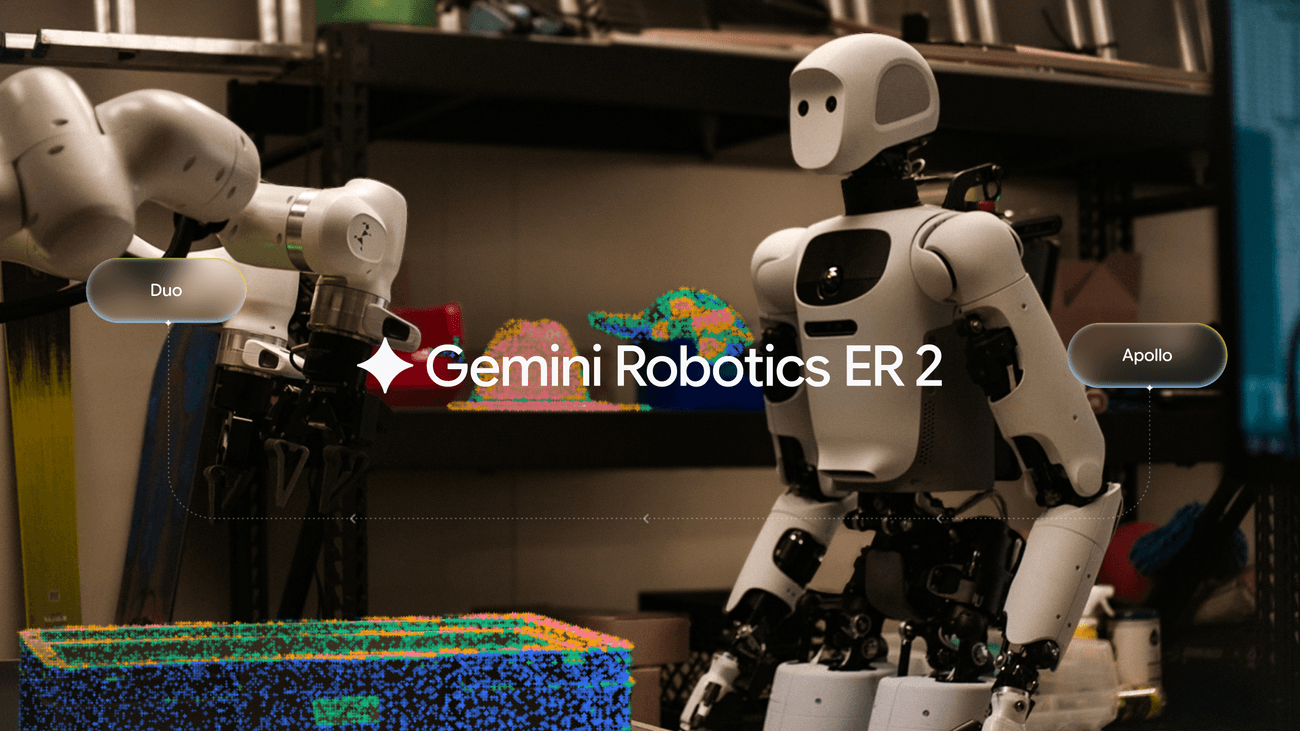
No single robot fits every task — a wheeled rover excels indoors, while a humanoid robot may excel at uneven terrain. Gemini Robotics 2 enables multi-robot collaboration, allowing diverse machines to communicate via a shared semantic understanding to handoff and complete complex tasks. See how Gemini Robotics ER 2 enables Apptronik’s Apollo 2 and Franka F3 Duo to collaborate here.
Why it matters
Think of Gemini Robotics ER 2 as a high-level brain for robots. It allows robots to chat with humans, understand the physical world, and plan multi-step tasks. It then hands off motor execution to any given lower level vision-language-action (VLA) model. Gemini Robotics ER 2 can also natively call tools like Google Search to find information, or any other user-defined function.
The design of Gemini Robotics ER 2 allows the robot to “think” about what comes next while simultaneously performing its actions. 6. By watching continuous video feeds, robots can now track their own progress, adapt if something goes wrong, and know exactly when to move on to the next step.
We are also introducing multi-robot collaboration, enabling robots to work together in shared spaces and complete complex workflows a single robot could not do alone. Gemini Robotics ER 2 is now publicly available to developers via the Gemini API, Google AI Studio, and in private preview on Gemini Enterprise Agent Platform.
To help you get started, we’re sharing examples of how to configure the model and prompt it to power more useful physical AI tasks. Most tasks in the physical world are complex and require multiple steps to complete. Gemini Robotics ER 2 is a physical agent, orchestrating steps for the robot and enabling it to self-correct, and generalize to more novel situations.
To build an agentic setup, developers can declare low-level control interfaces — like Vision-Language-Action (VLA) models or navigation APIs — as tools, and stream multimodal video, audio, or text directly into the model. Gemini Robotics ER 2 improves this tool orchestration workflow. We can evaluate its performance with robots in simulation, using real-world robot control, and even pair it with a human controlling the robot remotely.
What to watch
Gemini Robotics ER 2 advances our core spatial reasoning capability, as measured by three benchmarks: Looking ahead, our plans are to push these models towards even more complex tasks to accelerate the development of helpful robots and support the robotics community. Your information will be used in accordance with Google's privacy policy. You may opt out at any time.