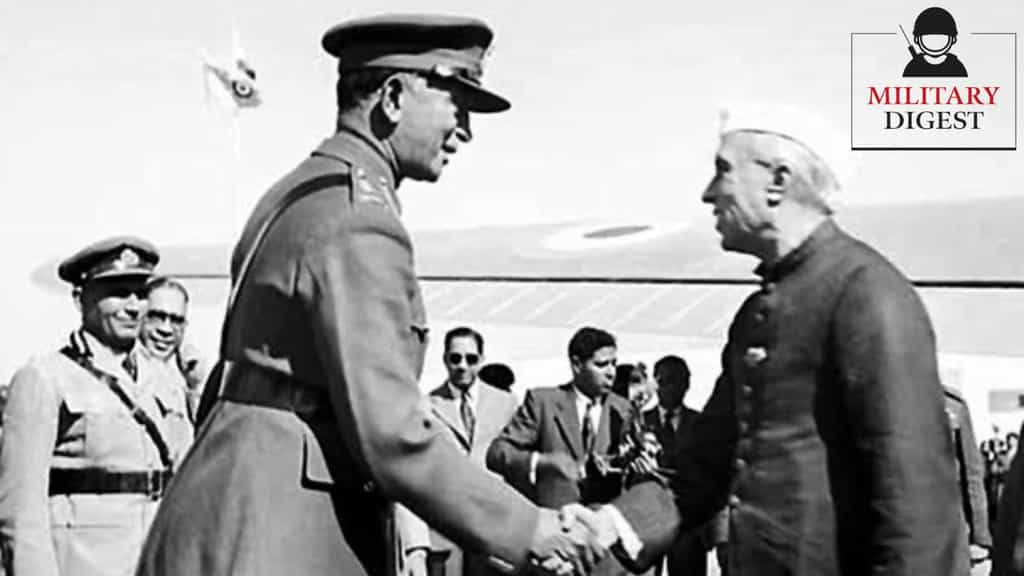
Chief of Army Staff General Upendra Dwivedi will hold an annual press conference on January 13 ahead of Army Day, January 15. It was on January 15, 1949, that General K M Cariappa (later Field Marshal) took over as the commander-in-chief and chief of army staff of the Indian Army—the first Indian to do so.
It is an apt occasion to look back at certain events that took place soon after General Cariappa took over as the Army chief, setting the tone for an apolitical Army in Independent India. The then prime minister, Jawaharlal Nehru, chided General Cariappa for having publicly praised the Government saying that it should have been avoided and that military officers should not broach political subjects in public. A letter that he wrote to General Cariappa on May 24, 1949, forms part of the Nehru Archives.
In an interview at Dehradun on May 2, 1949, Cariappa remarked, “The achievement made by the country under Pandit Nehru’s leadership in so short a period has no parallel in history.” He added that “the last Commonwealth Conference in London, when seen in clear perspective, will be found to have been a great triumph for the prime minister”. He also said that the people had not clearly appreciated the all-round progress made by the leadership.
Nehru was not pleased about these remarks made by the Army chief and conveyed his displeasure to him in no uncertain terms. “About three weeks ago, you made a statement to the press in the course of which you congratulated me for my work at the Commonwealth Conference in London. You further drew attention to the all-round progress made by the present leadership in the country. I am grateful to you for what you said. But this raises an important point, and indeed the press has drawn attention to this. Should our officers, civil or military, even including the head of the Army, express any opinion in regard to political subjects in public,” he said.
Nehru questioned whether senior officers should speak in praise of the work of the Government.
“Indeed should they deliver public speeches at all except on matters strictly confined to their own work or some social or cultural subjects? What you said was harmless enough, but there is always a danger in touching upon political questions. Obviously, it would be highly improper for an officer to criticise Government, more especially on a political issue. If this is so, then praise of Government should also be avoided,” said Nehru.
The then prime minister said he was drawing the Army chief’s attention to this matter as Cariappa set the tone for the Army, and Nehru did not want the Army to get mixed up in any way with politics. “You yourself have made this clear on many occasions. In the past I did not like the activities of some Sikh officers who indulged in communal politics. The safest course, therefore, is for all officers to avoid public speaking or public statements completely except on strictly limited topics. Sometimes an officer may not even know the exact political significance of some issue or some remarks he might inadvertently make,” he said.
Nehru noted that the Government had the largest political party and organisation at its back.
Nevertheless, there are other parties and groups, and they might object to the Army doing or saying something in praise or in criticism of political parties or ideologies, he said.
Nehru said Field Marshal Bernard Law Montgomery, a noted British military personality of World War II, is apt to let himself go in public. “He has been repeatedly asked by the British Government not to do so. Recently, I was in Switzerland, and some members of the Swiss Federal Government told me how they had been greatly embarrassed at a rather casual remark of Montgomery in Switzerland,” he said.
In fact, Nehru and Cariappa continued to spar on various issues even after the retirement of the latter as Army Chief.
In a letter written to the prime minister in 1958, General Cariappa expressed unhappiness over the report regarding the appointment of J K Bhonsle, who had been a member of the Indian National Army, as the Lieutenant Governor of Himachal Pradesh. Cariappa had written that Bhonsle, by serving in the INA, had shown disloyalty to the then Government and had also been disloyal to the traditions of the Army.
Cariappa had also expressed his disagreement with the military guard firing a ‘feu-de-joie’ (ceremonial rifle volley), sounding of the Last Post on bugles, and so on, as is done at military funerals, at Rajghat, the samadhi of Mahatma Gandhi, on January 30. He said he found it “out of place” in that atmosphere of “sanctity, purity and solemnity”.
Nehru responded by saying that the military honours at Rajghat were decided upon after careful consideration. On the issue of Bhonsle, Nehru said that whether he did right or not when he joined the INA under very peculiar circumstances in Malaya was a subject on which there might be differences of opinion.
“You know that we have not criticised our present army officers or men because they served the then British Government in India loyally. We have spoken highly of our army. But it is another matter for us to condemn for ever a person who, in a peculiar set of circumstances, thought it his duty to serve his country in another way. I do not know what I would have done if I had been in such a position,” he said.
Nehru commented that British army officers functioned with neither ability nor courage in Malaya. “Ultimately, they meekly surrendered, having made a mess of things. In India, conditions were very peculiar, and the country generally was opposed to the British. If a young Indian was affected by this widespread sentiment in India, I certainly am not prepared to blame him,” he said.
Editorial Context & Insight
Original analysis & verification
Methodology
This article includes original analysis and synthesis from our editorial team, cross-referenced with primary sources to ensure depth and accuracy.
Primary Source
The Indian Express