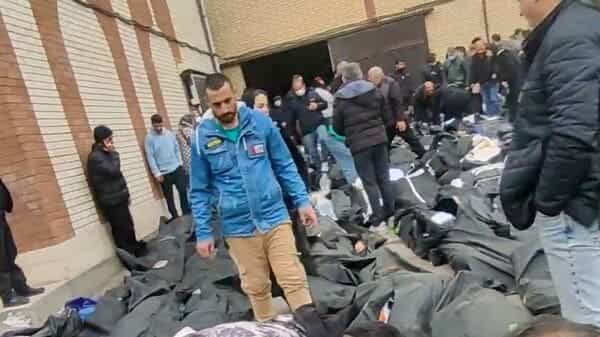
Iran’s Supreme National Security Council Secretary Ali Larijani hit back sharply at US President Donald Trump on Tuesday, responding to Trump’s call for Iranians to “save the names of their killers” amid nationwide protests.
“We announce the names of the main killers of the people of Iran: 1– Trump 2– Netanyahu,” Larijani said, directly naming the US and Israeli leaders.
His remarks came after Trump said he had cancelled all meetings with Iranian officials and voiced open support for protesters facing a violent crackdown.
In a post on Truth Social, Trump addressed Iranians directly, urging them to continue protesting and promising support.
“Iranian Patriots, KEEP PROTESTING – TAKE OVER YOUR INSTITUTIONS!!! Save the names of the killers and abusers. They will pay a big price,” Trump wrote.
“I have cancelled all meetings with Iranian Officials until the senseless killing of protesters STOPS. HELP IS ON ITS WAY.”
While Trump has repeatedly warned Tehran against using deadly force, he has not specified what form the promised “help” would take.
Iran’s defence minister responded with a strong warning, saying any attack on the country would be met with retaliation.
“Iran will respond forcefully to any aggression against us and will not allow anyone to threaten us,” he said.
“All US bases and countries that facilitate Washington’s operations in the region will be legitimate targets.”
He added that Iran’s military posture has improved since its last conflict. “Our defensive posture is good compared to the last war, thanks to the measures we have taken,” he said.
Human rights monitors say the unrest has already taken a heavy toll. According to the US-based Human Rights Activists News Agency (HRANA), more than 2,000 people have been killed over the past two weeks, with over 600 protests reported across all 31 provinces. The group estimates more than 16,700 people have been arrested so far.
The protests, which began in late December, have spread nationwide and evolved into broader anti-government demonstrations.
Amid the escalating crisis, Trump announced on January 12 that the US would impose 25% tariffs on countries continuing to do business with Iran, adding to economic pressure on Tehran.
He has also repeatedly warned Iranian leaders against using lethal force on demonstrators.
“I tell the Iranian leaders — you better not start shooting because we’ll start shooting, too,” Trump said earlier this month.
“We’re watching it very closely. If they start killing people like they have in the past, I think they’re going to get hit very hard by the United States.”
Trump has underscored that military action remains an option, declaring: “We are locked and loaded.”
Despite the rhetoric, the White House has signalled that diplomatic channels remain open. Press Secretary Karoline Leavitt said on Monday that Iran has adopted a “far different tone” in private discussions with Trump’s special envoy, Steve Witkoff.
Still, Trump’s decision to cancel talks and openly encourage protests suggests a shift toward a tougher stance.
Iran’s deepening economic crisis lies at the heart of the protests. The collapse of the national currency, rising food prices and fuel cost hikes have intensified public anger.
In December, the government raised prices under a new tiered gasoline subsidy system, ending years of ultra-cheap fuel. Food costs are expected to rise further after the central bank scrapped a preferential exchange rate for most imports except medicine and wheat.
The unrest also comes as Iran deals with the fallout from a brief but intense war with Israel in June, renewed sanctions and weakening regional alliances — compounding pressure on the country’s leadership.
Editorial Context & Insight
Original analysis and synthesis with multi-source verification
Methodology
This article includes original analysis and synthesis from our editorial team, cross-referenced with multiple primary sources to ensure depth, accuracy, and balanced perspective. All claims are fact-checked and verified before publication.
Primary Source
Verified Source
mint - news
Editorial Team
Senior Editor
James Chen
Specializes in India coverage
Quality Assurance
Associate Editor
Fact-checking and editorial standards compliance