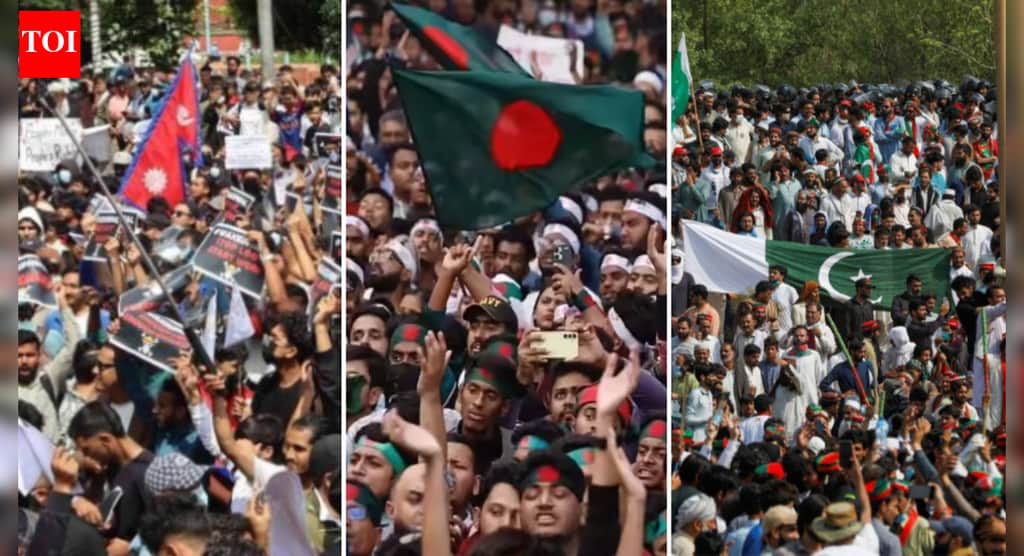
The year 2026 has begun and its about to get interesting for some of India's immediate neighbours — Bangladesh, Pakistan and Nepal — as they grapple with cascading crises of legitimacy. The stakes transcend borders: Bangladesh's February polls risk a Second Republic dominated by fundamentalist Islamists; Pakistan's army chief Asim Munir has tightened his grip on Islamabad but jailed ex-PM Imran Khan still threatens an uprising; while Nepal's interim regime eyes March elections haunted by 21% youth joblessness and a politically awakened GenZ.
A fragile neighbourhood risks unraveling into chaos, but it also presents New Delhi an opening to redefine South Asian stability on its terms, provided it navigates the fine line between influence and interference with the precision of a chess grandmaster. India's 'Neighbourhood First' policy is about to face its greatest test.
Bangladesh enters 2026 under the shadow of a highly-anticipated and supercharged February election that could reconfigure its ideological centre of gravity. For over a decade, Sheikh Hasina and the Awami League presided over what critics call a "managed democracy" built on authoritarian consolidation and a security-heavy approach to dissent. Since Hasina's ouster and the installation of the interim government led by Nobel laureate Muhammad Yunus, Bangladesh has grappled with anti-India protests, vengeance politics, institutional paralysis, and a power vacuum ripe for exploitation by revived Islamists and dynastic opposition.
With the Awami League banned from taking part in the polls, the turmoil has unleashed a three-way contest. First, the student-led National Citizens' Party (NCP), born from the Gen-Z protesters who felled Hasina, embodies a secular, anti-corruption youth surge. Drawing from urban campuses and social media savvy, NCP pushes radical reforms: dismantling the Chhatra League's campus stranglehold, quota abolition, and electoral overhauls.
Yet its lack of organisational depth and internal rifts over ideology—progressive vs. pragmatic—risk fragmenting the revolutionary momentum, especially if establishment forces co-opt its leaders.Second, Jamaat-e-Islami, unbanned and revitalised post-Hasina, leverages street muscle and madrasa networks to reclaim influence. Long suppressed through war-crimes trials and asset seizures, its cadres have flooded protests, blending anti-India rhetoric with welfare populism. With Hasina's fall removing legal barriers, Jamaat eyes a kingmaker role, potentially enforcing Sharia-inflected policies and eroding Bangladesh's secular constitution — a "Second Republic" where Islamists veto secular gains in women's rights, minority protections, and India ties.Third, the Bangladesh Nationalist Party (BNP) - purged under Hasina - merges dynastic appeal with anti-establishment fury. Tarique Rahman, Ziaur Rahman's son and BNP acting chair (exiled in London since 2008), has orchestrated a comeback following his return to Dhaka after 17 years.
It remains to be seen whether this popularity will translate into votes. Alliances with Jamaat or NCP remain tactical, not ideological.At stake is Bangladesh's identity: a liberalising economy (garments at $50 billion exports, reserves rebounding to nearly $30 billion) versus Islamist regression; youth aspirations amid 40% under-30 unemployment; and geopolitical tilt — India-friendly stability or China/Pakistan proxies. Yunus's interim regime, battling revenge killings, anti-India sentiments, economic contraction (-4% GDP dip post-uprising), and floods, must deliver credible polls. Failure risks jihadist enclaves, refugee waves to India, or hybrid authoritarianism. For Dhaka, 2026 isn't just elections — it's a referendum on whether revolution births renewal or regression.
Pakistan’s 2026 is defined by skewed power structure: a consolidated military command in Rawalpindi casts an increasingly dark shadow over a delegitimised political order in Islamabad. Army chief General Asim Munir has orchestrated a 'bloodless coup', using the fallout of the 2022–23 political crisis, the May 9, 2023 protests, and PM Shehbaz Sharif's weak hold on public sentiment, to systematically reassert the military's primacy. Munir, now Field Marshal and Pakistan's first ever Chief of Defence Forces (CDF), has amassed unmatched power via the 27th Constitutional Amendment, which unified military branches under his command, including nuclear oversight, while granting presidential immunity.While consolidating power, Munir - through a calibrated mix of legal engineering, media control, and behind-the-scenes coalition management - has sidelined Imran Khan's Pakistan Tehreek-e-Insaf (PTI) from formal politics, jailed its top leadership, and incentivised defections.
He also built a pivotal alliance with President Donald Trump through high-level 2025 meetings, including a historic solo White House lunch.Though arguably the most powerful man Pakistan has ever seen, Munir is still under threat.Imran Khan, even from prison, retains a potent support base, especially among urban middle classes, youth, and segments of the diaspora. His narrative of victimhood, anti-elite populism, and anti-establishment defiance continues to resonate, amplified through social media ecosystems that the Army struggles to fully control. Via smuggled messages and lawyer statements, Khan has branded Munir "power-hungry" and a dictator. Following his 17-year sentence in a corruption case, Khan slammed the "Asim Law" and rallied supporters for protests, sustaining public sympathy that threatens Rawalpindi's grip. The economic backdrop remains brittle too. Pakistan's bailout-dependent economy is stuck in a low-growth, high-debt trap, reliant on IMF programmes, Gulf support, and Chinese refinancing. Inflation, energy shortages, and regressive taxation have squeezed the middle and lower classes. Security challenges compound this uncertainty. The Tehreek-e-Taliban Pakistan (TTP) has escalated attacks, exploiting the Taliban’s return in Afghanistan and Islamabad’s limited leverage over Kabul’s rulers.
Border tensions with Iran, recurring friction with Afghanistan, and a frozen but volatile Line of Control with India create a multi-front security environment that strains resources and attention. In 2026, Asim Munir may preside over a tighter command structure, but he does so atop a political system with shallow legitimacy, an economy on life support. For India, this configuration means a neighbour simultaneously too weak to guarantee predictability and too securitised to fundamentally rethink its strategic posture.
Nepal stands at a historic crossroads ahead of its March 2026 general elections, galvanised by a Gen Z uprising that toppled Prime Minister KP Oli's government in late 2025. The youth-driven protests, marked by fierce street clashes and economic grievances, have injected raw energy into the polity. Having "tasted blood" in battles against police barricades, this digitally savvy generation—comprising over 40% of voters—demands a radical overhaul. Anti-India sentiments surge as the clarion call, framing the polls as a battle for true independence.The protesters who ousted Oli envision a Nepal free from external meddling, particularly India's perceived dominance in trade, borders, and internal affairs.
Social media erupted with #FreeNepalFromDelhi, boycotting Indian brands and revisiting disputes like Lipulekh-Kalapani. Beyond sovereignty, Gen Z is pushing for equitable federalism to uplift ethnic communities, ruthless anti-corruption measures, job creation in tech and eco-tourism, and climate safeguards for vulnerable glaciers.Projections indicate unprecedented 60% youth turnout, bolstering newcomers like the Nepal Youth Vanguard, which could disrupt the Nepali Congress (NC) and CPN-UML duopoly.Economic vulnerabilities sharpen the stakes. Agriculture remains fragmented and low-productivity; manufacturing is shallow; tourism is highly sensitive to shocks, as seen during the pandemic. Infrastructure projects, including those under China’s Belt and Road Initiative and India-supported connectivity initiatives, are mired in politicisation, environmental concerns, and bureaucratic inertia. Externally, Kathmandu continues to navigate a delicate balancing act between India and China. Domestic nationalism periodically weaponises India-Nepal disputes over borders, hydropower, and trade asymmetries, even as the economy and geography anchor Nepal to the Indian market and transit routes. Chinese engagement, ranging from infrastructure to party-to-party ties, has grown but is constrained by terrain, capacity, and local suspicion of overdependence. As Nepal heads into the 2026 polls, the core challenge is not just producing another coalition. A failure to address youth anxiety and economic stagnation could deepen the appeal of outsider populists, identity-based mobilisation, or constitutional revisionism — all of which carry implications for India’s Himalayan security calculus.
Bangladesh risks an Islamist-inflected 'Second Republic', Pakistan is teetering towards another military dictatorship, and Nepal grapples with youth-driven disillusionment.
It is a high-risk environment for India. Yet this turbulence also creates an opening for New Delhi to shape a more durable, India-centred conception of South Asian stability — if it can navigate the razor-thin line between influence and interference. India's Neighbourhood First policy faces its most severe stress test in 2026.India’s dilemma is threefold. First, it must prevent security externalities: cross-border militancy from a destabilised Pakistan or a more ideologically radical Dhaka, refugee flows or irregular migration if Bangladesh’s politics implode, and any spillover of unrest or radicalisation across the porous Indo-Nepal and Indo-Bangladesh borders. Second, it must manage strategic competition. China’s Belt and Road footprint in Pakistan and its growing infrastructure and political presence in Nepal, coupled with economic inroads in Bangladesh, mean that any vacuum created by domestic crises could be rapidly filled by Beijing, complicating India’s traditional primacy. Third, it must calibrate its own tools of influence — from economic assistance, energy and connectivity projects to security cooperation and diplomatic signalling — in ways that shore up stability without visibly choosing sides in internal power struggles.The opportunity lies in moving from ad hoc crisis firefighting to a more integrated regional strategy. That could mean fast-tracking cross-border connectivity and energy agreements that bind neighbours to India’s growth story; offering targeted, conditional assistance packages linked to governance, transparency and social protection; and using multilateral forums like BIMSTEC and the Indian Ocean Rim platforms to socialise a narrative of South Asian resilience anchored in economic interdependence, secular constitutionalism, and rule-based cooperation.
Quiet back-channel engagement with ruling and opposition forces in Dhaka, Islamabad and Kathmandu can help India hedge against sudden political transitions while signalling that New Delhi’s primary red lines concern terrorism, violent extremism and external military presence, not the partisan colour of regimes.Yet the risk of perceived interference is real. Too visible an embrace of incumbents could backfire if opposition forces come to power, fuelling anti-India nationalism.
Conversely, overt pressure over democracy and human rights could push beleaguered regimes closer to China or other external patrons. In 2026, India will need the discipline of a chess grandmaster: thinking several moves ahead, trading short-term ideological comfort for long-term structural leverage, and accepting that in a fragile neighbourhood, stability is not a fixed end-state but a constantly renegotiated balance.
Editorial Context & Insight
Original analysis & verification
Methodology
This article includes original analysis and synthesis from our editorial team, cross-referenced with primary sources to ensure depth and accuracy.
Primary Source
Times of India