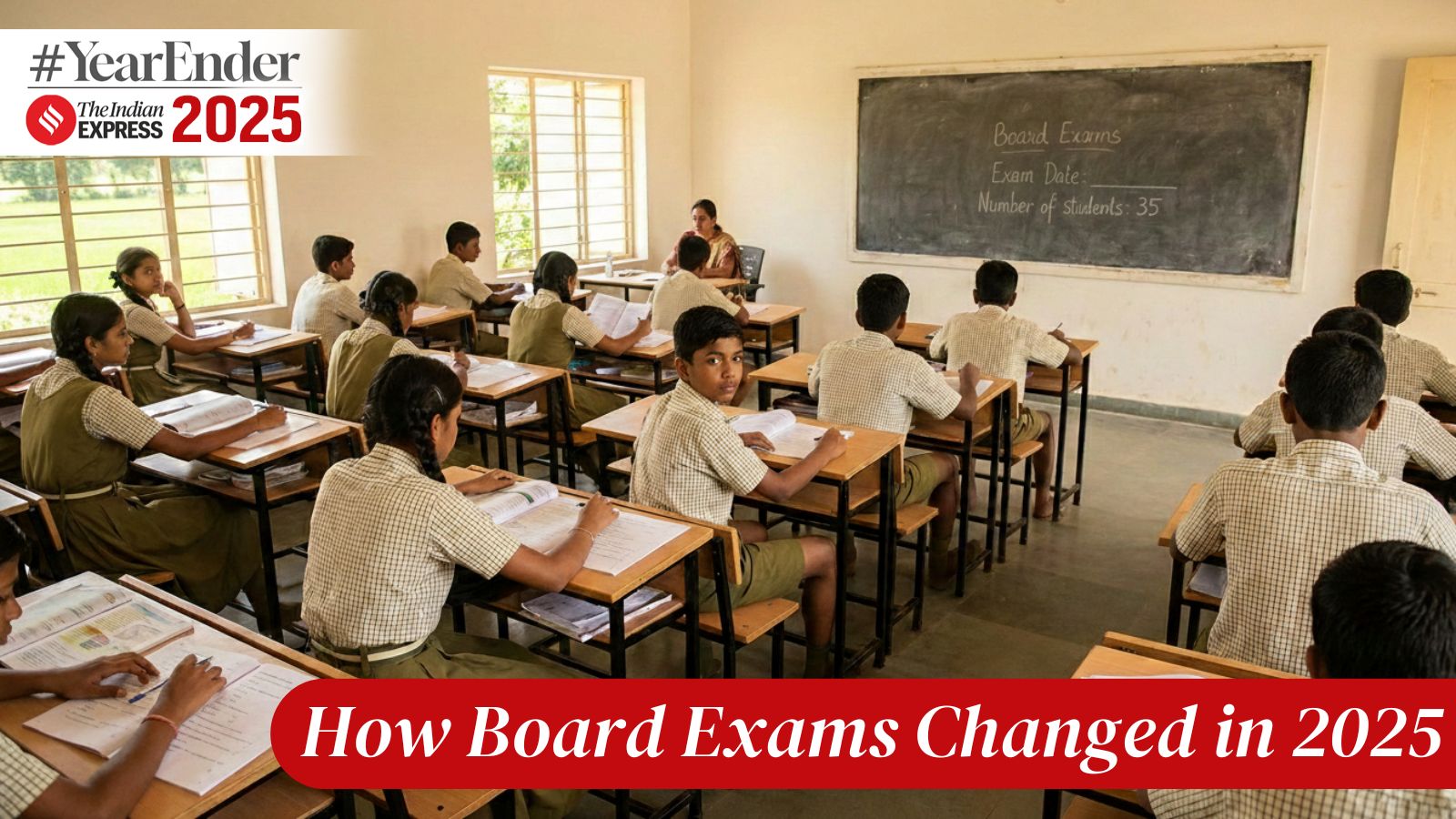
As 2025 draws to a close, India’s school examination system stands at the cusp of its most significant transformation in decades. This year did not witness the chaos of pandemic-era cancellations or abrupt pattern shifts. Instead, it marked something more structural and enduring: the quiet but decisive dismantling of the once-a-year, high-stakes board examination model.
Across central and state boards, policymakers have begun operationalising the National Education Policy (NEP) 2020’s vision of flexible, student-friendly assessments. The result is a sweeping move towards multiple board exam opportunities for Classes 10 and 12 – two exams a year in most cases, three in Karnataka – alongside a contrasting decision by Tamil Nadu to abolish the Class 11 public examination altogether.
Taken together, these decisions signal a fundamental reset of how board exams will function from 2026 onwards, reframing boards not as a single do-or-die moment but as a process offering choice, recovery, and improvement.
For decades, board exams in India have been synonymous with pressure – one timetable, one question paper, and one chance. A single illness, family emergency, or poor day could alter academic trajectories, college admissions, and career paths.
This policy is being challenged.
Under NEP 2020 and the new National Curriculum Framework (NCF), the Union government has encouraged all school boards to redesign board examinations to be more flexible, competency-based, and less stressful. A key recommendation was that Classes 10 and 12 board exams be conducted at least twice a year, with students allowed to retain their best performance.
By the end of 2025, this recommendation will have moved decisively from policy intent to implementation roadmap.
As India’s largest national board, the Central Board of Secondary Education (CBSE) has once again emerged as the bellwether for systemic change.
From the 2025-26 academic year, CBSE will conduct Class 10 board examinations twice annually. The first phase, scheduled around February, will be mandatory for all students. A second phase in May will be optional, allowing students to improve their scores or recover from an unsatisfactory first attempt.
CBSE results for the first phase will be declared in April, while second-phase results will be announced in June. Importantly, the final marksheet will reflect the best score obtained across the two attempts, effectively ending the concept of a “single final exam”.
CBSE officials have repeatedly emphasised that the second exam is not compulsory and should be seen as an improvement opportunity rather than a default expectation. The syllabus, exam pattern, and evaluation standards will remain identical across both phases.
While the initial rollout applies to Class 10, the framework is widely expected to extend to Class 12 in subsequent cycles, aligning senior secondary assessment with the same flexible logic.
CBSE’s move has been mirrored with a few state boards issuing notifications or policy clarifications during 2025 to align with the NEP framework.
Madhya Pradesh has adopted a twice-a-year board exam model for both Class 10 and Class 12, offering students two exam windows within the same academic year. The board retains the better of the two performances for the final result, effectively merging regular and improvement exams into a unified structure.
Gujarat, through the Gujarat Secondary and Higher Secondary Education Board (GSEB), has similarly approved two annual board exams for both secondary and higher secondary students. Officials have stressed that both exams will follow the same syllabus and format, with the second exam serving as a clear improvement option.
Haryana has moved towards a comparable system, positioning the second board exam as a pressure-relief mechanism rather than a re-test mandate. Students can choose whether or not to appear again, depending on their first performance.
Rajasthan has announced plans to follow CBSE’s model from the next academic year (2026-27), conducting Class 10 and 12 exams twice annually and preparing marksheets on a best-of-two basis.
These changes build on earlier assessment experiments in some states. West Bengal, for instance, had already moved towards a semester-based structure for Class 12, splitting the board exam across two phases – an approach that, while different in design, also diluted the weight of a single final test.
Meanwhile, the Chhattisgarh government has implemented the two-board exam pattern for the 2025 exams. The first examination was conducted in March, and the second one in June-July. The second chance exam provided the students an opportunity to improve their performance and obtain a pass certificate without having to wait an entire academic year.
Among all states, Karnataka has gone the farthest in reimagining board assessments. Even before CBSE, the Karnataka School Examination and Assessment Board in the 2023-24 academic year introduced up to three exam opportunities annually for its state board students. Under this system, students may appear in one, two, or all three exam windows, with the best score retained for the final marksheet.
The model effectively abolishes the distinction between “regular” and “supplementary” exams, integrating all attempts into a single continuum. Students who are satisfied with their performance can opt out of subsequent exams, while others can keep improving without the stigma historically associated with supplementary attempts.
Education officials have described this as a shift from a failure-centric to an opportunity-centric assessment system, directly aligned with NEP’s emphasis on flexibility and learner choice.
The policy rationale behind multiple board exams extends beyond convenience. Officials at both central and state levels have framed the shift as a mental-health intervention, an equity measure, and an academic reform rolled into one. Multiple attempts reduce anxiety, allow students to recover from unforeseen disruptions, and acknowledge that performance on a single day is an imperfect measure of learning.
NEP 2020 explicitly argued that board exams should test core competencies rather than rote memorisation, be offered more than once a year, and allow students adequate time and opportunities to perform at their best.
For higher education institutions, too, the new system could widen the pool of eligible candidates meeting cut-offs, particularly for competitive streams where a marginal improvement in board marks can have outsized consequences.
Unlike previous years marked by sudden reforms, 2025 was defined by institutionalisation. This was the year when boards locked in timelines, issued operational circulars, clarified that second exams are optional, and confirmed that syllabi and patterns would remain uniform across attempts. Supplementary exams, in many cases, are being phased out or absorbed into the new multi-exam framework.
Schools have begun recalibrating advice accordingly. Students are increasingly being encouraged to treat the first board exam as the primary attempt, with the second positioned as a safety net rather than an expectation.
Amid the nationwide push for more board exams at Classes 10 and 12, Tamil Nadu has taken a strikingly different decision at the Class 11 or Plus One level.
In October 2025, the Tamil Nadu state government issued an order abolishing the Plus One public examination from the 2025-26 academic year. The move restores the pre-2017 system, under which Class 11 students are assessed internally by their schools rather than through a state-level board exam.
As part of the change, integrated Class 11-12 mark certificates will be discontinued, and only Class 12 marks will be reflected in official board marksheets.
The Directorate of Government Examinations will continue to conduct Class 11 public exams until March 2030 only for repeaters who had failed earlier attempts, effectively phasing out the exam over a five-year transition period.
School managements and teachers’ associations have long argued that the additional board exam in Class 11 added pressure without significantly improving learning outcomes. The government’s decision suggests a growing recognition that fewer external checkpoints — if well-designed — may serve students better.